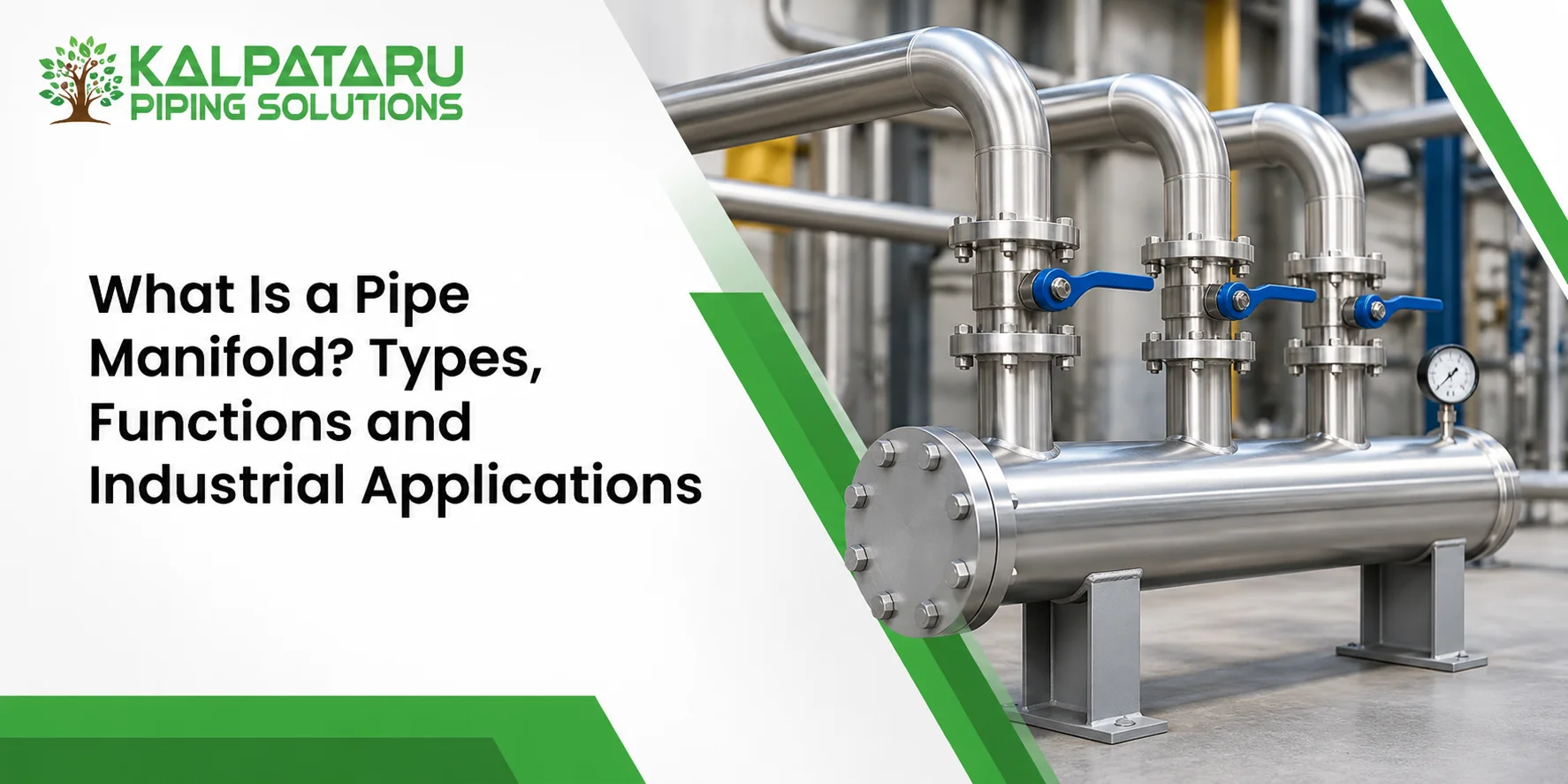
When you stroll through a cooling water facility, you will find a massive pipe section having several smaller pipes branching off it. Each of these smaller pipes is equipped with its valve. This is nothing but a piping manifold, also known as pipe manifold. It is a combination of pipes, fittings and valves which allows flow to be split from a single source into many outlets, or vice versa. This guide gives an overview of the manifold types, their functions, suggestions on design checking and applied practice, and it considers only process, utility and oil & gas piping. Exhaust and intake manifolds are not covered in this article. Kalpataru Piping Solution supplies valves, pipe fittings and flanges in stainless steel, duplex, super duplex and nickel alloy grades for industrial piping.
What Is a Pipe Manifold?
If a manifold were not present, a plant would have to set up an individual pipe between the line and every single customer. This would result in a great many connections, valves and chances for leaks. A manifold replaces all of these pipes with a unified system within a single unit. The flow enters, travels through a single line and exits through one of the branches on its way out, each fitted with a stop valve.
Main Parts of a Pipe Manifold
|
Part |
What it does |
|
Header pipe |
Carries the main flow along the manifold |
|
Branch connection |
Takes flow off the header, or feeds flow into it |
|
Isolation valve |
Shuts one branch without stopping the others |
|
Flange |
Joins the manifold to equipment, valves and other pipework |
|
Drain |
Empties the header for maintenance |
|
Vent |
Releases trapped air or gas when the line is filled |
|
Pressure gauge |
Shows the pressure in the header |
|
Support |
Holds the weight and controls movement and vibration |
For the valves, see our guide to industrial valves, types and applications. For the fittings, see our guide to the types of pipe fittings, and for the flanges, see the types of flanges, uses, materials and standards.
Types of Manifolds Pipe
|
Group |
Type |
What it is |
|
By function |
Distribution manifold |
One inlet, several outlets |
|
By function |
Collection manifold |
Several inlets, one outlet |
|
By construction |
Header type |
Branches come off one main pipe |
|
By construction |
Loop or ring type |
Several connections arranged in a loop |
|
By construction |
Block type |
Machined from one solid block, with drilled passages |
|
By service |
Process |
Carries process fluids in a plant |
|
By service |
Utility |
Carries steam, cooling water, compressed air or similar |
|
By service |
Oil and gas |
Gathers, tests, controls or distributes well and pipeline flow |
|
By service |
Instrument |
Connects instruments to a process line |
Functions of a Pipe Manifold
A pipe manifold controls how fluids move through a piping network by directing, regulating and monitoring flow between connected lines. Manifold functions include:
- Flow distribution: takes fluid from one source and sends it to several outlets, such as process units or utility users.
- Flow Collection: merges various fluids coming from different source pipes into one outlet for treatment or transit.
- Branch Isolation: makes it possible to close any sector for maintenance, inspection or repairs without bringing about stoppage in the operation of the entire system.
- Flow routing: switches flow between lines or equipment when the operating plan changes, for example from a duty pump to a standby.
- Flow Balancing: allows for equalizing the amount of fluids flowing through different outlets and ensure stable operation of the system.
- Sampling and measurement: gives fitted points for taking samples and reading pressure and flow.
A properly designed pipe manifold simplifies flow management, reduces unnecessary piping connections and allows multiple operations to run more efficiently.
Pipe Manifold vs Other Manifolds
|
Type |
What it does |
Where it is used |
|
Pipe manifold |
Distributes or collects process flow through a header and branches |
Process plants, utilities, oil and gas |
|
Instrument manifold valve |
Connects a gauge or transmitter to a process line, with isolation and equalising valves |
Instrument connections |
|
Hydraulic manifold block |
Routes hydraulic fluid through drilled passages in a block |
Hydraulic machinery |
|
Engine intake and exhaust manifold |
Feeds air into or carries exhaust out of an engine |
Vehicles and engines |
For instrument work, read our monoflange valve vs 3 valve manifold selection guide and our monoflange valve guide, key types and uses. You can also see our stainless steel manifold valves.
Pipe Manifold Applications
- Process plants: feed and collect streams for reactors, heat exchangers and pumps
- Utilities: share steam, cooling water and compressed air between users
- HVAC and chilled water: supply and return headers for air handling units and chillers
- Water treatment: distribute water and chemicals between filters and tanks
- Fuel and gas distribution: supply gas or fuel to several burners or consumers
- Ships and offshore platforms: share seawater, fuel and fire water across a compact space
Manifolds in Oil and Gas
|
Manifold |
What it does |
|
Production manifold |
Gathers flow from several wells into a header |
|
Test manifold |
Routes one well at a time to a test separator, to measure its output |
|
Choke manifold |
Reduces wellhead pressure by passing flow through chokes |
|
Kill manifold |
Pumps heavy fluid into a well to control it |
|
Gas lift and injection manifolds |
Distribute gas or water to wells |
|
Pigging manifold |
Routes pig launchers and receivers on a pipeline |
A choke manifold and a kill manifold are part of the well control system. API 16C covers choke and kill systems, and API 6A covers wellhead equipment such as valves. A pipeline manifold at a terminal or pump station routes product between lines. Check the scope of each standard against your project before you rely on it.
Materials for Pipe Manifolds
|
Material |
Typical use |
Why |
|
Carbon steel |
General process and oil and gas |
Strong, economical and easy to fabricate |
|
Stainless steel |
Corrosive and clean service |
Resists corrosion and keeps the fluid clean |
|
Duplex and super duplex |
Chlorides and higher strength |
Resist chloride attack and carry more load |
|
Nickel alloys |
Severe service |
Handle aggressive fluids and high temperature |
The fluid, the temperature and the project specification decide the material. See our stainless steel pipe fittings and duplex steel pipe fittings.
How to Design a Pipe Manifold
Manifold design follows a clear order. Here is how to size a manifold and check it.
- Define the fluid and the flow.
- Set the pressure and the temperature.
- Choose the number of outlets and the spacing between them.
- Size the header so flow stays even across the branches.
- Check pressure drop and velocity against your project limits.
- Choose the branch connections. Our guide to the types of pipe connections helps.
- Select the valves.
- Allow for thermal expansion.
- Plan supports and access for maintenance.
- Follow ASME B31.3 for process piping. See our guide to ASTM vs ASME standards for pipes, tubes and fittings.
Velocity and pressure drop limits come from your project specification, so take them from there.
Common Problems and Maintenance
- Erosion at branch entries: fast flow wears the metal where it turns, so check wall thickness on inspection
- Uneven flow across outlets: a header that is too small starves the far branches, so size it with the whole system in mind
- Vibration at small branches: unsupported branches fatigue and crack, so support them
- Leaking flanged joints: poor bolting or the wrong gasket lets fluid out, so tighten to the procedure and match the gasket to the service.
- Blocked drains and vents: deposits stop them working, so flush them on a schedule
- Valves left in the wrong position: label the valves and keep a log
Frequently Asked Questions
A double block and bleed valve is a valve or valve arrangement that gives two sealing points in a line with a vent or bleed connection between them. When both seals are closed, the bleed is opened to drain the space between them. This lets operators isolate a section of pipe and check that the seals are holding.
The valve is closed so that both seats seal. The bleed or vent is then opened to release any pressure in the cavity between the seats. If nothing keeps flowing from the bleed, both seals are holding. If fluid keeps coming out, one seat is leaking and the isolation cannot be trusted.
A DBB valve seals against pressure from both ends and has a way to vent the cavity. A DIB valve, short for double isolation and bleed, has two seats that each seal against pressure from a single source. DIB designs usually need an external way to relieve cavity pressure, while many DBB designs relieve it through the seats.
Not exactly. Double isolation and bleed, or DIB, is a separate classification with different seat behaviour. People often use the two terms loosely, but a project specification should state clearly which one is required.
DBB valves can be grouped by valve family, such as trunnion ball, expanding gate and plug valves, and by arrangement, such as a single body valve, a twin valve in one body, two separate valves with a spool piece, and an instrument manifold. The right type depends on the service and the specification.
They are used where a section of line must be isolated with checked seals. Common examples are oil and gas pipelines and storage, LNG, petrochemical and chemical plants, power plants, industrial gas systems and meter calibration or proving lines.
Choosing the Right Isolation for Your Line
A double block and bleed valve earns its place by proving its own isolation. It gives two seals, a bleed to check them and, in many designs, a way to relieve cavity pressure. Know whether your project needs DBB or DIB, match the valve to the service and the standard, and test the seals every time they are used.
If you are planning a piping project and need valves, fittings or flanges for it, explore our full product range or get in touch with our team with your valve type, size, pressure class and material, and we will help you confirm the right specification.
Enquire Now
Related Blogs
What is Stainless Steel Valve?
What Is Monel Alloy? Composition, Properties & Uses (Guide)