
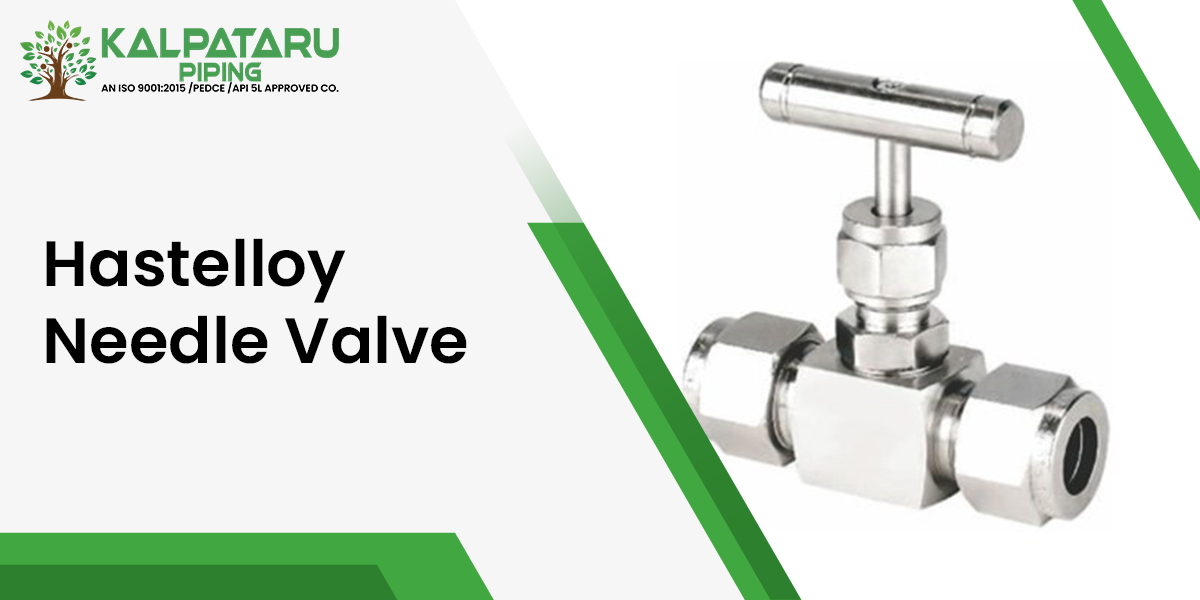
Kalpataru Piping Solution is a leading Hastelloy Needle Valve manufacturer and exporter in India, supplying precision-engineered needle valves in Hastelloy C276 (UNS N10276), Hastelloy C22 (UNS N06022), and Hastelloy B2 (UNS N10665) grades to clients across 50+ countries. Our Hastelloy needle valves are engineered to deliver exceptional resistance to pitting, crevice corrosion, and stress corrosion cracking in aggressive chemical environments where standard stainless steel valves fail. Designed to ASME B16.34 standards and pressure-tested per API 598, these valves serve critical flow-control applications in chemical processing, oil and gas, pharmaceuticals, and marine engineering. Every valve ships with EN 10204 3.1 material test certificates and IBR approval, ensuring full traceability and compliance. Whether you need a manual needle valve, angle pattern, manifold, or instrumentation valve, Kalpataru offers a complete range of corrosion-resistant needle valves with short lead times and competitive pricing.
What Is a Hastelloy Needle Valve?
A Hastelloy needle valve is a precision flow-control valve that uses a slender, needle-shaped plunger to provide fine regulation of fluid flow in piping systems. The needle tip seats against a conical orifice seat, allowing incremental throttling — from fully open to fully closed — with far greater accuracy than gate or ball valves.
The term “Hastelloy” refers to a family of nickel-molybdenum and nickel-chromium-molybdenum superalloys developed for extreme corrosion resistance. When applied to needle valves, these alloys deliver performance in acids, chlorides, and oxidising environments that destroy carbon steel or 316 SS valves.
Two primary grades are used in Hastelloy needle valves:
Grade | UNS | Best For |
|---|---|---|
N10276 | Hydrochloric acid, wet chlorine, FGD, seawater | |
N06022 | Oxidising acids, mixed-acid environments, pharmaceutical |
Types of Hastelloy Needle Valves
Type | End Connection | Pattern | Typical Application |
|---|---|---|---|
Straight Needle Valve | NPT / BSPT / SW | Straight | Instrument isolation |
Angle Needle Valve | NPT / SW | 90° Angle | Space-saving installations |
Manifold Needle Valve | Integral | Block & bleed | Gauge and transmitter hookup |
Instrumentation Needle Valve | Compression / SW | Straight / Angle | Process instruments |
High Pressure Needle Valve | SW / BW | Straight | HP test rigs, hydraulics |
Multiport Needle Valve | NPT | 3-way / 4-way | Sampling, blending |
Barstock Needle Valve | NPT / SW | Straight | OEM panels, analysers |
Double Block & Bleed | Flanged / SW | Inline | Safety isolation |
Key Construction Features:
- Body: Forged Hastelloy C276 / C22 / B2
- Stem: Anti-blowout, back-seated, rising stem
- Seat: Integral metal or PTFE / PEEK soft seat
- Packing: PTFE / Graphite / Grafoil
- Handwheel: SS with position indicator
- Pressure rating: Class 800 / 1500 / 2500 / up to 15,000 psi
- Temperature range: –73°C to +649°C
Technical Data
Hastelloy Needle Valve Technical Specifications
Parameter | Specification |
|---|---|
Materials | Hastelloy C276, C22, B2 |
Size Range | 1/4″ to 2″ (DN6 to DN50) |
Pressure Class | 800 / 1500 / 2500 ANSI; up to 15,000 psi |
Temperature Range | –73°C to +649°C |
End Connections | NPT, BSPT, Socket Weld (SW), Butt Weld (BW), Flanged |
Body Pattern | Straight, Angle, T-pattern |
Operation | Manual (handwheel), Gear, Pneumatic actuated |
Design Standard | ASME B16.34, BS 5352, API 602 |
Testing Standard | API 598, API 6D, BS 6755 |
Face-to-Face | ASME B16.10 |
Flange Drilling | ASME B16.5, BS 4504 |
Hastelloy Needle Valve Chemical Composition
Element | C276 (%) | C22 (%) | B2 (%) |
|---|---|---|---|
Nickel (Ni) | Bal. | Bal. | Bal. |
Molybdenum (Mo) | 15–17 | 12.5–14.5 | 26–30 |
Chromium (Cr) | 14.5–16.5 | 20–22.5 | 1.0 max |
Iron (Fe) | 4–7 | 2–6 | 2.0 max |
Tungsten (W) | 3–4.5 | 2.5–3.5 | — |
Cobalt (Co) | 2.5 max | 2.5 max | 1.0 max |
Carbon (C) | 0.01 max | 0.015 max | 0.02 max |
Hastelloy Needle Valve Mechanical Properties
Property | C276 | C22 | B2 |
|---|---|---|---|
Tensile Strength | 790 MPa min | 690 MPa min | 760 MPa min |
Yield Strength (0.2%) | 355 MPa min | 310 MPa min | 350 MPa min |
Elongation | 40% min | 45% min | 40% min |
Hardness (Rockwell B) | 100 max | 100 max | 99 max |
Dimensional Range (NPT Threaded)
Size (inches) | OD Body (mm) | Length (mm) | Weight (kg) |
|---|---|---|---|
1/4″ | 22 | 68 | 0.12 |
3/8″ | 25 | 75 | 0.18 |
1/2″ | 32 | 90 | 0.32 |
3/4″ | 40 | 108 | 0.55 |
1″ | 50 | 130 | 0.90 |
Hastelloy vs Stainless Steel Needle Valve
Parameter | Hastelloy C276 | SS 316L | SS 304 |
|---|---|---|---|
Chloride Resistance | Excellent | Moderate | Poor |
HCl Resistance | Excellent | Poor | Very Poor |
Sulphuric Acid Resistance | Excellent | Limited | Poor |
Max Temperature (continuous) | 649°C | 454°C | 425°C |
Pitting Resistance (PREN) | ~70 | ~24 | ~18 |
Crevice Corrosion Resistance | Excellent | Moderate | Poor |
Cost vs SS 316L | 4–6× higher | Baseline | Lower |
Recommended for | Acids, chlorides, seawater | Mild corrosives | General service |
When to choose Hastelloy over SS: Specify Hastelloy needle valves when process media includes hydrochloric acid, wet chlorine, FGD slurry, seawater, or mixed organic/inorganic acids. For purely water-service or mild-corrosive duties, SS 316L needle valves remain the cost-effective choice.
Hastelloy Needle Valve Applications
Industry | Application | Recommended Grade |
|---|---|---|
Chemical Processing | HCl reactors, acid dosing, scrubbers | C276, B2 |
Oil & Gas | Wellhead control, sour gas service, offshore | C276, C22 |
Pharmaceuticals | API synthesis, CIP/SIP lines, sterile filtration | C22 |
Power Generation | FGD wet scrubbers, boiler feed, condensate | C276 |
Marine & Offshore | Seawater cooling, ballast, brine systems | C276 |
Pulp & Paper | Bleach plant, chlorine dioxide, black liquor | C276 |
Semiconductor | Ultra-pure chemical distribution, etch gas | C22, C276 |
Desalination | Brine concentration, evaporator circuits | C276 |
Agrochemicals | Pesticide, herbicide synthesis lines | B2, C276 |
Specific Use Cases:
- Flow control in hydrochloric acid transfer lines (B2)
- Instrument isolation in offshore wellhead panels (C276)
- Pressure gauge root valves in pharmaceutical API reactors (C22)
- Sampling valves in FGD absorber circuits (C276)
- Block-and-bleed on chemical injection skids (C276, C22)
Manufacturing Process & Quality Control
- Raw Material Procurement — Certified Hastelloy bar stock, forgings, and plate sourced from approved mills. Mill Test Certificates (EN 10204 3.1) verified against heat numbers before acceptance.
- Forging & Machining — Bodies are hot-forged for grain refinement and superior mechanical properties. CNC turning centres machine body, stem, and seat to tolerances within ±0.02 mm.
- Heat Treatment — Solution annealing at 1,121°C with rapid water quench to restore corrosion resistance lost during fabrication.
- Surface Finishing — Internal bores pickled and passivated; external surfaces shot-blasted or electropolished per customer requirement.
- Assembly & Lapping — Precision needle-to-seat lapping ensures bubble-tight shutoff to ANSI Class VI leakage standard.
- Testing & Inspection — Every valve undergoes:
- Hydrostatic shell test: 1.5× rated pressure
- Seat leakage test: 1.1× rated pressure (API 598)
- Dimensional check to drawing
- PMI (Positive Material Identification) by XRF
- Hardness testing per Brinell/Rockwell
- Visual & surface inspection
- Marking, tagging, and certificate preparation
Third-Party Inspection: TPI by Bureau Veritas (BV), SGS, Lloyds, DNV-GL, or customer-nominated agency available on request.
Certifications & Standards
Standard | Scope |
|---|---|
ASME B16.34 | Valves — Flanged, Threaded & Welding End |
API 598 | Valve Inspection & Testing |
API 602 | Compact Steel Gate Valves (reference for small bore) |
ASME B16.10 | Face-to-Face and End-to-End Dimensions |
ASME B16.5 | Pipe Flanges and Flanged Fittings |
ASTM B574 | Hastelloy C276 Bar |
ASTM B575 | Hastelloy C276 / C22 Sheet & Plate |
ASTM B619 | Hastelloy C276 Welded Pipe |
EN 10204 3.1 | Material Test Certificate (Mill Cert) |
IBR (India Boiler Regulations) | Approved for steam service in India |
PED 2014/68/EU | Pressure Equipment Directive (CE Mark) |
Quality Management: ISO 9001:2015 certified manufacturing facility. All inspection records and MTCs retained for 10 years and available for review.
Frequently Asked Questions - Hastelloy Needle Valve
A Hastelloy needle valve is used for precise flow control and isolation in piping systems that handle corrosive media such as hydrochloric acid, chlorine, sulphuric acid, seawater, and aggressive solvents. Industries include chemical processing, oil and gas, pharmaceuticals, power generation, and marine engineering.
Hastelloy C276 offers superior resistance to reducing acids (HCl, H₂SO₄) and mixed acid environments. Hastelloy C22 provides better resistance to oxidising media, ferric chloride, and wet chlorine. C22 is preferred for pharmaceutical applications due to its cleaner surface passivation; C276 is the standard choice for chemical plants and FGD systems.
Kalpataru supplies Hastelloy needle valves in pressure classes 800, 1500, and 2500 ANSI, and in special high-pressure ratings up to 15,000 psi for test and hydraulic applications.
Yes. Every Hastelloy needle valve supplied by Kalpataru Piping Solution ships with an EN 10204 3.1 Mill Test Certificate (MTC) showing the chemical composition, mechanical properties, and heat number traceable to the original melt.
We supply Hastelloy needle valves with NPT (ANSI B1.20.1), BSPT, socket weld (SW), butt weld (BW), and flanged ends (ASME B16.5 / BS 4504).
Get a Quote — Titanium Ball Valves by Kalpataru Piping Solution
- Manufacturer-Direct Pricing — no middlemen, no inflated margins
- Full Traceability — every valve ships with MTC, test reports, and PMI records
- Fast Delivery — stocked sizes available; full lead time 4–8 weeks
- Expert Technical Support — our metallurgists help you select the right grade, seat, and body for your application
- Worldwide Export — we export to 50+ countries across the Middle East, Europe, North America, Southeast Asia, and Africa
- Third-Party Inspection — BV, SGS, TÜV, Lloyd's and other TPI agencies welcome
Have Any Questions ?
Please feel free to contact us. We will get back to you with 2 business days. Or just call us now.