
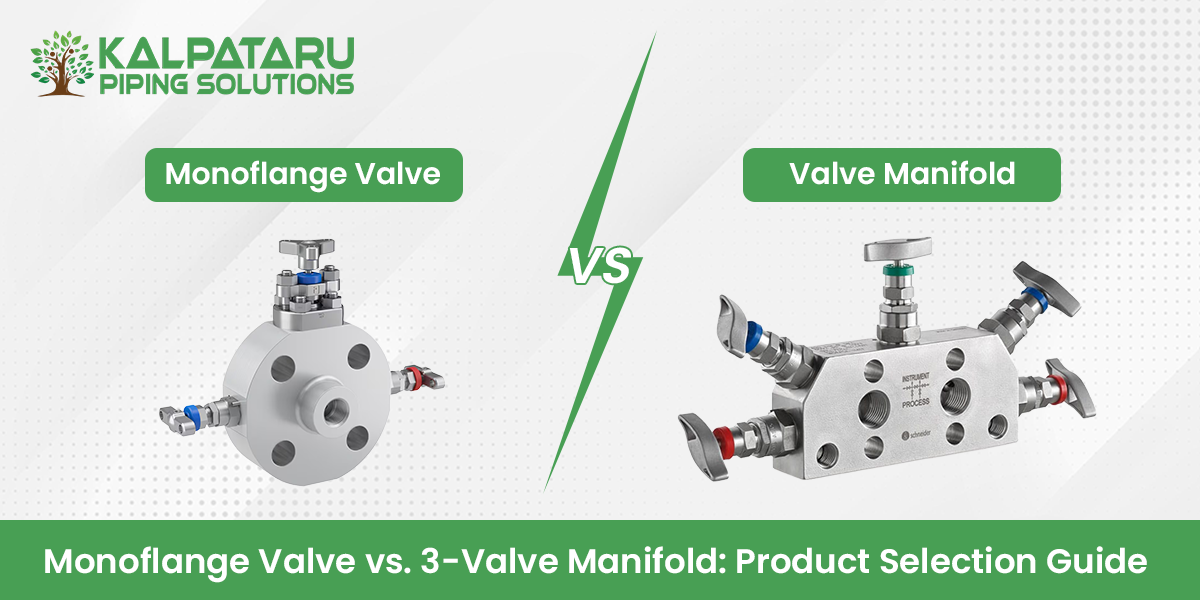
The process piping configurations associated with industrial pressure measurement applications are essential to achieving accurate pressure measurement, safety and long service life. The conventional valve-based designs are gradually being replaced by more sophisticated and integrated valve systems like Monoflange Valves and Manifold Valves, complemented by other parts like Instrumentation Ball Valves, Needle Valves and Check Valves.
Monoflange Valve is a compact, flanged body that integrates several valve functions, which can be directly installed on the stainless steel flanges or equipment, and reduces the number of potential leakage points. Conversely, a Manifold Valve is equipped with multiple valves to provide differential pressure transmitter and remote instrumentation applications with precise control, isolation and calibration. They are commonly used in combination with Manifold Valves, Globe Valves and Gate Valves to form a complete and efficient instrumentation network.
This article gives a clear-cut explanation of the design and working principle, type, installation and selection procedure of Monoflange Valves and Manifold Valves. It also links into the context of their use in greater valve systems, aiding engineers and industry professionals to make technically informed decisions in a variety of challenging process conditions.
What is a Monoflange Valve?
The Monoflange Valve is an integrated compact valve solution, developed for industrial pressure measurement systems. It incorporates many of the functions of several other valves, which are traditionally required, and packages them all in a single streamlined valve. The Monoflange Valve serves as a vital component in the interface between the process line and pressure transmitter or gauges, particularly in oil & gas, chemical processing and power generation applications where reliable connection to the process line is essential. It is commonly employed in complex instrumentation systems with Instrumentation Ball Valves,, Needle Valves and Manifold Valves.
A Monoflange Valve is normally attached to the pipeline flange in a secure and leak-proof manner. Sometimes it’s also called Hastelloy C276 instrumentation ball valves and famous for It’s features like venting and isolation in a single valve body. An integrated design reduces the use of additional impulse tubing and fittings and connectors, which leads to a more compact design, fewer leak paths and better efficiency.
What Is a Manifold Valve?
A Manifold Valve is an assembly of several valves typically used for differential pressure measuring applications. It includes a combination of several Needle Valves in a definite arrangement for performing critical operations such as isolation, equalization and venting. Typical applications are 2-valve, 3-valve and 5-valve manifolds. Normally, installation of the manifold valves can be done together with the impulse lines that connect to the pressure transmitter. This makes it possible to have the valves mounted remotely from the main process piping, especially in cases of high temperatures, vibrations, and lack of room for mounting.For multi-point process connections, air header distribution manifolds are often installed alongside manifold valves to centralise instrument connections.
Comparison Table of Monoflanges Valve vs 3-Valve Manifold
Parameter | Monoflange Valve | 3-Valve Manifold |
Design Structure | Single compact unit integrating flange and valve functions | Multi-valve assembly with three separate valves |
Number of Valves | Typically 2 or 3 integrated valves | 2 isolation valves + 1 equalizing valve |
Installation Type | Direct mounting on process flange | Remote or direct mounting using impulse tubing |
Space Requirement | Very compact, ideal for limited space | Requires more space due to tubing and fittings |
Leakage Risk | Minimal due to fewer connections | Higher compared to Monoflange due to multiple connections |
Maintenance | Limited flexibility for complex maintenance | Easier calibration and maintenance |
Application Type | Suitable for single pressure measurement points | Ideal for differential pressure measurement systems |
Vibration Resistance | High (compact and rigid structure) | Moderate (depends on tubing length and support) |
Installation Cost | Lower (fewer fittings and faster installation) | Higher (requires tubing, fittings, and more labor) |
Safety Configuration | Available in double block and bleed design | Equalizing valve prevents pressure imbalance |
Best Use Case | Space-constrained and high-pressure applications | Systems requiring frequent calibration and balancing |
Key Design Features and Advantages of Monoflange Valves
The following sections explain the key structural characteristics of Monoflange Valves and their practical advantages in industrial applications.
1. Integrated Compact Design
A Monoflange Valve is a flange connected valve which is integrated with the flange. The valve body has precision-made internal flow passages to ensure smooth flow and control of the media. This design eliminates the need for external impulse piping, so pressure transmitters can be mounted directly to the process line.
A Monoflange Valve’s compact design allows for installation space savings and the elimination of excessive tubing and fittings. This makes it ideal for areas like onshore platforms, skids and other space-critical installations.
2. Double Isolation/Power Indicator LED Status Light
Monoflange Valves are offered in various configurations as per the safety requirements. Simple design: one isolation valve and one vent valve. The isolation valve regulates the process media, and the vent valve helps to relieve the trapped pressure.
The double block and bleed configuration with two isolation valves and one vent valve is used for critical applications for increased safety. If one valve does fail, the second will provide proper isolation and no leaks!
3. Fewer Leak Points and Vibration Resistance
There are multiple points of leakage that can be found in each tubing connection. This is even greater in traditional systems that have more valves and fittings. Monoflange Valves decrease the connections, minimizing the amount of leakage.
The compact and light weight also make them more vibration resistant, reduce the amount of material used, and accelerate the installation process, which in turn increases efficiency and reduces total costs.
How Monoflange Valves Work: Flow Paths, Isolation, and Venting
The working principle of monoflange valves are very easy to understand and the detailed information is listed below.
1. Internal Flow Passages and Valve Arrangement
The valves in the Monoflange Valve body have precision-drilled passages that form an interconnected flow path between the valve cavities. The valve body may contain one or two or three valves depending on the process requirements and service conditions.
Process media is fed into the valve body and the process is initially blocked off below the first isolation valve in a standard double block and bleeds. The opened media will flow to the second isolation valve. Both of the valves are open, and the instrument is fully connected to the process line, enabling accurate pressure measurement.
2. Operation of Two-Valve and Three-Valve Designs
The two-valve Monoflange Valve is usually employed for low pressure or less critical applications. It includes one isolation valve to isolate process media and one vent valve to allow trapped pressure to be vented from the instrument side. If there is an upstream shutoff valve, this system is adequate for basic safety needs.
A three-valve Monoflange Valve has two isolation valves in series with a vent valve. The operating personnel will shut both isolation valves during shutdowns to isolate the instrument from the process. Any trapped media can be safely vented out via the vent valve and drain valve. Smooth and controlled media flow is provided by the angular positioning of the valves.
3. Function of the Vent System
The vent system is an important aspect of safe operation. It lets out any leftover media (particularly when the media should not contact the instrument after the measurement)
It also allows for calibration and maintenance without removing the instrument, which helps to minimize downtime and enhance efficiency. Plus, it eliminates the build-up of pressure within the system by means of a vent. Operators can verify complete depressurization, ensuring safe working conditions, before maintenance or replacement, using the vent valve.
Monoflange vs Manifold: 10-Point Selection Checklist for Instrumentation Engineers
- Temperature & Pressure Conditions
For remote mounting, High-temperature systems are best suited to 3-Valve Manifolds. Monoflange Valves are suitable for high pressure applications because they have fewer leakage paths and are compact. - Installation Space
Monoflange Valves are ideal for limited space as they eliminate tubing. There will be an additional space needed for impulse lines and fittings for manifolds. - Maintenance Requirements
Frequent calibration and equalization can be performed on 3-Valve Manifolds. Low maintenance systems use better Monoflange Valves. - Vibration Resistance
The risks of vibration are higher if there are long impulse lines. Direct mounting and fewer connections results in less vibration for Monoflange Valves. - Leakage Risk
The more fittings used in manifolds, the more leak points are created. With integrated design, the leakage is reduced to a minimum in Monoflange Valves. - Process Media Type
Fewer joints are required for hazardous or corrosive fluids. Monoflange valves enhance safety, and manifolds can be used to vent them in a controlled manner. - The time and costs associated with installation
Monoflange Valves save installation time and manpower. More fittings and set up are required for manifolds. - Connection Compatibility
Sealing is obtained by using the right thread. Use NPT vs. BSPT Thread Dimensions in Tube-to-Male and Female Fittings. - Thermal Expansion Handling
Thermal expansion is easier using remote mounted manifolds. These Direct-mounted Monoflange Valves are less flexible. - System Complexity
Monoflange Valves are preferred for simple systems. A 3-Valve Manifold is needed for complex loops. - Installation process of Monoflange Valve vs. 3-Valve Manifold
Follow the step given below to install the Monoflange Valve vs. 3-Valve Manifold easily into your system:
1. Confirm flange face condition (RF or RTJ)
2. Install with proper torque sequence per manufacturer datasheet
3. Open isolation valve slowly to check for seat weep
4. Bleed the vent to confirm complete fill.
5. Check instrument zero before closing the vent valve.
This sequence prevents transmitter over-range during start-up.
Conclusion:
In conclusion, Monoflange Valves and Manifold Valves are key components in modern pressure measurement systems. The compact design and fewer leakages of Monoflange Valves with their space saving installation makes them ideal for direct mounting. Manifold Valves offer the flexibility of differential pressure measurement, remote installation and maintenance. The requirements for temperature, pressure, space, vibration, and maintenance should be considered before selection. The knowledge of NPT to BSPT Thread, Raised Face (RF) vs. Ring Type Joint (RTJ) Flanges, Single Ferrule vs. Double Ferrule Compression Fitting guarantees reliable connection. By collaborating with Kalpataru Piping, you can be assured of quality products, technical support, and a reliable system.
Frequently Asked Questions
A Monoflange Valve is a compact, single-unit design for direct mounting, while a 3-valve manifold uses multiple valves with tubing for control and calibration.
It depends on the application. Monoflange is better for compact, simple setups, while 3-valve manifolds are better for complex and differential pressure systems.
Use a Monoflange Valve when space is limited, leakage risk must be minimized, and direct mounting is preferred.
They reduce leakage points, require less space, lower installation cost, and improve vibration resistance.
Monoflange Valves can be safer in high-pressure systems due to fewer connections, but manifolds offer better control for complex applications.
Enquire Now
Related Blogs
What is Stainless Steel Valve?

What Is Monel Alloy? Composition, Properties & Uses (Guide)