
In industries where stainless steel corrodes, titanium performs. Kalpataru Piping Solution is a leading titanium needle valve manufacturer and exporter in India, engineering precision valves that deliver absolute flow control reliability where chlorides, seawater, oxidising acids, and aggressive process media destroy conventional alloys. Our titanium needle valves are manufactured from Commercially Pure Titanium Grade 2 (UNS R50400) and the high-strength Ti-6Al-4V Grade 5 (UNS R56400), machined to exacting tolerances from forged barstock per ASTM B381 and castings per ASTM B367.
Available in straight, angle, and block-and-bleed configurations from 1/8″ to 2″ (DN 6 to DN 50), rated from 1,500 PSI to 20,000 PSI, with NPT, BSP, JIC, tube-end, socket weld, butt weld, and flanged connections Kalpataru’s titanium needle valves cover every instrumentation, sampling, and process isolation need. Lightweight, non-magnetic, biocompatible, and inherently corrosion-proof, they are the valve of choice for chlorine processing, desalination, aerospace hydraulics, pharmaceutical clean rooms, and offshore oil & gas systems. Every valve ships with full material traceability, hydrostatic test reports, and material test certificates.
What Is a Titanium Needle Valve?
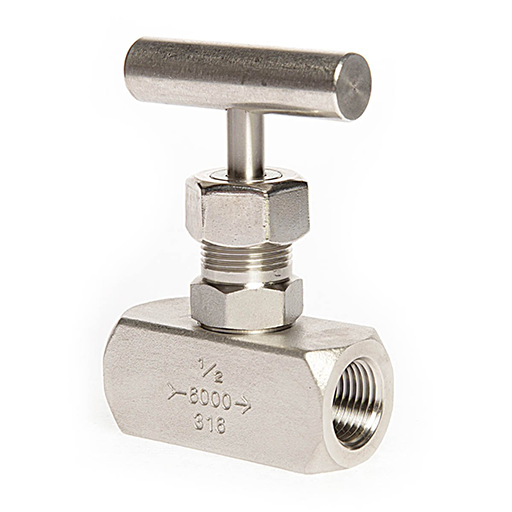
A titanium needle valve is a precision manual throttling and shut-off valve that uses a long, tapered needle-shaped plunger (the stem tip) to control flow through a small orifice. Unlike a ball valve that is simply open or closed, a needle valve offers fine, graduated flow adjustment — making it the instrument of choice for metering, sampling, pressure gauge isolation, and instrumentation isolation applications.
The defining advantage of a titanium needle valve over stainless steel or brass equivalents is titanium’s unmatched combination of properties:
- Immunity to chloride stress corrosion cracking (SCC) — the failure mode that causes 316L stainless steel valves to crack without warning in seawater and chloride-rich environments
- Exceptional resistance to oxidising acids — nitric acid, chromic acid, and wet chlorine that attack austenitic stainless steel
- 45% lighter than steel — critical for weight-sensitive offshore topsides, aerospace, and mobile instrumentation panels
- Biocompatibility — titanium is non-toxic and inert, making it FDA-acceptable for pharmaceutical and food contact applications
- Non-magnetic — essential for sensitive instrumentation near magnetic field equipment
As a dedicated titanium needle valve manufacturer, Kalpataru Piping Solution supplies valves machined from forged barstock (ASTM B381) for zero-porosity integrity, or from cast blanks (ASTM B367 Grade C2) for complex geometries at competitive pricing. Both configurations undergo full hydrostatic pressure testing per API 598 before dispatch.
Explore our full needle valve range at our Needle Valves page, or compare with our Stainless Steel Needle Valve range and Duplex Steel Needle Valves for a complete view of available alloy options.
Titanium Grades & Material Data
Kalpataru Piping Solution manufactures titanium needle valves in the two most widely specified grades for industrial valve applications. Selection of the correct grade is fundamental to valve longevity and process safety.
Grade 2 — Commercially Pure Titanium (CP Ti)
| Property | Value |
|---|---|
| UNS Number | R50400 |
| Werkstoff Nr. | 3.7035 |
| ASTM Forging | B381 F2 |
| ASTM Casting | B367 C2 |
| ASTM Barstock | B348 Gr. 2 |
| Density | 4.51 g/cm³ |
| Melting Point | 1,665°C (3,030°F) |
| Tensile Strength | 344 MPa (49,900 PSI) min |
| Yield Strength (0.2% offset) | 275 MPa (39,900 PSI) min |
| Elongation | 20% min |
| Max Service Temperature | 315°C (600°F) |
Technical Data
Chemical Composition — Ti Grade 2 (UNS R50400)
| Element | Ti | C | Fe | H | N | O | Al | V |
| % | 99.2 min | 0.1 max | 0.3 max | 0.015 max | 0.03 max | 0.25 max | — | — |
Best used for: General corrosive service, seawater, desalination, oxidising acids (HNO₃, CrO₃), chlorine gas and bleach plants, pharmaceutical/biotech, food processing, marine hardware.
Grade 5 — Ti-6Al-4V (Alpha-Beta Alloy)
| Property | Value |
| UNS Number | R56400 |
| ASTM Forging | B381 F5 |
| ASTM Barstock | B348 Gr. 5 |
| Density | 4.43 g/cm³ |
| Tensile Strength | 895 MPa (130,000 PSI) min |
| Yield Strength (0.2% offset) | 827 MPa (120,000 PSI) min |
| Elongation | 10% min |
| Max Service Temperature | 315°C (600°F) |
Best used for: High-pressure hydraulic lines, aerospace fuel and control systems, deep-sea oil & gas instrumentation, defence, motorsport — wherever maximum strength-to-weight ratio is required alongside corrosion resistance.
See also our Titanium Grade 2 Needle Valve and Titanium Grade 5 Needle Valve dedicated pages for grade-specific product listings.
Titanium Needle Valve Technical Specifications
Kalpataru Piping Solution’s titanium needle valves are manufactured to the most demanding dimensional, pressure, and material standards. The tables below cover our standard supply range; custom configurations are available on request.
| Parameter | Specification |
| Valve Type | Titanium Needle Valve (Straight, Angle, 3-Way, Block & Bleed) |
| Valve Size | 1/8″ to 2″ / DN 6 to DN 50 (standard); larger on request |
| Body Material | Titanium Grade 2 (UNS R50400) / Grade 5 (UNS R56400) |
| Body Form | Bar Stock (Forged) or Casting |
| Orifice Size | 2 mm to 9.5 mm |
| Flow Pattern | Straight, Angle, Cross / 3-Way |
| Function | 2-Way, 3-Way |
| Body Shape | Square, Round, Hexagonal |
| Pressure Rating | 1,500 / 3,000 / 6,000 / 10,000 / 15,000 / 20,000 PSI |
| Operating Temperature | -120°C to +500°C (media & seat dependent) |
| Seat / Packing Material | PTFE, PEEK, Graphite, Metal-to-Metal |
| Handle Type | T-bar handle, Knob handle, Wheel handle |
| End Connections | NPT, BSPP, BSPT, JIC, Metric, UNF |
| Connection Types | Threaded, Tube End (Single/Double Ferrule), Socket Weld, Butt Weld, Flange End |
| Equivalent Brands | Swagelok®, Parker A-LOK®, DK-LOK, Hamlet, Oliver Valves, HOKE |
Instrumentation Needle Valve Specifications
| Parameter | Specification |
| Standard Sizes Available | 1/8″ NPTF, 1/4″ NPTF, 3/8″ NPTF, 1/2″ NPTF, 3/4″ NPTF, 1″ NPTF |
| Tube OD (Compression End) | 1/4″, 3/8″, 1/2″, 5/8″, 3/4″, 1″ |
| Pressure Class | 3,000 PSI / 6,000 PSI (standard); up to 20,000 PSI (special) |
| Stem Design | Non-rotating stem tip (prevents seat galling on close) |
| Packing Type | PTFE V-ring (standard); Graphite (high-temp) |
| Stem Material | Titanium Grade 2 / Grade 5 |
| Seat Material | Integral titanium (metal seat) or PTFE / PEEK insert |
Mechanical Characteristics — Grade 2 Hydraulic Needle Valve
| Element | Density | Melting Point | Tensile Strength | Yield Strength (0.2%) | Elongation |
| Titanium Grade 2 | 4.51 g/cm³ | 1,665°C | 344 MPa (49,900 PSI) | 275 MPa (39,900 PSI) | 20% |
Applicable Standards
| Standard | Scope |
| ASTM B381 | Titanium and titanium alloy forgings |
| ASTM B367 Gr C2 | Titanium castings |
| ASTM B348 Gr 2 | Titanium bar and billet |
| API 598 | Valve inspection and pressure testing |
| BS EN 12266-1 | Industrial valve pressure testing |
| EN 10204 3.1 | Material test certificates |
| ISO 9001:2015 | Quality management system |
Quick Selection Guide
| Requirement | Recommended Type |
| In-line flow control / shut-off | Straight pattern, 2-way |
| Panel-mount, 90° tubing change | Angle pattern |
| DP gauge or transmitter isolation | 3-way needle valve |
| Gauge isolation with vent | Block & bleed |
| Vibration service, tube connection | Compression (double ferrule) |
| Ultra-high pressure (>6,000 PSI) | High-pressure forged |
| Pharmaceutical / food service | Forged Grade 2, PTFE seat |
For complementary valves in your instrument loop, see our Titanium Grade 2 Manifold Valves and Grade 5 Manifold Valves, as well as our Titanium Grade 2 Instrumentation Ball Valves
Titanium Needle Valve Applications & Industries
Titanium’s exceptional combination of light weight, strength, and corrosion immunity has made the titanium needle valve the preferred choice across industries where conventional valve materials reach their limits. Kalpataru Piping Solution exports titanium needle valves to customers in 50+ countries across these critical sectors.
| Industry | Specific Application | Why Titanium? |
| Chlorine & Chemical Processing | Chlorine injection lines, NaOCl transfer, wet chlorine gas systems, HNO₃ metering | Resists chlorine attack that destroys 316L SS; handles oxidising acids at process temperatures |
| Seawater Desalination | RO membrane isolation, brine sampling, high-pressure feed line instrumentation | Immune to seawater pitting and crevice corrosion at all ambient temperatures |
| Oil & Gas (Offshore & Subsea) | Wellhead instrument isolation, subsea control lines, sour gas (H₂S) service | NACE MR0175 compliant; no chloride SCC or SSC; extreme weight savings on topsides |
| Aerospace & Defence | Hydraulic control systems, fuel metering, pneumatic test rigs, aircraft oxygen systems | Ti-6Al-4V Grade 5 delivers maximum strength at minimum weight; non-magnetic |
| Pharmaceutical & Biotech | CIP/SIP isolation, sterile sampling, API manufacturing, clean room gas lines | Biocompatible, non-toxic, electropolishable; no contamination risk; FDA-acceptable |
| Food & Beverage | High-purity liquid metering, CO₂ and gas control | Inert, non-contaminating; no leaching into food-contact streams |
| Power Generation | Condenser seawater cooling instrumentation, feedwater sampling | Resists seawater pitting; no corrosion in cooling water at elevated temperatures |
| Marine & Shipbuilding | Ballast water treatment isolation, seawater fire main instrumentation | Zero corrosion in continuous seawater immersion; lightweight for vessel stability |
| Firefighting & Safety Systems | Saltwater foam agent isolation, halon system sampling valves | Resistant to foam agent chemicals; lightweight for mobile fire skids |
| Hydrometallurgy & Mining | Acid leach line instrumentation, electrochemical cell sampling | Resists sulphuric and nitric acid streams in heap leach and SX-EW processes |
Titanium Needle Valve vs. Other Alloys
Choosing the right needle valve material is not just about upfront cost — it determines service life, maintenance frequency, safety, and total cost of ownership over the life of your plant. This table helps you identify when a titanium needle valve is the optimal long-term investment.| Property | Titanium Gr 2 | SS 316L | Hastelloy C-276 | Monel 400 | Duplex 2205 | Super Duplex 2507 |
| Density (g/cm³) | 4.51 | 8.00 | 8.89 | 8.80 | 7.82 | 7.80 |
| Tensile Strength | 345 MPa | 485 MPa | 690 MPa | 485 MPa | 620 MPa | 750 MPa |
| Seawater Resistance | ★★★★★ | ★★☆☆☆ | ★★★★★ | ★★★★☆ | ★★★★☆ | ★★★★☆ |
| Chloride SCC | Immune | Susceptible | Resistant | Resistant | Resistant | Highly Resistant |
| Chlorine Gas / Wet Cl₂ | Excellent | Poor | Good | Limited | Poor | Poor |
| Oxidising Acid (HNO₃) | Superior | Good | Limited | Poor | Moderate | Moderate |
| Reducing Acid (HCl) | Limited (Gr 7 better) | Moderate | Superior | Good | Moderate | Moderate |
| Biocompatibility | Excellent — non-toxic | Moderate | No | No | No | No |
| Non-Magnetic | Yes | No | No | No | No | No |
| Weight vs. Steel | 45% lighter | Baseline | 11% heavier | 10% heavier | Similar | Similar |
| Relative Upfront Cost | Medium-High | Lowest | Highest | Medium | Medium | Higher |
| Lifecycle Cost | Lowest in corrosive duty | Higher (replacement) | Lower | Medium | Medium | Medium |
Types of Titanium Needle Valves
Kalpataru Piping Solution manufactures a comprehensive range of titanium needle valve configurations to suit every process and instrumentation application. All types are available in Titanium Grade 2 and Grade 5.
- Titanium Straight Pattern Needle Valve
The most common configuration — inlet and outlet in line. Suitable for in-line installation on instrument impulse lines, pressure gauge isolation, and general flow control. Available in 2-way and 3-way designs. Body styles: square, round, and hexagonal.
- Titanium Angle Pattern Needle Valve
Inlet and outlet are at 90°. Used where the instrument tubing changes direction at the valve, reducing the number of tube fittings required and minimising dead legs. Preferred in compact instrumentation panels and manifolds.
- Titanium 3-Way Needle Valve
Provides one inlet and two outlets (or two inlets and one outlet). Used in calibration rigs, differential pressure gauge isolation, pressure transmitter isolation, and vent/drain service. The 3-way design eliminates the need for separate isolation and vent valves in differential pressure measurement loops.
- Titanium High-Pressure Needle Valve
Forged from ASTM B381 barstock and rated to 10,000 or 20,000 PSI. Used in hydraulic testing, CNG/HPNG gas systems, deep-sea control lines, and ultra-high-pressure laboratory rigs. Available in 700 bar (10,000 PSI) and 1,400 bar (20,000 PSI) pressure classes.
- Titanium Block & Bleed Needle Valve
Combines one block (isolation) valve and one bleed (vent/drain) valve in a single body. Eliminates piping joints between the two functions, reducing potential leak points and overall installation weight. Widely used for pressure gauge isolation in offshore and process plant duty.
- Titanium Tube End (Compression) Needle Valve
Featuring double-ferrule (Swagelok-equivalent) or single-ferrule tube compression connections. Provides a leak-tight, vibration-resistant tube joint without welding. Available in 1/4″, 3/8″, 1/2″, and 3/4″ tube OD.
- Forged Titanium Grade 2 Needle Valve
Machined from forge-quality barstock, providing a refined, aligned grain structure with zero casting porosity. The preferred supply form for critical, high-cycle, high-pressure duty where absolute material integrity is non-negotiable.
Most Popular Export Destinations
- Kalpataru ships titanium needle valves to customers in:
- Asia-Pacific: Malaysia, Singapore, Thailand, Japan, South Korea, Indonesia, Philippines, Bangladesh
- Middle East: UAE, Saudi Arabia (KSA), Bahrain, Kuwait, Oman, Qatar
- Europe: UK, Germany, Netherlands, Norway, Sweden, Belgium, Romania, France
- Americas: USA, Canada, Brazil, Chile, Mexico
- Africa: South Africa, Egypt
Complete Your Titanium Piping System
Kalpataru also supplies:
- Titanium Grade 2 Tube Fittings and Grade 5 Tube Fittings
- Titanium Grade 5 Instrumentation Ball Valves
- Titanium Tubes — seamless, for instrument and process lines
- Full range of specialty alloy valves at our Valves page
Manufacturing Excellence & Quality Assurance
At Kalpataru Piping Solution, every titanium needle valve is manufactured through a rigorous, documented process that ensures material authenticity, dimensional precision, and absolute pressure integrity before shipment.
Step-by-Step Manufacturing Process
Step 1 — Raw Material Sourcing & PMI Verification All titanium barstock and forgings are sourced from certified mills and arrive with EN 10204 3.1 / 3.2 material test reports. Before any machining begins, each heat lot is verified by Positive Material Identification (PMI) using XRF spectrometry to confirm grade purity. No material enters production without a confirmed PMI record.
Step 2 — CNC Precision Machining Valve bodies, stems, seats, and packing glands are machined on multi-axis CNC turning and milling centres. Titanium machining protocols — low cutting speeds, heavy feed rates, sharp HSS or carbide tooling, and generous flood coolant — are strictly followed to prevent work-hardening and maintain surface integrity.
Step 3 — Stem Tip Lapping & Seat Preparation The needle tip and its mating seat are precision-lapped as a matched pair to achieve Class VI (zero-leakage) shut-off. Lapped surface finish is confirmed with optical profilometry to Ra ≤ 0.8 µm for standard duty; Ra ≤ 0.4 µm for pharmaceutical-grade valves.
Step 4 — Packing Assembly & Gland Setting PTFE V-ring or graphite packing is loaded and the gland nut is set to the specified torque to ensure zero fugitive emissions at rated pressure. Live-loaded gland assemblies are available for high-cycle or vibration-prone service.
Step 5 — Non-Destructive Testing (NDT)
- Dye Penetrant Testing (PT) — mandatory on all machined valve bodies
- Radiographic Testing (RT) — for cast valve bodies
- Ultrasonic Testing (UT) — for forged bodies in critical service classes
- Hydrostatic / Pneumatic Pressure Testing — per API 598 and BS EN 12266-1; shell test at 1.5× rated pressure; seat leakage at rated pressure
Step 6 — Dimensional & Visual Inspection Full dimensional check against the applicable connection standard (ASME B1.20.1 for NPT, BS EN ISO 228 for BSPP, etc.). Visual inspection per MSS SP-55.
Step 7 — Marking & Documentation Every valve is marked with: material grade, pressure rating, size, manufacturer’s identification, and heat number. Complete documentation package: MTC, hydrostatic test report, NDT reports, dimensional inspection record, and packing list with HS code and COO for export.
Certifications & Compliance Standards
Kalpataru Piping Solution’s titanium needle valves are manufactured, tested, and documented to internationally accepted standards demanded by EPC contractors, oil majors, pharmaceutical manufacturers, and defence procurement agencies worldwide.
Quality Management & Traceability
| Certification | Scope |
|---|---|
| ISO 9001:2015 | Quality Management System |
| EN 10204 3.1 | Mill test certificates — manufacturer’s inspection |
| EN 10204 3.2 | Mill test certificates — third-party (TPI) certified |
| CE Marking | Available for valves supplied to European markets |
| IBR Approval | Indian Boiler Regulations — available on request |
Testing & Inspection
| Standard | Scope |
|---|---|
| API 598 | Valve inspection and pressure testing — shell & seat leakage |
| BS EN 12266-1 | Industrial valve pressure testing — European standard |
| MSS SP-55 | Visual quality standard for castings |
| MSS SP-25 | Standard marking system for valves and fittings |
Material Standards
| Standard | Product Form | Grade |
|---|---|---|
| ASTM B381 | Forgings | F2 (Grade 2), F5 (Grade 5) |
| ASTM B367 | Castings | C2, C3 |
| ASTM B348 | Bar and billet | Grade 2, Grade 5 |
| ASTM B265 | Sheet and strip (seat materials) | Grade 2 |
Third-Party Inspection (TPI)
- Kalpataru welcomes and facilitates inspection by authorised TPI agencies:
- Bureau Veritas (BV) · SGS · TÜV Rheinland · Lloyd’s Register · DNV GL · Intertek · RINA · CEIL · TOFD
Export Compliance
All shipments include HS code, Certificate of Origin (COO), barcode labelling, and export documentation compliant with DGFT (India) regulations. We are a Government Recognised Export House
When to Specify Titanium Instead of 316L
- Chloride ion concentration exceeds 200 ppm and operating temperature is above 60°C
- Valve is in continuous seawater service
- Process fluid is oxidising acid (HNO₃, CrO₃, wet Cl₂)
- Biocompatibility and non-contamination are mandatory (pharma, food, medical gas)
- Weight reduction is a design constraint (offshore topsides, aerospace, mobile systems)
- Non-magnetic material is required near instrumentation sensitive to magnetic fields
For Hastelloy, Inconel, Monel or Duplex needle valves, explore our Hastelloy Valves, Inconel Valve, Monel Valve, and Stainless Steel Needle Valve pages.
Explore Related Products:
- Needle Valves — Full alloy range
- Titanium Grade 2 Needle Valve
- Titanium Grade 5 Needle Valve
- Stainless Steel Needle Valve
- Duplex Steel Needle Valves
- Manifold Valves — all alloys
- Check Valves — all alloys
- Ball Valves — all alloys
- Pipe Fittings — full alloy range
- Steel Flanges — all grades
FAQs - Titanium Needle Valve
A titanium needle valve is a precision throttling and shut-off valve using a tapered needle-point stem to control flow through a small orifice. Choose titanium when your process involves seawater, chlorides, oxidising acids, chlorine gas, or any media that causes stress corrosion cracking in standard stainless steel. Titanium is also the right choice when biocompatibility, non-magnetic construction, or weight savings are engineering requirements.
Kalpataru Piping Solution supplies titanium needle valves rated at 1,500 / 3,000 / 6,000 / 10,000 / 15,000 / 20,000 PSI. Standard instrumentation needle valves are rated at 3,000 PSI and 6,000 PSI. Ultra-high-pressure valves up to 20,000 PSI are available in forged Grade 2 and Grade 5.
We supply titanium needle valves with: NPT (1/8″ to 1″), BSPP/BSPT, JIC/SAE, Metric, UNF threads, double-ferrule compression (Swagelok-equivalent), single-ferrule, socket weld, butt weld, and flanged ends. Custom end connections are available on request.
Yes. Titanium Grade 2 is one of the very few metallic materials that resists both wet and dry chlorine gas over a wide temperature and pressure range. This makes titanium needle valves the standard specification in chlor-alkali, bleach plant, and chlorine injection systems where stainless steel is rapidly attacked.
Temperature range depends on seat material: PTFE seats — -50°C to +260°C; PEEK seats — -100°C to +250°C; Graphite packing — up to +500°C; Metal-to-metal seats — up to +540°C (Grade 2 service limit). For cryogenic service, consult our engineering team for specific seat and packing selection.
Yes. We supply pharmaceutical-grade titanium needle valves with electropolished internal surfaces (Ra ≤ 0.4 µm), PTFE or PEEK seats, and EN 10204 3.2 certified material test reports. All materials are biocompatible and FDA-acceptable. Full documentation packages including material compliance declarations are available.
Get a Quote — Titanium Needle Valves by Kalpataru Piping Solution
- Direct Manufacturer — No distributor mark-up. Factory-direct pricing on every order
- Complete Traceability — Every valve ships with MTC, hydrostatic test report, PMI records, and NDT certificates
- Swagelok/Parker Equivalent Patterns — Drop-in replacements for your existing tube fitting system
- OEM & EPC Tender Support — Dedicated team for bulk orders, vendor approval documentation, and data books
- Custom Engineering — Non-standard sizes, materials, pressure classes, and end connections on request
- Fast Lead Time — Standard delivery 4–6 weeks; expedited options for stocked sizes
- Export-Ready Packaging — Wooden cases, HS code, COO, barcode — cleared for customs worldwide
- Global Reach — Exporting to 50+ countries; trusted by oil majors, EPC contractors, and pharma manufacturers
Have Any Questions ?
Please feel free to contact us. We will get back to you with 2 business days. Or just call us now.