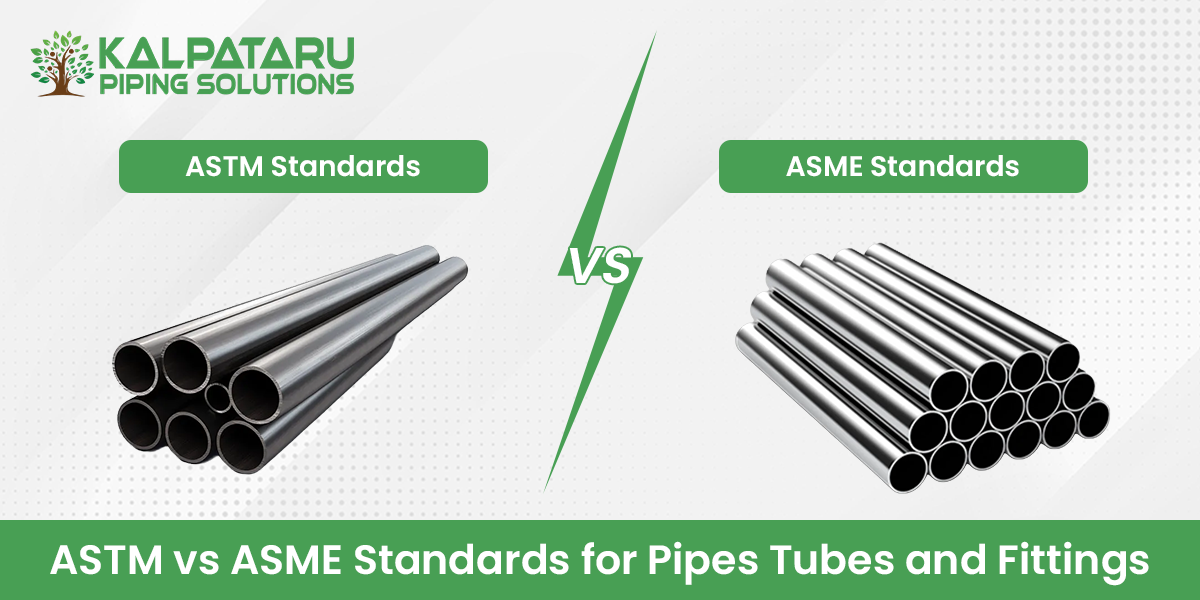
In the case of purchasing and specifying pipe, tube, flange, and fitting specifications, there will be standards found in the same project documents, which include ASTM A106, ASTM A312, ASME B16.5, and ASME B31.3. When there is mention of ASTM and ASME in piping specifications, things might become confusing. The most obvious difference is that ASTM standards primarily identify the material and product specifications, while ASME standards typically identify piping design, dimensions, pressure ratings and component requirements. They are complementary standards and one is not typically replacing the other. For instance, the seamless carbon steel pipe can meet the requirements of ASTM A106 grade B specification. Then, the pipe can be designed and used in a process piping system according to ASME B31.3, and ASME B36.10M can be adopted for the pipe dimensions. It is also important to note that the materials specification, dimensional standard, design code, testing condition and certification documents for the buyer must be consistent with the project specification.
What is ASTM?
ASTM International is an organization that produces standards for material, products, test methods, and engineering uses. Regarding pipe, tubes, flanges, and fittings, the ASTM standard basically specifies material composition and characteristics, manufacturing specifications, testing, and inspection. In other words, can ASTM assist you to determine the material of this product, as well as its compliance with the specification of materials? Standards for pipes are usually ASTM A106 (seamless carbon steel pipe), ASTM A312 (austenitic stainless steel pipe), ASTM A333 (low temperature service pipe), ASTM A335 (alloy steel pipe), and ASTM A234, A403, and A420 (pipe fittings).
What Is ASME?
The American Society of Mechanical Engineers, otherwise known as ASME, makes codes and standards for the designing and manufacture of mechanical and pipe engineering; the sizing, pressure rating, and safe application of these. It also provides standards for piping materials, tubes, flanges, fittings, valves and the complete piping systems. This includes ASME process piping, ASME power piping (B31.1), pipe flanges (B16.5), buttwelding fittings (B16.9), forged fittings (B16.11), pipe dimensions (B36.10M and B36.19M). This ASME standard is typically used in conjunction with the ASME material standards (ASTM A312 TP316L) and the ASME dimension standard (ASME B36.19M) and the pipe system design standard (ASME B31.3).
ASTM & ASME Side-by-Side: Key Differences at a Glance
Aspect | ASTM | ASME |
Full Name | ASTM International | American Society of Mechanical Engineers |
Main Focus | Materials, products, and test requirements | Engineering codes, component standards, and design requirements |
Typical Piping Examples | A106, A312, A333, A335, A213, A234, A403 | B31.3, B16.5, B16.9, B16.11, B36.10M |
Core Governing Question | “Does the material/product meet the specified requirements?” | “Does the component or piping system meet the applicable engineering requirements?” |
Common Use | Material and product specification | Piping design and component requirements |
Typical Documentation | Material test reports (MTRs), certificates, and inspection records | Code compliance documentation and certification where applicable |
Inter-relationship | Defines material and product specifications | Integrates and mandates material standards alongside component design codes |
ASTM and ASME in Piping and Material Selection
In piping, ASTM specifies what the pipe is made of and its mechanical properties, tensile strength, yield, and hardness while ASME specifies wall thickness, pressure rating, and how it’s installed in the system. A material must satisfy the ASTM spec called out in the purchase order and meet the design requirements set by the governing ASME code for the application; the two are never a choice between one or the other.
ASTM and ASME by Product Form
Standards pair differently depending on the product you’re ordering. Here’s the breakdown by form:
Product Form | Governing ASTM Material Standard | Governing ASME Design Standard |
Seamless / Welded Pipe | A106, A312, A333, A335, A358 | B31.3, B36.10M / B36.19M (dimensions) |
Seamless / Welded Tube | A213, A249, A269 | B31.3 |
Buttweld Fittings | A234, A420 | B16.9 |
Socket Weld / Threaded Fittings | A105, A182 | B16.11 |
Flanges | A105, A182, A350 | B16.5, B16.47 |
Forged Fittings | A105, A182 | B16.11, B16.34 |
We stock and supply pipes, tubes, flanges, and fittings across these product forms see our ASTM A312 stainless steel pipes, ASME B16.5 flanges, and stainless steel tube fittings ranges for grade-specific availability.
Common Mistakes When Specifying ASTM & ASME Standards
Treating ASTM and ASME as alternatives:
One standard does not replace the other. Depending on the project, both may need to be met because they cover different requirements.
Using an outdated revision:
ASTM and ASME standards are updated from time to time. Always check the edition or year specified in the project documents before placing an order.
Overlooking “SA” vs “A”:
For pressure equipment, missing the difference between an ASME “SA” designation and an ASTM “A” designation can lead to material that meets the ASTM requirements but does not satisfy the project’s ASME Code requirements.
Ignoring international standards:
For export orders, always check whether the destination country requires or accepts standards such as DIN, JIS, or BS along with the specified ASTM or ASME standard.
How to Read ASTM & ASME Callouts on a Mill Certificate or Spec Sheet
It is easier to read the ASTM and ASME callouts when you break the material requirement and the design or dimensional requirement. An example of this is a pipe that could be specified as ASTM A312 TP316L / ASME B36.19M. In this case ASTM A312 TP316L refers to the stainless steel pipe material and grade; ASME B36.19M refers to the standard dimensions for stainless steel pipe.
A flange may be listed as ASTM A182 F316L / ASME B16.5. The flange material and grade is listed in ASTM A182 F316L; the flange size, pressure class and other requirements are specified in ASME B16.5.
When reviewing a mill test certificate or specification sheet, compare it to the purchase order for the standard, grade, heat number, chemical composition, mechanical properties, dimension, testing requirements and inspection results. Also verify the mandated standard edition and/or any project specific certification requirements prior to acceptance of the material.
Frequently Asked Questions
ASTM mainly covers material and testing requirements, while ASME covers design, dimensions, pressure ratings, and safe operation.
No. ASTM A106 specifies seamless carbon steel pipe, while ASME B31.3 covers process piping design and installation.
ASME uses the “SA” prefix for material specifications adopted into its Boiler and Pressure Vessel Code. For example, ASTM A106 may appear as ASME SA-106.
It depends on the project requirements. ASTM may specify the material, while ASME standards may cover design, dimensions, or pressure requirements.
Both can be relevant. ASME standards such as B36.10M and B36.19M specify standard pipe dimensions, while applicable design codes determine required wall thickness based on service conditions.
Yes. Both are widely used internationally, especially in oil & gas, petrochemical, and power industries. Local standards such as DIN, JIS, or BS may also apply.
An MTC provides test results and material information for a specific product or heat. An ASME Code stamp shows that applicable equipment or fabrication meets the requirements of an ASME certification program.
Enquire Now
Related Blogs
What is Stainless Steel Valve?
What Is Monel Alloy? Composition, Properties & Uses (Guide)