
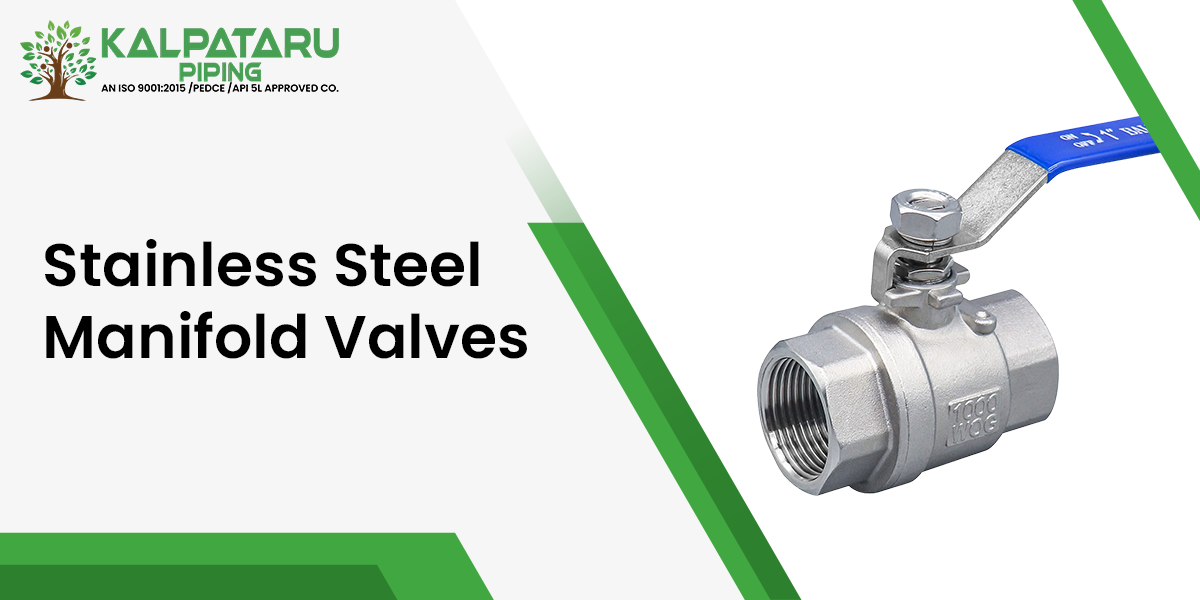
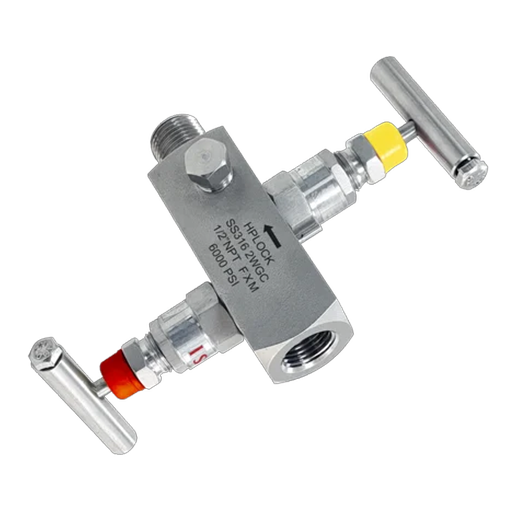
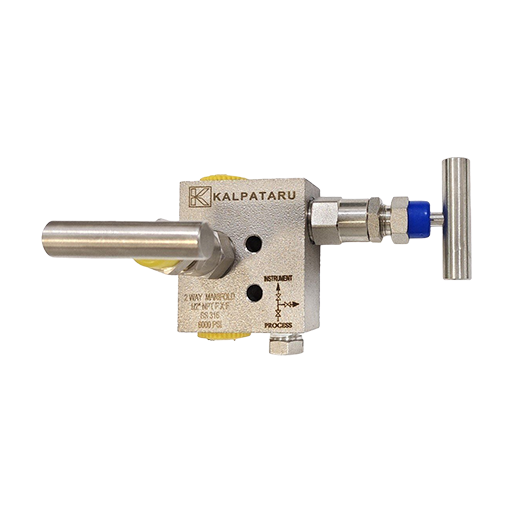
Every pressure or differential pressure instrument in a process plant gauges, transmitters, differential pressure cells connects to the process line through a stainless steel manifold valves. The manifold is the multi-port isolation, equalising, and venting block that lets engineers isolate an instrument for maintenance, calibrate it under live process conditions, and safely vent it to atmosphere all without disturbing the process. At Kalpataru Piping Solution, we manufacture and supply SS manifold valves in 2-way, 3-way, and 5-way configurations in grades SS 304, 304L, 316, 316L, 316Ti, 317L, 321, 347H, and 904L in R-type, T-type, and H-type body patterns, direct mount and remote mount designs, and pressure ratings from 1500 PSIG to 6000 PSIG. Body: ASTM A182 F304 / F316 forged bar stock. Standards: 3A, ISO, DIN, ASTM, JIS. Compatible with Yokogawa, Rosemount, Swagelok, Parker, and other leading transmitter manufacturers. Tell us your grade, configuration, pressure class, and end connection. We respond within 24 hours.
What is a Stainless Steel Manifold Valves?
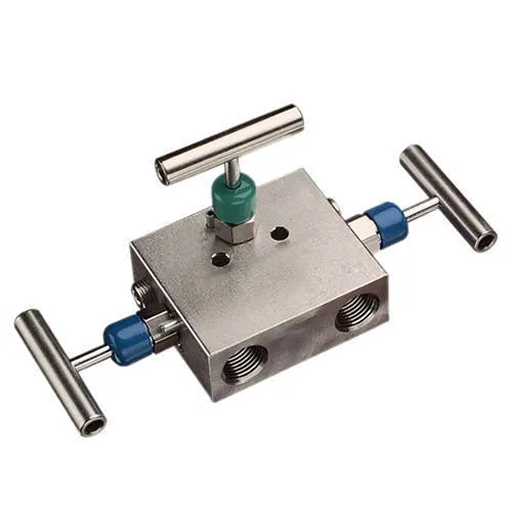
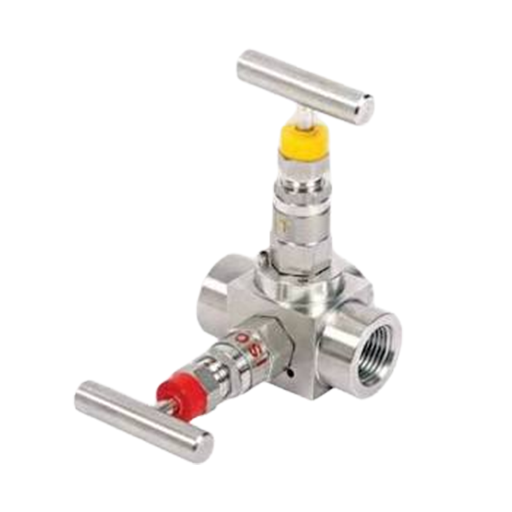
A stainless steel manifold valves is a multi-port, multi-function instrument isolation block that replaces the collection of individual valves, tubing, and fittings that would otherwise be needed to safely connect a pressure instrument to a process line. It integrates isolating, equalising, and venting functions into a single machined body — reducing leak points, installation cost, and the space required at an instrument connection.
Manifold valves are designed for three primary service types:
- Static pressure service — isolating and venting a single pressure transmitter or gauge from one process connection (2-way and 3-way manifolds)
- Differential pressure service — connecting both high-pressure and low-pressure sides of a DP transmitter to a process line, with the ability to equalise pressures across the transmitter for calibration (3-valve and 5-valve manifolds)
- Liquid level and flow measurement — same as differential pressure service but at elevated process temperatures or corrosive conditions where the manifold material must be matched to the process fluid
How a Manifold Valve Works
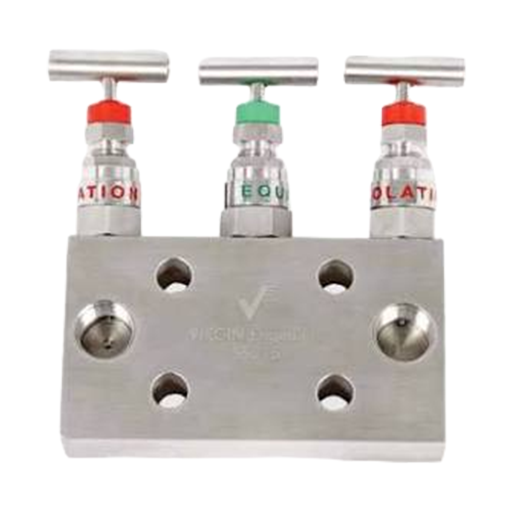
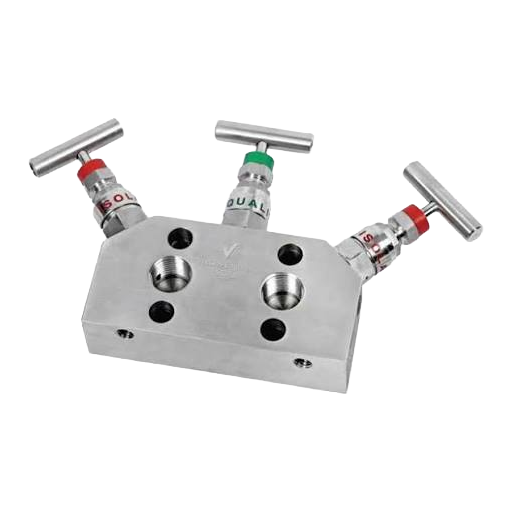
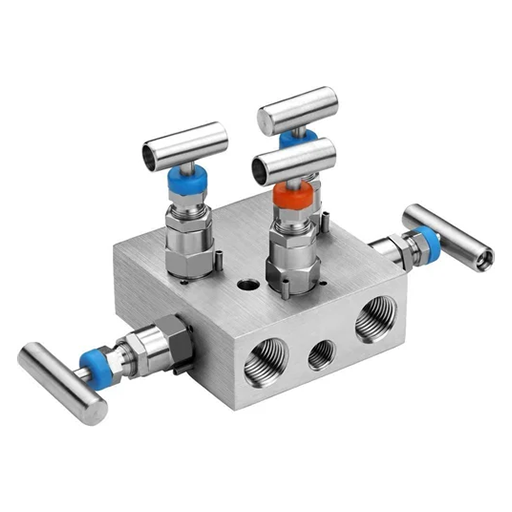
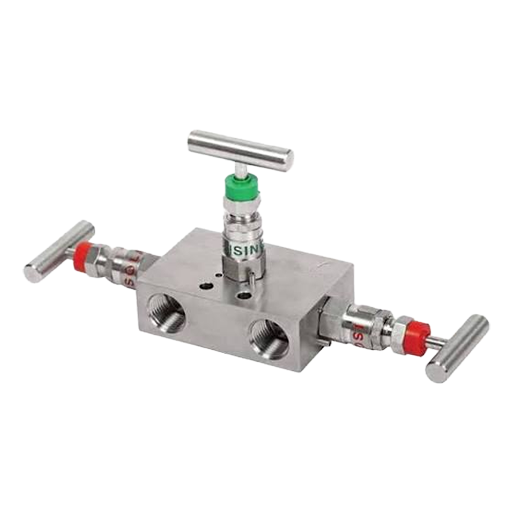
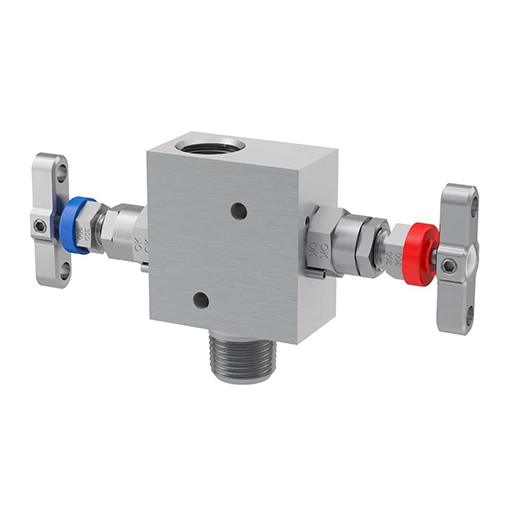
- Isolation valves (blue handles, in 3- and 5-valve manifolds) block or admit process fluid to the transmitter. Closed = instrument isolated from process.
- Equalising valve (green handle, centre of a 3- or 5-valve manifold) connects high-pressure and low-pressure sides of the transmitter — used during calibration so both sides see the same pressure before the instrument is zeroed.
- Vent / bleed valve (red handle, in 5-valve manifolds) bleeds process fluid or trapped pressure to atmosphere before the instrument is removed for maintenance.
SS Air Manifold Valve — for Calibration Systems
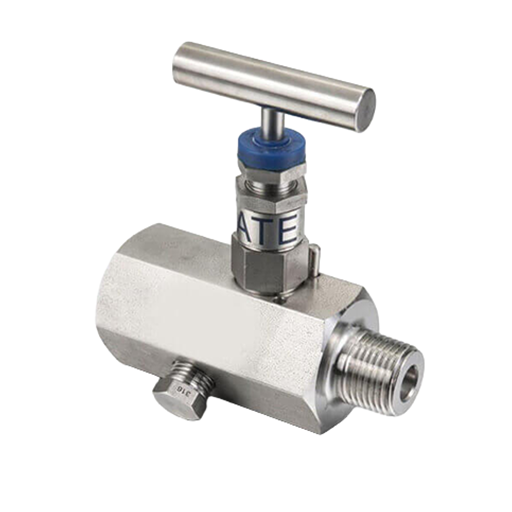
SS air manifold valves for calibration are available in 2-way and 3-way configurations in SS 316 (ASTM A182 F316), rated to 3000 PSIG, with NPT or BSPT female connections. One-piece forged body. 100% pneumatic seat test per API 598 before dispatch.
Stainless Steel Manifold Valves Materials Grades

Complete Manifold Valve Type Matrix
| Type | Valves | Function | Body Pattern | Mounting |
|---|---|---|---|---|
| 2-Way | 2 (isolate + vent) | Single pressure, gauge isolation | R2 straight / angle | Remote or direct |
| 3-Way | 3 (HP isolate + LP isolate + equalise) | DP transmitter standard | R3, T3, H3 | Remote or direct |
| 5-Way | 5 (HP + LP isolate + equalise + 2 vents) | DP with individual venting | R5, T5, H5 | Remote or direct |
| Monoflange | 1 or 2 | Root valve + instrument block in one | Flanged | Direct on pipe flange |
| Double Block & Bleed | 3 (2 isolate + 1 bleed) | Positive isolation + bleed | Inline or flange | Remote or direct |
Technical Data
Direct Mount vs Remote Mount Stainless Steel Manifold Valves
The installation method — direct mount or remote mount — is the first decision in manifold valve selection, because it determines the body pattern, the connection type, and the number of potential leak points in the instrument connection.
| Feature | Direct Mount SS Manifold Valve | Remote Mount SS Manifold Valve |
|---|---|---|
| Leak Points | Fewer — manifold bolts directly to transmitter | More — impulse tubing runs from process tap to manifold |
| Maintenance Cost | Less expensive | More expensive (tubing, fittings, trace heating) |
| Installation Cost | Less expensive — no impulse tubing required | More expensive installation |
| Process Isolation | Integrated — valves are in the same block | System is still hard-piped with separate root valves |
| Valve Integration | Integrated — no separate block valve | Uses standard instrument manifolds |
| Piping | None — transmitter connects directly | The piping is mounted to the transmitter via tubing |
| Installation | Easier — single unit mounts on transmitter flange | Easier to position instrument away from process |
| Transmitter Compatibility | Requires matching bolt-hole pattern (Rosemount, Yokogawa, Honeywell) | Universal — any process tap configuration |
| Vibration Tolerance | Better — rigid, no tubing to vibrate or fatigue | Tubing susceptible to vibration fatigue |
| High Temperature Service | Less suitable — transmitter close to hot process | Better — instrument positioned away from heat source |
| Uses Standard Manifolds | No — specific direct-mount pattern required | Yes — uses standard instrument manifolds |
| Uses Tubing / Tube Fittings | No | Yes |
| Calibration | Slightly more complex space-access | Instrument positioned for easier access |
When to Specify Direct Mount
- Ambient or moderate-temperature service (below ~90°C at the transmitter)
- Where minimising leak points is a priority (offshore, high-pressure gas)
- New installations where transmitter and manifold are specified together
- Rosemount 3051, Yokogawa EJA, Honeywell STD compatible flanged DP transmitters
When to Specify Remote Mount
- High-temperature service where the transmitter must be located away from the process
- Retrofitting an existing installation with an existing impulse line system
- Transmitters on vibrating equipment (pumps, compressors) where the transmitter itself is mounted on a separate support
- Level measurement with a significant elevation difference between taps
3-Valve vs 5-Valve Manifold — Which Do You Need?
For differential pressure (DP) transmitters, the choice between a 3-valve manifold and a 5-valve manifold is determined by whether the vent lines can be safely routed to atmosphere at the transmitter’s location.
| Feature | 3-Valve SS Manifold | 5-Valve SS Manifold |
|---|---|---|
| Total Valves | 3 (HP isolate + LP isolate + equalise) | 5 (HP + LP isolate + equalise + HP vent + LP vent) |
| Vent Ports | 1 (common vent / equalise handle) | 2 (individual HP and LP vents) |
| In-Place Calibration | Possible but limited | Full in-place calibration without removing transmitter |
| Confined Space / Hazardous Area | Less suitable — single vent location | Preferred — vent lines can be piped to safe area |
| Transmitter Removal | Usually required for full calibration | Not required — calibration pressure applied through vent port |
| Cost | Lower | Higher |
| Space Required | Compact | Slightly larger |
| Applicable Standard | API 598 | API 598 |
| Typical Industries | General process, water, HVAC | Offshore, nuclear, chemical, confined-space DP |
How the 5-Valve Manifold Enables In-Place Calibration
In a 5-valve manifold, the calibration procedure works as follows:
- Close both HP and LP isolation valves — transmitter isolated from process
- Open the equalising valve — both sides of transmitter see equal pressure; zero the transmitter
- Close the equalising valve
- Connect a calibration pressure source to the HP vent port
- Apply calibration pressure — transmitter sees it on the HP side while LP remains vented
- Span-calibrate the transmitter without removing it from the process
This procedure is particularly valuable in offshore and nuclear applications where access to the transmitter location is restricted or hazardous. The 5-valve manifold allows calibration pressure to be routed from a remote safe location through the vent line while the LP vent is open to a safe vent header — the transmitter never needs to be removed from the process connection.
Stainless Steel Manifold Valves Specification
| Parameter | Details |
| Material | SS 316, SS 304, SS 304L, SS 316Ti, SS 317L, SS 321, SS 347H, SS 904L |
| Body Type | Bar stock, Forged (ASTM A182 F304 / F316 / F316L) |
| Manufacturing Process | Forged bar stock |
| Size Range | ⅛” to 1″ (NPT / BSPT); custom sizes available |
| Orifice Size | 2mm to 9.5mm |
| Thread | NPT, BSPP, BSPT |
| Connection | Threaded, Flange End, Socket Weld, Tube End, Single Ferrule, Double (Dual) Ferrule, Twin Ferrule |
| Function | 2-Way, 3-Way, 4-Way, 5-Way, Diverter, Normally Closed, Normally Open |
| Body Pattern / Type | R-type, T-type, H-type (Square / Rectangle body) |
| Pressure Rating | 1500 PSI, 3000 PSI, 6000 PSI, 10,000 PSI, 15,000 PSI |
| Working Pressure (SS) | Up to 6000 PSIG (414 bar) |
| Media Temperature | –120°C to +500°C (range as per pressure class and seat material) |
| Seat / Seal Material | PTFE (–65°F to +450°F / –54°C to +232°C), Grafoil (–65°F to +700°F / –54°C to +371°C), PEEK (–65°F to +600°F / –54°C to +315°C), PPL, Soft Graphite |
| Flow Pattern | Straight / Angle |
| Flow Rate (Cv) | 0.93, 2.34, 6.42, 0.70, 1.04, 3.62, 87 Cv (size-dependent) |
| Handle | Bar T-handle |
| End Connection (detailed) | Male/Female NPT, BSPT, SW, Dual Ferrule Tube, BSPP, C.61/C.62 4-bolt / combo / split flange, ISO 6149, SAE |
| Standard | 3A / ISO / DIN / SMS / ASTM / JIS |
| Design Standard | BS 1868 |
| Face-to-Face | ASME B16.10 |
| Flange Dimensions | ASME B16.5 |
| Pressure & Temperature | ASME B16.34 |
| Test & Inspection | API 6D / API 598 |
| Visual Inspection | MSS SP-55 |
| Marking | MSS SP-25 |
| Leakage | Soft Seat: zero leakage (100% leak test) / Hard Seat: ≤ Rated Flow 10⁻⁵ |
| Approvals | IGC ‘E’ practice, NACE 3.1, MSS SP-110, API 598, ANSI B1.20.1, ANSI B16.11, ANSI B16.34, API 607 Fire-Safe |
| Packing | Box packing, wooden pallet |
| OEM Service | Available |
| Equivalent Brands | Swagelok, Parker, Rosemount, Hamlet, Oliver Valves, HOKE, DK LOK, GYROLOK, TYLOK, BILOK, DUOLOK |
SS 304 Two-Way Manifold Valve Dimensions (mm)
| Process Connection | Instrument Connection | A (mm) | B (mm) |
|---|---|---|---|
| ¼” Female | ¼” Male | 24 | 80 |
| ¼” Female | ¼” Female | 24 | 80 |
| ¼” Male | ¼” Male | 24 | 80 |
| ½” Female | ½” Male | 30 | 115 |
| ½” Male | ½” Female | 30 | 115 |
| ½” Male | ½” Male | 30 | 115 |
| ¾” Female | ½” Male | 30 | 115 |
| ½” Male | ¾” Female | 38 | 115 |
| ¾” Female | ¾” Male | 38 | 115 |
| ¾” Female | ¾” Female | 38 | 115 |
| ¾” Male | ¾” Male | 38 | 115 |
SS 316 3-Way R-Type Manifold Valve Key Data
| Parameter | Value |
| Orifice | 4mm |
| Approximate Weight | 1.5 kg |
| Working Pressure | Up to 6000 PSI |
| Operating Temperature | Up to 400°C |
| Dimensions | All in millimetres (DWG available on request) |
Stainless Steel Manifold Valves Material & Equivalent Grades
| Grade | UNS Number | Forging (ASTM) | Bar Stock (ASTM) | Casting (ASTM) |
| SS 304 | S30400 | A182 F304 | A276 / A479 304 | A351 CF8 |
| SS 304L | S30403 | A182 F304L | A276 / A479 304L | A351 CF3 |
| SS 316 | S31600 | A182 F316 | A276 / A479 316 | A351 CF8M |
| SS 316L | S31603 | A182 F316L | A276 / A479 316L | A351 CF3M |
| SS 317L | S31703 | A182 F317L | A276 / A479 317L | A351 CG8M |
| SS 321 | S32100 | A182 F321 | A276 / A479 321 | — |
| SS 347 / 347H | S34700 | A182 F347 | A276 / A479 347 | A351 CF8C |
| SS 904L | N08904 | B625 N08904 | B649 N08904 | — |
| 22% Duplex | S31803 | A182 F51 | A276 / A479 S31803 | A890 Gr 4A |
| 25% Super Duplex | S32750/S32760 | A182 F53 | A276 / A479 S32750 | A890 Gr 6A |
| 254 SMO | S31254 | A182 F44 | A182 F44 | A351 CK3MCuN |
| Alloy 400 (Monel) | N04400 | B564 N04400 | B164 N04400 | A494 M35-1 |
International Equivalent Grades of SS Manifold Valves Material
| Standard | Werkstoff Nr. | JIS | UNS | AFNOR | EN |
| SS 304 | 1.4301 | SUS 304 | S30400 | Z7CN18-09 | X5CrNi18-10 |
| SS 304L | 1.4306 / 1.4307 | SUS 304L | S30403 | Z3CN18-10 | X2CrNi18-9 |
| SS 316 | 1.4401 / 1.4436 | SUS 316 | S31600 | Z7CND17-11-02 | X5CrNiMo17-12-2 |
| SS 316L | 1.4404 / 1.4435 | SUS 316L | S31603 | Z3CND17-11-02 | X2CrNiMo17-12-2 |
| SS 316Ti | 1.4571 | SUS 316Ti | S31635 | Z6CNDT17-12 | X6CrNiMoTi17-12-2 |
| SS 317L | 1.4438 | SUS 317L | S31703 | — | X2CrNiMo18-15-4 |
| SS 321 | 1.4541 | SUS 321 | S32100 | — | X6CrNiTi18-10 |
| SS 347H | 1.4961 | SUS 347H | S34709 | — | X6CrNiNb18-12 |
| SS 904L | 1.4539 | SUS 904L | N08904 | Z2 NCDU 25-20 | X1NiCrMoCu25-20-5 |
SS Manifold Valves Mechanical Properties
| Grade | Melting Point | Density | Yield Strength (0.2% Offset) | Tensile Strength | Elongation |
| 304 / 304L | 1400°C (2550°F) | 8.0 g/cm³ | 30,000 psi / 205 MPa | 75,000 psi / 515 MPa | 35% |
| 304H | 1400°C (2550°F) | 8.0 g/cm³ | 30,000 psi / 205 MPa | 75,000 psi / 515 MPa | 40% |
| 310 / 310S / 310H | 1402°C (2555°F) | 7.9 g/cm³ | 30,000 psi / 205 MPa | 75,000 psi / 515 MPa | 40% |
| 316 / 316H | 1400°C (2550°F) | 8.0 g/cm³ | 30,000 psi / 205 MPa | 75,000 psi / 515 MPa | 35% |
| 316L | 1399°C (2550°F) | 8.0 g/cm³ | 30,000 psi / 205 MPa | 75,000 psi / 515 MPa | 35% |
| 317 | 1400°C (2550°F) | 7.9 g/cm³ | 30,000 psi / 205 MPa | 75,000 psi / 515 MPa | 35% |
| 321 | 1400°C (2650°F) | 8.0 g/cm³ | 30,000 psi / 205 MPa | 75,000 psi / 515 MPa | 35% |
| 347 | 1454°C (2650°F) | 8.0 g/cm³ | 30,000 psi / 205 MPa | 75,000 psi / 515 MPa | 35% |
| 904L | 1350°C (2460°F) | 7.95 g/cm³ | 32,000 psi / 220 MPa | 71,000 psi / 490 MPa | 35% |
Industrial Applications of SS Manifold Valves
| Industry | Instrument Service | Recommended Grade | Manifold Type |
| Oil & Gas (Onshore) | DP flow, pressure, level on process gas and crude lines | SS 316L (NACE MR0175) | 3-valve or 5-valve, R-type or H-type |
| Oil & Gas (Offshore) | DP transmitters in confined and hazardous locations | SS 316L (NACE MR0175) | 5-valve, H-type direct mount |
| Chemical Processing | Pressure and DP on acid, chlorinated, and solvent service | SS 316L, SS 317L | 3-valve or 5-valve remote mount |
| Power Generation | DP flow and level, steam and feedwater | SS 321, SS 347H | 5-valve, T-type or H-type |
| LNG / Cryogenic | DP and pressure on cryogenic liquid lines | SS 304L, SS 316L | 3-valve or 5-valve, remote mount |
| Pharmaceutical / Biotech | Pressure and DP on sterile and CIP service | SS 316L (electropolished) | 2-valve or 3-valve, direct or remote |
| Food & Beverage | Pressure on product lines | SS 316L sanitary | 2-valve, direct mount |
| Pulp & Paper | DP on bleach liquor and black liquor lines | SS 317L, SS 904L | 3-valve or 5-valve remote mount |
| Nuclear Power | DP and pressure, safety-category instruments | SS 316L (NACE certified) | 5-valve, H-type, API 607 fire-safe |
| HVAC | Pressure differential across AHUs, chillers | SS 304 | 3-valve, remote mount |
Quality Testing & Certifications
Stainless steel manifold valves connect precision instruments to process lines — a leaking manifold gives a false reading; a failed manifold allows uncontrolled process fluid release. Every manifold we supply is individually tested.
Quality Tests Performed on SS Manifold Valves
| Test | Standard | Purpose |
|---|---|---|
| Chemical Analysis | ASTM A751 / OES / XRF | Grade identity — Cr, Ni, Mo, C per heat |
| Mechanical Testing | ASTM A370 | Tensile, yield, elongation compliance per ASTM A182 |
| Hardness Testing | ASTM E18 / E10 | Grade and heat treatment confirmation |
| Radiographic Testing | ASME Section V | Internal defect detection — body integrity |
| Hydrostatic Shell Test | API 598 | Body seal integrity at 1.5× rated pressure |
| Pneumatic Seat Test | API 598 | Seat leakage test at rated pressure using air/gas |
| 100% Helium Leak Test | 1 × 10⁻⁴ ml/s max | Detects micro-leakage that hydrostatic testing misses; standard for gas service |
| Pitting Resistance Test | ASTM G48 | Confirms Mo-bearing grades resist chloride pitting |
| IGC Test (Intergranular Corrosion) | ASTM A262 Practice E | Rules out sensitisation in welded L-grade valves |
| Dimensional Inspection | Drawing / customer spec | All connection sizes, orifice, body dimensions |
| PMI (Positive Material ID) | XRF Gun | Grade confirmed at final dispatch |
| Hydrostatic Test (seat) | API 598 | Seat leakage at rated working pressure |
Features of SS 304 3-Way R-Type Manifold Valve (Competitor Benchmark)
- Maximum standard pressure up to 6000 PSIG @ 100°F (414 bar @ 38°C)
- Mounting holes provided for self-supporting applications
- SS 316 stainless steel pin prevents detachment of bonnet from body due to vibration
- Burr-free threads and internal surfaces reduce leaks, promoting accurate transmitter readings
- Bonnet-to-body seals are metal-to-metal; no O-rings used
- Panel mounting options available
- One-piece construction body provides strength
- Combines isolating and venting in a single valve — eliminates tubing and fittings
- 100% helium leak tested to 1 × 10⁻⁴ ml/s for guaranteed performance
- Compact design for minimum space during operation and installation
- Dust caps fitted to contain stem lubricant and prevent ingress of contaminants
Certifications & Approvals
- ASME B16.34 — Pressure-temperature rating standard
- API 598 / API 6D — Valve inspection and testing
- NACE MR0175 / ISO 15156 — Sour service material compliance
- EN 10204 Type 3.1 — Mill test certificate (all heats)
- EN 10204 Type 3.2 — With client-nominated TPI countersignature (on request)
- API 607 — Fire-safe tested (on request)
- MSS SP-110 — Ball valve anti-static design
- ISO 9001:2015 — Quality management system compliance
Third-party inspection by Lloyd’s Register, TÜV India, Bureau Veritas, SGS, or any client-nominated agency co-ordinated as standard.
Types of Stainless Steel Manifold Valves – Complete Range
Kalpataru Piping Solution supplies alignment shims to customers across India — including Maharashtra, Gujarat, Tamil Nadu, Karnataka, Delhi NCR, Rajasthan, and West Bengal — and exports to the Middle East, Asia, Africa, Europe, and the Americas, supporting industrial buyers, EPC contractors, and stockists worldwide.
2-Way Stainless Steel Manifold Valves
The 2-way manifold valve (also called a 2-valve manifold or single isolation manifold) provides isolation and venting for a single pressure instrument — a pressure gauge, pressure transmitter, or pressure switch — connected to one process tap. It has one isolating valve and one vent/bleed valve integrated into a single body.
- Function: Isolate → Vent → Remove instrument for maintenance
- Process connections: ¼” or ½” NPT/BSPT (process side); ¼” or ½” NPT/BSPT or tube (instrument side)
- Configurations: R-type (right-angle), straight; direct mount or remote mount
- Typical applications: Pressure gauges, pressure transmitters in non-DP service
3-Way Stainless Steel Manifold Valves (3-Valve Manifold)
The 3-way manifold valve (also called a 3-valve manifold or 3-way instrument valve) is the standard manifold for differential pressure (DP) transmitters. It has two isolation valves (one for the high-pressure side, one for the low-pressure side) and one equalising valve that connects the two sides of the transmitter.
- Function: Isolate HP/LP → Equalise (open centre valve) → Zero transmitter → Re-pressurise → Isolate equaliser → Open isolators
- Body types: R-type (remote mount, threaded process connections), T-type (tee body, direct or remote), H-type (direct mount for Rosemount / Yokogawa flange)
- Process connections: ½” NPT or BSPT; ¼” NPT or BSPT instrument side
- Typical applications: DP flow, DP level, DP pressure in oil and gas, chemical, power
Grade-specific pages: SS 304 | SS 316 | SS 316L | SS 317L | SS 321 | SS 347H | SS 904L
5-Way Stainless Steel Manifold Valves (5-Valve Manifold)
The 5-way manifold valve (also called a 5-valve manifold or 5-way instrument manifold) adds two vent valves to the 3-valve manifold arrangement — one on the high-pressure side and one on the low-pressure side. This allows both sides of the transmitter to be independently vented to atmosphere, which is essential in confined-space installations where the vent line must be routed to a safe area away from the instrument.
- Advantage over 3-valve manifold: Both process sides can be individually vented; calibrating pressure source can be applied to either side while keeping the other vented — in-place transmitter calibration without removal
- Body types: R5-type (remote), T5-type, H5-type (direct mount)
- Typical applications: Offshore platforms, confined-space DP service, hazardous area DP transmitters, nuclear and power plant DP applications
Direct Mount vs Remote Mount — Body Patterns
- R-type (Remote Mount): Threaded process connections (½” NPT/BSPT) on the process side; instrument connections on the top. The manifold is installed remotely from the transmitter and connected by impulse tubing. Standard for high-temperature and vibration-prone services.
- T-type (Tee Body, Direct or Remote): T-shaped body for direct mounting on the transmitter process flange. Reduces impulse tubing runs and leak points. Compatible with Rosemount, Yokogawa, and Honeywell transmitter flanges.
- H-type (Direct Mount): Flat manifold body with bolt-hole pattern matching the transmitter’s process connection flange. Eliminates all impulse tubing — the transmitter bolts directly to the manifold top face. Fewest leak points; lowest installed cost.
Monoflange Valves
The monoflange valve is the ultimate compact manifold — a single forged body that replaces both the instrument root valve and the manifold block. It provides isolation, venting, and calibration port functions in one compact unit that mounts directly on the process pipe flange. Available in 1-valve and 2-valve configurations. See our monoflange valves page.
Frequently Asked Questions – Stainless Steel Manifold Valves
A stainless steel manifold valves is a multi-port instrument isolation block that integrates isolating, equalising, and venting functions in a single forged body. It is used to safely connect pressure and differential pressure instruments — gauges, transmitters, DP cells — to process lines in oil and gas, chemical, power, and marine industries. It allows instruments to be isolated for maintenance, equalised for calibration, and vented safely to atmosphere without disturbing the process.
A 2-way manifold valve has one isolation and one vent valve — for single pressure instruments. A 3-way manifold has two isolation valves and one equaliser — for differential pressure transmitters, allowing the instrument to be zeroed during calibration. A 5-way manifold adds two additional vent valves to the 3-valve arrangement, enabling the vent lines to be piped to a remote safe area and allowing full in-place transmitter calibration without removal.
R-type manifolds are remote mount with threaded process connections on the side — connected to the process tap via impulse tubing and to the transmitter on the top. T-type manifolds have a tee body for direct or remote mounting with the instrument port on the top. H-type manifolds are direct mount with a flat face and bolt-hole pattern matching a specific transmitter’s process connection flange — the transmitter bolts directly to the manifold top.
A monoflange valve is the most compact instrument connection — a single forged body that replaces both the root valve and the manifold block, mounting directly on the pipe flange. It provides 1 or 2 valve functions (isolation and vent) in one compact unit. Monoflanges are preferred where space is severely restricted, in offshore applications, and when minimising weight on instrument connections is a priority. See our monoflange valves page.
Yes. Stainless steel 316L manifold valves with PTFE packing are rated down to –54°C (–65°F) as standard. For cryogenic service below –54°C (LNG, liquid nitrogen), extended-stem manifold valves with PEEK packing, rated to –200°C, are available on request. The austenitic SS 304L and 316L grades maintain toughness at cryogenic temperatures where carbon steel valves would become brittle.
Stainless steel manifold valve price depends on configuration (2-way, 3-way, 5-way), body grade (SS 304, SS 316, SS 316L), connection type (NPT, ferrule, flanged), pressure rating, and order quantity. Contact Kalpataru Piping Solution with your grade, configuration, pressure, and connection specification — we provide a confirmed price within 24 hours.
Need SS Manifold Valves with 100% Helium Leak Test & NACE Certification?
Specify your grade (SS 304, 316, 316L), configuration (2-way, 3-way, 5-way), pressure rating (3000 or 6000 PSIG), connection type, and mount style. We respond with a confirmed price and EN 10204 3.1 MTC availability within 24 hours.
Get a Free Quote in 24 HoursHave Any Questions ?
Please feel free to contact us. We will get back to you with 2 business days. Or just call us now.