
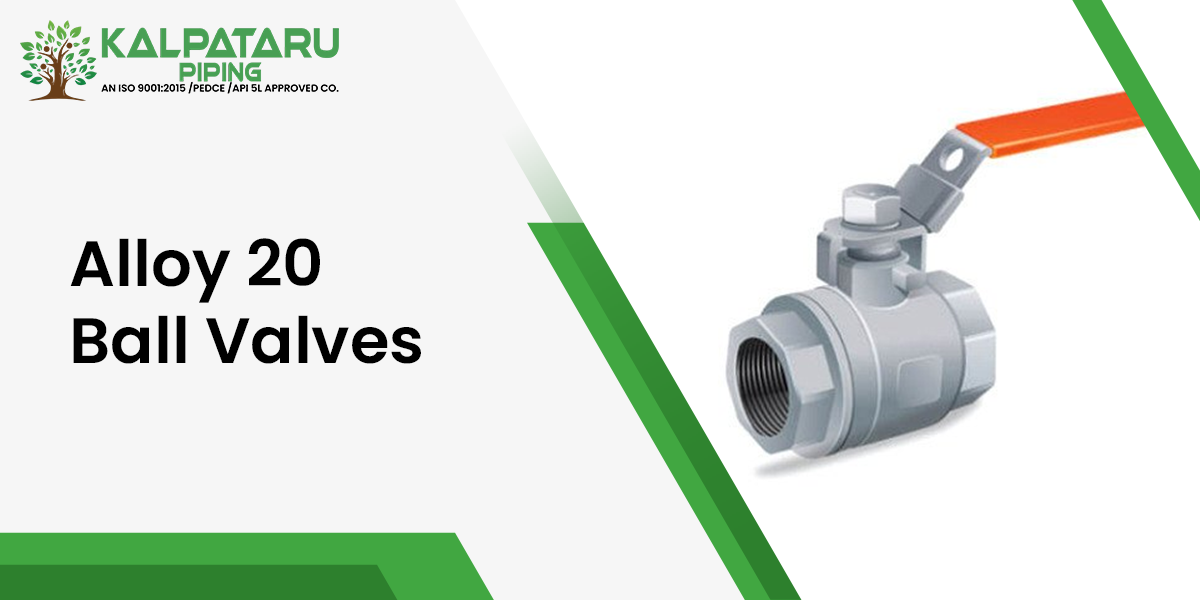
Alloy 20 Ball Valves Manufacturer, Supplier & Exporter in India
If your plant handles sulphuric acid, phosphoric acid or chloride-bearing process fluids, you already know how quickly standard stainless steel valves pit, crack and leak. That is exactly where an Alloy 20 ball valve earns its place. Made from UNS N08020, a nickel-iron-chromium alloy with added copper and molybdenum, it keeps working in environments that corrode 304 and 316 stainless steel.
At Kalpataru Piping Solution, we manufacture, stock and export Alloy 20 ball valves for chemical, pharmaceutical, fertiliser, pulp and paper, and water treatment plants. Every valve is built to recognised standards, pressure-tested before dispatch, and supplied with traceable material certificates, so your inspector and your maintenance team both get what they expect.
Whether you need a compact threaded valve for a dosing line or a large flanged, fire-safe valve for an acid transfer header, our team will help you match size, end connection, seat and pressure class to your actual service. Explore our wider range of Alloy 20 valves or send us your enquiry today.
What Is an Alloy 20 Ball Valve?
An Alloy 20 ball valve is a quarter-turn shut-off valve whose body, ball and stem are made from Alloy 20 (also called Carpenter 20, UNS N08020, Werkstoff 2.4660 or, in cast form, CN7M). A bored ball sits between two seats. Turn the handle 90 degrees and the bore lines up with the pipe for full flow, or turns across it to stop flow completely.
The alloy was developed for one job: surviving hot, strong sulphuric acid. It contains roughly 32–38% nickel, 19–21% chromium, 2–3% molybdenum and 3–4% copper, stabilised with niobium. That mix resists general corrosion, pitting, crevice attack and chloride stress corrosion cracking far better than standard austenitic stainless steels.
Alloy 20 ball valves are quarter-turn valves made from a nickel-chromium-molybdenum-copper alloy, used to control corrosive fluids such as sulphuric acid, where 304 and 316 stainless steel valves fail early.
Technical Data
Alloy 20 Ball Valve Types We Manufacture and Supply
| Valve Type | Typical Size Range | End Connection | Best For |
| One-piece ball valve | ¼” – 2″ | Threaded / socket weld | Low-cost shut-off, light duty lines |
| Two-piece ball valve | ¼” – 4″ | Threaded / socket weld / flanged | General chemical service, easy maintenance |
| Three-piece ball valve | ½” – 4″ | Threaded / socket weld / flanged | Lines that need in-line cleaning and seat replacement |
| Flanged split-body ball valve | ½” – 18″ | RF / RTJ flanged | Process headers, acid transfer |
| Top entry ball valve | 1″ – 12″+ | Flanged / butt weld | In-line repair without removing the valve |
| Fully welded (trunnion mounted) | 2″ – 24″+ | Butt weld / flanged | Buried, high-pressure and large-bore lines |
| 3-way / 4-way ball valve | ½” – 12″ | Flanged / threaded | Diverting and mixing flow |
| Jacketed ball valve | 1″ – 12″ | Flanged | Fluids that must stay heated (sulphur, polymers) |
| Fire-safe ball valve | ½” – 12″ | Flanged / threaded | Flammable chemical lines (API 607 / API 6FA) |
| Pneumatic / electric / gear-operated | All sizes | As above | Remote and automated plant operation |
| High-pressure & instrumentation ball valve | ⅛” – 2″ | Tube end / NPT / BSP | Sampling, analyser and instrument lines. See Alloy 20 instrumentation ball valves |
Alloy 20 Ball Valve Specifications
Parameter | Specification |
Material grade | Alloy 20 / Carpenter 20 / UNS N08020 / W.Nr. 2.4660 / CN7M (cast) |
Size range | ⅛” to 12″ (DN 6 to DN 300); larger sizes on request |
Pressure class | Class 150, 300, 600, 900, 1500, 2500 | PN 16 to PN 420 | up to 10,000 PSI for small-bore high pressure |
Body design | 1-piece, 2-piece, 3-piece, split body, top entry, fully welded, uni-body |
Ball type | Floating or trunnion mounted |
Port | Full port / reduced (regular) port |
End connections | Flanged (RF, RTJ, FF), threaded (NPT, BSP, BSPT), socket weld, butt weld, tube end, SAE |
Operation | Lever / wrench, gear, pneumatic, electric, hydraulic |
Seats and seals | PTFE, RPTFE, PEEK, PVDF, Delrin, graphite |
Stem packing and gaskets | PTFE, glass-filled PTFE, graphite |
Fire safe design | API 607 / API 6FA on request |
Design and testing standards | ASME B16.34, API 608, API 6D, ISO 17292, BS 5351, API 598 / API 6D testing |
Face to face / flange standards | ASME B16.10, ASME B16.5, ASME B16.25, ASME B16.34 |
Media | Sulphuric acid, chemicals, hydraulic oil, water, sea water, steam, gas |
Temperature | Approx. -120°C to 500°C, subject to seat material and pressure rating |
Inspection | Manufacturer, client or third party. Documents: EN 10204 3.1 / 3.2 MTC |
Packing | Each valve wrapped and capped; export wooden box or pallet, marked with size, grade and quantity |
Chemical Composition of Alloy 20 (Typical, %)
Ni | Cr | Mo | Cu | Nb (+Ta) | C | Mn | Si | P | S | Fe |
32 – 38 | 19 – 21 | 2.0 – 3.0 | 3.0 – 4.0 | 8×C to 1.0 | 0.07 max | 2.0 max | 1.0 max | 0.045 max | 0.035 max | Balance |
Mechanical Properties (Typical Minimum, Annealed)
Property | Value |
Density | ~8.1 g/cm³ |
Melting range | ~1400 – 1450°C |
Tensile strength | 80 ksi (551 MPa) min |
Yield strength (0.2% offset) | 35 ksi (241 MPa) min |
Elongation | 30% min |
Alloy 20 Ball Valves Equivalent Grades
| UNS | Werkstoff | AFNOR | EN | Common Names |
| N08020 | 2.4660 | Z2NCUD31-20AZ | NiCr20CuMo | Carpenter 20, Alloy 20, CN7M (cast), F20 |
Where Alloy 20 Ball Valves Are Used
| Industry | Typical Application |
| Chemical processing | Sulphuric acid transfer, acid dilution, reactor feed lines |
| Petrochemical | Process lines with chlorides and mixed acids |
| Fertiliser plants | Phosphoric and sulphuric acid handling |
| Pharmaceutical | Corrosive intermediates and solvent lines |
| Pulp & paper | Bleaching chemicals, liquor lines |
| Food processing | Cleaning-in-place and acid wash lines |
| Water & effluent treatment | Chemical dosing, pickling and neutralisation lines |
| Metal pickling & plating | Acid baths and rinse lines |
| Synthetic rubber, detergent, textile | Aggressive process streams |
| Oil & gas / refining | Alkylation units, sample and injection lines |
Standards & Certifications We Follow
| Area | Standards |
| Design | API 608, API 6D, ISO 17292, BS 5351, ASME B16.34 |
| Dimensions | ASME B16.10, ASME B16.5, ASME B16.25 |
| Testing | API 598, API 6D, ISO 5208 |
| Fire safety | API 607 / API 6FA (on request) |
| Materials | ASTM B462, B473, A351 CN7M, UNS N08020 |
| Management systems | [ISO 9001:2015 – confirm] |
| Documentation | EN 10204 3.1 / 3.2 |
How We Make and Check Every Alloy 20 Ball Valve
- Material selection. Bar, forgings or castings sourced from approved mills, with positive material identification (PMI) on receipt.
- Machining. CNC machining of body, ball and stem to tight tolerances for smooth operation.
- Assembly. Seats, seals and stem packing fitted in a clean environment, with anti-static and blow-out proof stem design where specified.
- Pressure testing. Shell and seat tests per API 598 / API 6D, as requested.
- Final inspection. Dimensional, visual and documentation check, with optional third-party inspection.
- Packing. Marked, protected and packed for domestic or export shipment.
Documents supplied: Material Test Certificate (EN 10204 3.1 / 3.2), test reports, [Certificate of Conformity], and heat number traceability.
Why Buyers Choose Kalpataru Piping Solution
- One-stop source. Valves, pipe fittings, tube fittings, steel flanges and tubes in matching alloys, so one PO covers a full spool.
- Honest selection help. We will tell you if Alloy 20 is the wrong choice for your fluid and suggest a better one.
- Ready stock plus custom builds. Common sizes ship fast; special ports, actuators and pressure classes are made to order.
- Export experience. Proper packing, documentation and shipping support to the Middle East, Africa, Europe and Asia.
- Transparent pricing. Itemised quotes with lead time and test documents stated up front.
Learn more about us or browse our full valves range.
Related Alloy 20 Products
How to Get Your Alloy 20 Ball Valve Quote
| Step | What You Send | What We Do |
|---|---|---|
| 1 | Size, class, end connection, media, temperature | Review your service conditions |
| 2 | Quantity and required standard | Recommend body type, seat and port |
| 3 | Inspection and documents needed | Send priced quote with lead time |
| 4 | Purchase order | Manufacture, test and inspect |
| 5 | Dispatch address | Pack and ship with full certificates |
FAQs - Alloy 20 Ball Valves
Alloy 20 is used where valves face sulphuric acid, phosphoric acid or chloride-bearing fluids that corrode ordinary stainless steel. It is common in chemical, fertiliser, pharmaceutical and pickling plants.
In hot sulphuric acid and chloride stress cracking environments, yes. In mild, non-acidic service 316 is usually enough and cheaper, so the right choice depends on your fluid, concentration and temperature.
Alloy 20 is also called Carpenter 20, UNS N08020, W.Nr. 2.4660 and EN NiCr20CuMo. The cast equivalent is CN7M.
Typically ⅛” to 12″ and Class 150 to 2500, with larger sizes and special classes made on request. Small-bore high pressure valves go up to 10,000 PSI.
Yes. Every supply includes EN 10204 3.1 material certificates, and 3.2 with third-party inspection is available on request.
Need Alloy 20 Ball Valves for Your Plant? Let's Talk Specs.
Tell us your size, pressure class and fluid. Our engineers will recommend the right valve and send a priced quote, usually within 24 hours.
Get a Free Quote in 24 HoursHave Any Questions ?
Please feel free to contact us. We will get back to you with 2 business days. Or just call us now.