
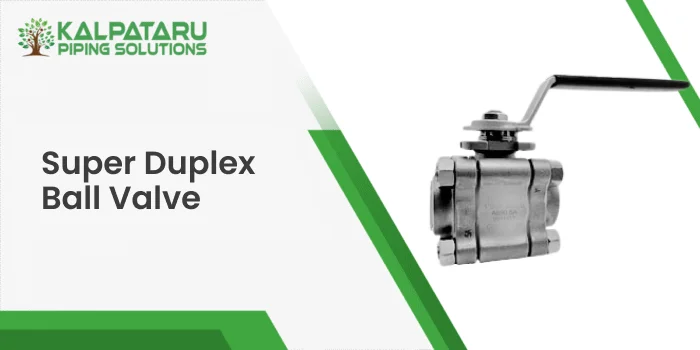
Super Duplex Ball Valve Material Grades
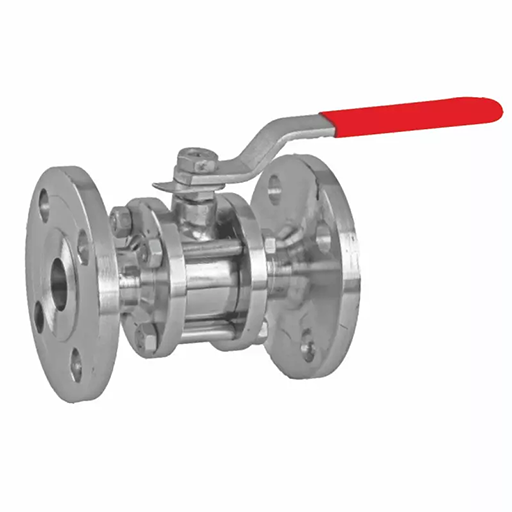
Technical Specifications Super Duplex Ball Valve
| Parameter | Specification |
| Material Grades | UNS S32750 (2507) · UNS S32760 (Zeron 100) |
| Material Standards | ASTM A182 F53 · ASTM A182 F55 · ASTM A351 CE8MN |
| Design Standard | API 6D · API 608 · ASME B16.34 · BS 5351 |
| Face-to-Face Dimensions | ASME B16.10 · API 6D |
| Flanged Ends | ASME B16.5 (up to 24”) · ASME B16.47 Series A/B (above 24”) |
| Butt Weld Ends | ASME B16.25 |
| Pressure-Temperature Rating | Per ASME B16.34 Table 2 (Group 3.3) |
| Nominal Pipe Size | ¼” NPS to 24” NPS (DN 8 to DN 600) |
| Pressure Class | ASME Class 150 · 300 · 600 · 900 · 1500 · 2500 |
| Operating Temperature | −50°C to +300°C (−58°F to +572°F) |
| Bore Type | Full Bore (FB) · Reduced Bore (RB) |
| Ball Design | Solid Ball · Hollow Ball |
| Seat Material | PTFE · Reinforced PTFE · PEEK · Metal-to-Metal (fire-safe) |
| Stem Design | Anti-blowout (in-built stem retention) |
| Packing | PTFE chevron rings · Graphite (fire-safe) |
| Fire Safe | API 607 · API 6FA |
| Anti-Static | Per API 6D / EN ISO 17292 |
| Actuation Options | Manual (lever/gear) · Pneumatic · Electric · Hydraulic |
| Valve Testing | API 598 · EN 12266-1 · API 6D Annex B |
| Sour Service | NACE MR0175 / ISO 15156 compliant |
| Material Certification | EN 10204 Type 3.1 (standard) · Type 3.2 (on request) |
| Surface Finish | As machined · Electropolished · Passivated |
| Marking | MSS SP-25 |
| Painting / Coating | Epoxy primer + topcoat per customer spec |
Pressure-Temperature Reference (UNS S32750 – ASME B16.34 Group 3.3)
| Pressure Class | Max. Pressure at 20°C (bar) | Max. Pressure at 200°C (bar) | Max. Pressure at 300°C (bar) |
| 150# | 19.6 | 17.7 | 16.5 |
| 300# | 51.1 | 46.6 | 43.8 |
| 600# | 102.1 | 93.2 | 87.6 |
| 900# | 153.2 | 139.8 | 131.4 |
| 1500# | 255.3 | 233.0 | 219.1 |
| 2500# | 425.5 | 388.3 | 365.1 |
Types of Super Duplex Ball Valves
Kalpataru’s product portfolio covers every ball valve configuration used in corrosive-service pipeline and process applications. Each type is manufactured from certified super duplex stock with full traceability to heat and lot.
1. Floating Ball Valve
The simplest and most widely used design. The ball floats freely between two resilient seats; upstream pressure generates the seating load. Ideal for instrumentation and small-bore isolation in chloride service (sizes ¼” to 3”, up to Class 1500).
2. Trunnion-Mounted Ball Valve (TMBV)
The ball is fixed via top and bottom trunnion bearings; spring-loaded seats float to maintain the seal. Low and consistent operating torques at all pressure classes make this the standard for pipeline mainline, subsea wellhead, and high-pressure gas gathering. Sizes 2” to 24”, Class 150 to 2500.
3. Top-Entry Ball Valve
The bonnet and internals are accessible from the top without removing the valve body from the pipeline. Used where in-line maintenance is required on offshore platforms or buried pipelines with permanent piping connections. Available in trunnion design, sizes 2” to 24”.
4. Split-Body Ball Valve
The body is split into two or three pieces bolted together, providing excellent access to seats and ball during maintenance. A popular choice for chemical processing plants where valve internals need periodic inspection without line removal.
5. V-Port / Segmented Ball Valve (Control)
A V-notch cut into the ball allows characterised flow control, turning a shutoff valve into a modulating control valve. Used in chemical dosing systems, pulp-and-paper stock handling, and corrosive slurries where equal-percentage or linear flow characteristics are needed.
6. Three-Way Ball Valve (L-Port / T-Port)
A single valve body with three port connections allows diversion of flow between two outlets (L-port) or mixing of two streams (T-port). Eliminates the need for two separate isolation valves and an elbow/tee in tight skid layouts. Available in floating and trunnion designs.
7. Instrumentation Ball Valve
Compact, small-bore (¼” to 2”) valves for process connection, sample-point, and gauge-isolation duty. Available with NPT, compression-tube, or socket-weld ends. Our Super Duplex Instrumentation Ball Valves are stocked in S32750 with 1,000 psi (69 bar) pressure ratings for offshore chemical-injection service.
8. Fire-Safe Ball Valve
Designed and tested to API 607 (soft-seated) and API 6FA (metal-seated and assembly) standards. In the event of a seat fire, graphite packing and metal-to-metal secondary seats maintain integrity, preventing hydrocarbon release. Mandatory on oil & gas wellheads, FPSO process decks, and LNG loading arms.
| Type | Typical Size Range | Typical Pressure Class | Primary Application |
| Floating | ¼” – 3” | 150# – 1500# | Instrumentation, utility isolation |
| Trunnion Mounted | 2” – 24” | 150# – 2500# | Pipeline, wellhead, subsea |
| Top Entry | 2” – 24” | 150# – 1500# | Buried / platform mainline |
| Split Body | ½” – 12” | 150# – 900# | Chemical processing |
| V-Port / Control | 1” – 12” | 150# – 600# | Flow modulation, slurry |
| Three-Way | ½” – 6” | 150# – 600# | Diversion, mixing |
| Instrumentation | ¼” – 2” | Up to PN 690 | Sample, gauge, injection |
| Fire-Safe | 1” – 24” | 150# – 1500# | Oil & gas, LNG, FPSO |
Super Duplex Ball Valve Sizes and Dimensions
Kalpataru Piping Solution supplies super duplex ball valve sizes from ¼” NPS (DN 8) up to 24” NPS (DN 600), covering both ASME and metric standards. Custom dimensions are available for special project requirements.
Size-to-Pressure Class Availability Matrix
| NPS (inch) | DN (mm) | Class 150 | Class 300 | Class 600 | Class 900 | Class 1500 | Class 2500 | Full Bore | Reduced Bore |
| ¼ | 8 | • | • | • | • | • | • | • | — |
| ½ | 15 | • | • | • | • | • | • | • | • |
| ¾ | 20 | • | • | • | • | • | • | • | • |
| 1 | 25 | • | • | • | • | • | • | • | • |
| 1¼ | 32 | • | • | • | • | • | • | • | • |
| 1½ | 40 | • | • | • | • | • | • | • | • |
| 2 | 50 | • | • | • | • | • | • | • | • |
| 3 | 80 | • | • | • | • | • | • | • | • |
| 4 | 100 | • | • | • | • | • | • | • | • |
| 6 | 150 | • | • | • | • | • | — | • | • |
| 8 | 200 | • | • | • | • | • | — | • | • |
| 10 | 250 | • | • | • | • | — | — | • | • |
| 12 | 300 | • | • | • | • | — | — | • | • |
| 16 | 400 | • | • | • | — | — | — | • | • |
| 20 | 500 | • | • | • | — | — | — | • | • |
| 24 | 600 | • | • | • | — | — | — | • | • |
• = Available · — = Not standard; consult factory for special requirements
Face-to-Face Dimensions (ASME B16.10 / API 6D) – Representative Values
| NPS | Class 150 F-F (mm) | Class 300 F-F (mm) | Class 600 F-F (mm) | Class 1500 F-F (mm) |
| ½ | 108 | 108 | 108 | 140 |
| 1 | 108 | 108 | 108 | 165 |
| 2 | 178 | 178 | 178 | 330 |
| 3 | 203 | 203 | 203 | 381 |
| 4 | 229 | 229 | 229 | 457 |
| 6 | 267 | 267 | 267 | 610 |
| 8 | 292 | 292 | 305 | — |
| 12 | 356 | 381 | 394 | — |
| 16 | 406 | 457 | 508 | — |
| 24 | 508 | 610 | 762 | — |
Actual dimensions per order drawing; above are standard API 6D long-pattern values. Short-pattern and custom face-to-face available on request.
Note: Piggable (full bore) valves maintain a minimum bore equal to pipe schedule bore throughout the valve body. Consult Kalpataru’s engineering team with your pipeline ID and pig gauge plate diameter when specifying piggable valves. See our Ball Valves catalogue page for complete dimensional drawings.
Chemical Composition – Super Duplex Ball Valve Materials
The corrosion performance of a super duplex ball valve is governed by its elemental composition, particularly the chromium, molybdenum, and nitrogen content that determine pitting and crevice corrosion resistance. Kalpataru sources bar stock, forgings, and castings exclusively from mills with certified heat analysis traceable to ASTM A182 F53 / F55 or ASTM A351 CE8MN requirements.
Chemical Composition Limits (Weight %)
| Element | UNS S32750 (2507) ASTM A182 F53 | UNS S32760 (Zeron 100) ASTM A182 F55 | Role in Corrosion Resistance |
| Chromium (Cr) | 24.0 – 26.0 | 24.0 – 26.0 | Primary passive layer former; pitting resistance |
| Nickel (Ni) | 6.0 – 8.0 | 6.0 – 8.0 | Austenite stabiliser; SCC resistance |
| Molybdenum (Mo) | 3.0 – 5.0 | 3.0 – 4.0 | Critical pitting resistance; crevice corrosion |
| Tungsten (W) | — | 0.5 – 1.0 | Supplements Mo; deepwater chloride resistance |
| Nitrogen (N) | 0.24 – 0.32 | 0.20 – 0.30 | Interstitial strengthener; raises PREN by 16×N |
| Copper (Cu) | 0.50 max | 0.50 – 1.00 | Acid resistance (H₂SO₄ environments) |
| Manganese (Mn) | 1.20 max | 1.00 max | Deoxidiser; austenite former |
| Silicon (Si) | 0.80 max | 1.00 max | Deoxidiser |
| Carbon (C) | 0.030 max | 0.030 max | Low C prevents sensitisation |
| Phosphorus (P) | 0.035 max | 0.030 max | Kept low for weldability |
| Sulfur (S) | 0.020 max | 0.010 max | Kept low; MnS inclusions nucleate pits |
| Iron (Fe) | Balance | Balance | Matrix |
PREN Calculation
The Pitting Resistance Equivalent Number quantifies chloride resistance:
PREN = %Cr + 3.3 × (%Mo + 0.5 × %W) + 16 × %N
| Alloy | Typical PREN | Classification |
| 316L Stainless Steel | ≈24 | Standard austenitic |
| Duplex 2205 (S31803) | ≈34–36 | Duplex stainless |
| Super Duplex 2507 (S32750) | ≥ 42 | Super duplex |
| Zeron 100 (S32760) | ≥ 40 | Super duplex |
| Alloy 625 (N06625) | ≈51 | Nickel superalloy |
A PREN above 40 is the recognised threshold for super duplex classification. Both S32750 and S32760 exceed this threshold, confirming their suitability for seawater, chlorinated process streams, and high-H₂S sour service. All incoming material at Kalpataru is verified by positive material identification (PMI) using X-ray fluorescence (XRF) prior to machining.
Mechanical Properties – Super Duplex Ball Valve Body & Trim
The dual austenite-ferrite microstructure of super duplex stainless steel delivers a mechanical property profile that no single-phase stainless can match at equivalent alloy cost. Higher yield strength means smaller wall thicknesses, lighter actuation torques, and more compact valve bodies — directly reducing super duplex ball valve price per unit of pressure containment.
Minimum Mechanical Properties (per ASTM A182 / ASTM A479)
| Property | UNS S32750 (2507) F53 | UNS S32760 (Zeron 100) F55 | 316L SS (Ref.) |
| 0.2% Proof Stress / Yield Strength (Rp0.2) | 550 MPa (80 ksi) | 550 MPa (80 ksi) | 170 MPa (25 ksi) |
| Ultimate Tensile Strength (Rm) | 795 MPa (115 ksi) | 750 MPa (109 ksi) | 485 MPa (70 ksi) |
| Elongation at Break (A50mm) | ≥ 15% | ≥ 25% | ≥ 40% |
| Reduction in Area | ≥ 45% | ≥ 45% | ≥ 50% |
| Hardness | ≤ 32 HRC / ≤ 310 HV | ≤ 32 HRC / ≤ 310 HV | ≤ 22 HRC |
| Charpy V-Notch Impact (0°C) | ≥ 45 J | ≥ 45 J | ≥ 100 J |
| Charpy V-Notch Impact (−40°C) | ≥ 27 J (on request) | ≥ 27 J (on request) | ≥ 60 J |
Physical Properties
| Property | UNS S32750 | UNS S32760 |
| Density | 7.8 g/cm³ | 7.8 g/cm³ |
| Elastic Modulus (E) | 200 GPa | 200 GPa |
| Thermal Conductivity (20°C) | 14 W/m·K | 14 W/m·K |
| Thermal Expansion (20–100°C) | 13.0 × 10⁻⁶ /K | 13.0 × 10⁻⁶ /K |
| Magnetic Permeability | ~1.5–1.8 (ferromagnetic due to ferrite) | ~1.5–1.8 |
| Electrical Resistivity | 0.80 μΩ·m | 0.80 μΩ·m |
Heat Treatment Requirements
All super duplex forgings and bar stock must be solution-annealed and water-quenched to dissolve intermetallic sigma (σ) and chi (χ) phases that form between 600°C and 1000°C. Kalpataru mandates:
- Solution Anneal Temperature: 1,050°C to 1,150°C minimum
- Quench: Rapid water quench to below 300°C within 3 minutes of removal from furnace
- Verification: ASTM A923 Method C (Charpy impact) or Method A (etch test) to confirm absence of intermetallic phases on production lots
- Ferrite Content: 40–60 vol% ferrite (per ASTM E562 point-counting or Fischer ferritescope)
Post-weld heat treatment is not required for field repairs provided welding procedures are qualified to ASME Section IX or EN ISO 15614-1 with approved super duplex filler metals (ER2594 or equivalent) and controlled interpass temperatures below 150°C.
Applications of Super Duplex Ball Valves by Industry
The combination of extreme chloride resistance, high strength, and wide temperature range makes the super duplex ball valve the valve of choice wherever standard austenitic grades corrode prematurely or exotic nickel alloys exceed budget.
Oil & Gas – Upstream and Midstream
Offshore production platforms and subsea manifolds operate in seawater-flooded environments with chloride concentrations of 19,000–35,000 ppm. Topside seawater lift, injection, and firewater systems demand valves that resist both external seawater corrosion and internal produced-water attack. Trunnion-mounted super duplex ball valves in API 6D configuration with NACE MR0175-compliant hardness controls are the standard fitment on FPSOs, TLPs, and jackup wellhead decks. Our Ball Valves range covers every API 6D pipeline class.
Oil & Gas – Downstream (Refining & Petrochemical)
Alkylation units using HF or H₂SO₄ acid catalyst, crude unit desalters, and amine gas-treating plants all expose valves to strong acids combined with chloride contamination. Super duplex outperforms Alloy 20 and even 904L in mixed acid environments, and its higher yield strength reduces valve weight on elevated-temperature lines where thermal fatigue from cycling matters.
Seawater Desalination
Reverse osmosis (RO) and multi-stage flash (MSF) desalination plants use high-pressure seawater feed (up to 80 bar) with chlorination chemicals added to control biofouling. Super duplex ball valves in S32750 handle both the chloride load and the chemical oxygen demand without pitting or crevice attack at the seat-body interface — the most common failure point in desalination valve installations.
Chemical & Pharmaceutical Processing
Chloride-containing process streams — hydrochloric acid dilution, chlorination reactors, sodium hypochlorite dosing, bleach manufacturing — are processed at elevated temperatures where 316L stainless fails by pitting within months. Super duplex ball valves installed in these streams routinely deliver 10–15 year service lives with zero corrosion-related maintenance.
Pulp & Paper
Bleaching sequences in pulp mills (chlorine dioxide, hydrogen peroxide, ozone stages) create aggressive oxidising chloride environments. Super duplex’s PREN >40 sustains performance in ClO₂ service at 70–90°C, where duplex 2205 begins to show crevice corrosion at flanged connections.
Marine & Shipbuilding
Ballast water treatment systems (BWTS), seawater cooling circuits, bilge systems, and fire-suppression lines on naval and commercial vessels are fitted with super duplex ball valves to resist the electrolytic corrosion driven by dissimilar metal contact and high-velocity seawater. Compact floating-ball designs in ½” to 3” sizes serve BWTS dosing injection points.
Power Generation
Coastal and offshore power stations using once-through seawater cooling, geothermal brines containing hydrogen sulfide, and flue-gas desulphurisation (FGD) scrubber slurries all demand super duplex alloys. FGD absorber inlet/outlet isolation in Class 150 flanged ball valves handles the wet SO₂/Cl⁻ combination at 50–70°C.
Quality Standards and Certifications
Every super duplex ball valve manufactured at Kalpataru Piping Solution’s Mumbai facility passes through a documented quality management system aligned to international procurement authority requirements. Our certifications are not issued for marketing purposes — they are active third-party accreditations that cover material traceability, dimensional inspection, pressure testing, and non-destructive examination.
Manufacturing Quality System
| Certification / Accreditation | Scope | Issuing Body |
| ISO 9001:2015 | Design, manufacture, and supply of industrial valves and piping products | Bureau Veritas / TUV |
| PED 2014/68/EU | Pressure Equipment Directive compliance for EU export | Notified Body |
| ATEX / IECEx | Anti-static and fire-safe valves for explosive atmosphere zones | Third-party |
Material and Testing Standards Applied
| Standard | Description | Applied At |
| ASTM A182 F53 / F55 | Forged or rolled alloy material for high-temp service | Material procurement |
| ASTM A351 CE8MN | Cast super duplex for body / bonnet | Foundry inspection |
| ASTM A923 | Detecting detrimental intermetallic phase in duplex SS | Heat treatment QC |
| ASTM G48 Method A/E | Critical pitting temperature (CPT) by ferric chloride test | Corrosion QC |
| EN 10204 Type 3.1 | Mill material test certificate, certified by mill inspector | Every heat |
| EN 10204 Type 3.2 | MTC countersigned by independent third-party inspector | On request |
| API 598 | Valve pressure and leak testing (shell, seat, backseat) | 100% valves |
| API 6D Annex B | Pipeline ball valve production testing | Pipeline valves |
| EN 12266-1 | Industrial valve testing – pressure tests of metallic valves | EU-spec orders |
| API 607 / API 6FA | Fire-safe type testing | Fire-safe designs |
| NACE MR0175 / ISO 15156 | Materials for H₂S / sour service environments | Sour-service valves |
| MSS SP-25 | Standard marking system for valves, fittings, and flanges | All valves |
Inspection and Testing Scope
Every valve lot undergoes the following inspections before dispatch:
- Positive Material Identification (PMI): XRF analysis confirms alloy grade on body, bonnet, ball, and stem — no substitutions reach the test bench.
- Dimensional Inspection: Face-to-face, flange bore, raised face OD, bolt circle, and bore diameter checked against ASME B16.10, B16.5, and order drawing.
- Hydrostatic Shell Test: 1.5× rated pressure for 30 seconds minimum (API 598 Table 2). Zero visible leakage required at body and bonnet seals.
- Low-Pressure Pneumatic Seat Test: 80–100 psi (5.5–6.9 bar) air or nitrogen from both directions. Bubble-tight (Class VI) leakage allowed only on soft-seated PTFE designs per API 598.
- High-Pressure Seat Test: 1.1× rated pressure hydrostatic from both seats. Metal-seated valves to API 6D Annex B leakage rates.
- Anti-Static Test (if ordered): Resistance ≤ 10 Ω between ball/stem and body measured before assembly (BS EN ISO 17292).
- Torque Test: Operating torque measured and documented against actuator sizing data.
All test records, MTC packages, and inspection reports are compiled into a Document Data Book and supplied with every order. Third-party witnessing by TPI agencies (Lloyds Register, Bureau Veritas, SGS, TPCO, etc.) is accommodated at no facility charge with 48-hour notice.