
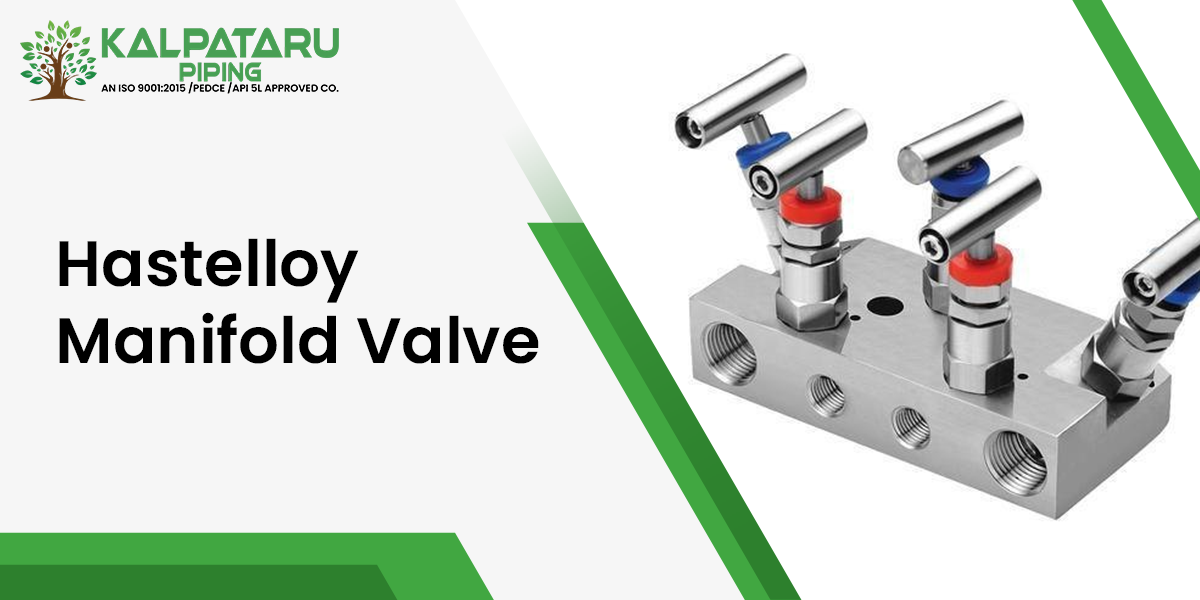
A Hastelloy Manifold Valve is the first line of defence wherever process fluids are aggressive, temperatures swing between cryogenic lows and 500 °C, and a single leak can shut down an entire plant. Kalpataru Piping Solution manufactures and exports a complete range of Hastelloy Manifold Valves in C276 and C22 grades, covering 2-way, 3-way, and 5-way configurations in R-Type, T-Type, and H-Type body designs. Each valve is bar-stock forged from ASTM B574/B575 certified material, pressure-tested up to 15,000 PSI, and 100 % helium-leak-tested before dispatch.
Our manifold valves are used to isolate, vent, and equalise differential-pressure transmitters in oil refineries, chemical plants, offshore platforms, power stations, and pharmaceutical facilities. They replace the need for separate tubing and fittings, reducing potential leak points by up to 60 %. With metal-to-metal bonnet-to-body seals, burr-free threads, and an optional direct-mount or remote-mount configuration, Kalpataru valves meet or exceed the performance of Swagelok, Parker, and Rosemount equivalents — at a competitive Indian manufacturing cost. Request a quote today or explore our full Manifold Valves catalogue.
What Is a Hastelloy Manifold Valve?
A manifold valve is an integrated valve block that combines two or more shut-off functions — isolation, equalization, and venting — into a single forged body. When that body is machined from Hastelloy (a family of nickel-molybdenum-chromium superalloys), the assembly gains outstanding resistance to pitting, crevice corrosion, and stress-corrosion cracking in chloride-rich, oxidising, and reducing media.
Why Hastelloy?
- C276 grade (UNS N10276 / DIN 2.4819): the industry workhorse for hydrochloric acid, wet chlorine gas, and mixed acid environments. Its high molybdenum content (15–17 %) makes it uniquely resistant to chloride-induced pitting and the widest range of process chemicals.
- C22 grade (UNS N06022 / DIN 2.4602): superior to C276 in oxidising environments (nitric acid, nitric-hydrofluoric mixtures, oxidising chloride solutions) due to higher chromium content (20–22 %) and excellent weldability.
Both grades retain mechanical integrity from –120 °C (cryogenic) to 500 °C, resist scaling at 650 °C, and can be heat-treated for use in hydraulic manifold systems.
Kalpataru Piping Solution stocks and custom-manufactures these valves alongside our broader range of Hastelloy Valves, Stainless Steel Manifold Valves, and Inconel Valves for complete instrumentation loop solutions.
Hastelloy Manifold Valve Material Grades
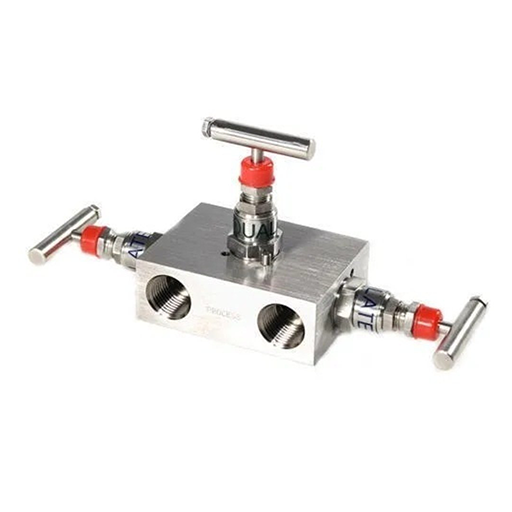
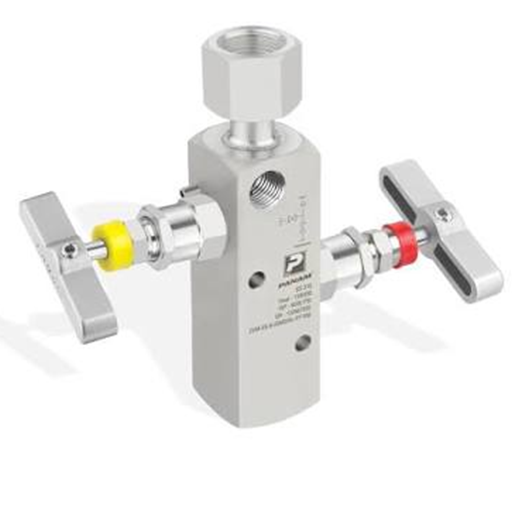
Technical Data
Hastelloy Manifold Valve Specifications
Parameter | Specification |
|---|---|
Material Grade | Hastelloy C276 (UNS N10276), Hastelloy C22 (UNS N06022), Hastelloy B2 (UNS N10665) |
Valve Size | 1/8″ to 1″ |
Orifice Size | 2 mm to 9.5 mm |
Thread Standard | NPT, BSPP, BSPT |
End Connection | Threaded, Flange End |
Body Type / Shape | Bar Stock, Forged · Square, Rectangle |
Valve Type | R-Type, T-Type, H-Type |
Function / Configuration | 2-Way, 3-Way, 5-Way |
Pressure Rating | 1,500 PSI · 3,000 PSI · 6,000 PSI · 10,000 PSI · 15,000 PSI |
Media Temperature | –120 °C to 500 °C (range as per pressure) |
Handle | Bar T-Handle |
Seal Type | Metal-to-Metal (No O-rings) |
Testing Standard | ASTM B574 / B575 · 100 % Helium Leak Test |
Mounting | Direct Mount, Remote Mount, Panel Mount |
Packing | Box Packing, Wooden Pallet |
Equivalent Brands | Swagelok, Parker, Rosemount, Hamlet, Oliver Valves, Hoke |
All specifications can be customised. Contact Kalpataru Piping Solution for non-standard sizes and special alloy grades.
Types of Hastelloy Manifold Valves
By Number of Ways
Type | Function | Typical Use |
|---|---|---|
2-Way Manifold Valve | Isolation only | Single-port instruments, gauge isolation |
3-Way Manifold Valve | Isolation + equalisation | Differential pressure transmitters, flow meters |
5-Way Manifold Valve | Isolation + equalisation + venting | DP transmitters requiring in-place calibration |
5-way vs. 3-way: A 5-way manifold adds a dedicated vent tube to a safe or inaccessible area, enabling in-place transmitter calibration without breaking the process connection — the preferred choice for hazardous-fluid service.
By Body / Configuration Type
- R-Type (Remote Mount): Valve block connected to the transmitter via tubing and compression fittings. Uses standard instrument manifolds; easier installation in tight spaces.
- T-Type (Top-Entry): All valve stems access from the top; suited for panel-mounted setups.
- H-Type (In-Line / Horizontal): Process and instrument connections on the same horizontal axis; minimises installation height.
By Mounting Style
- Direct Mount Manifold — fewer leak points, less expensive installation, integrated valves; system is still hard-piped to the transmitter.
- Remote Mount Manifold — piping mounted on the transmitter; uses standard manifolds and tubing/fittings; easier maintenance.
Explore related valve categories: Stainless Steel Manifold Valves · Duplex Steel Valves · Monel Valve · Inconel Valve
Hastelloy C276 vs C22 Manifold Valve — Which Grade Should You Choose?
Property | Hastelloy C276 (UNS N10276) | Hastelloy C22 (UNS N06022) |
|---|---|---|
DIN / Werkstoff Nr. | 2.4819 | 2.4602 |
Ni content | Balance | Balance |
Cr content (%) | 14.5 – 16.5 | 20 – 22 |
Mo content (%) | 15 – 17 | 12.5 – 14.5 |
Fe content (%) | 4 – 7 | 2 – 6 |
Best corrosion resistance | Reducing acids, chloride pitting, wet chlorine | Oxidising acids (HNO₃), mixed oxidising–reducing media |
Stress-corrosion cracking | Excellent | Superior |
Weldability | Good | Excellent |
Cryogenic use | Yes (–120 °C) | Yes (–120 °C) |
Max service temperature | 500 °C | 500 °C |
Tensile strength | ~790 MPa | ~690 MPa |
Melting point | 1,370 °C | 1,399 °C |
Typical applications | Pulp & paper, HCl service, offshore oil & gas | Pharmaceutical, nitric acid plants, flue-gas desulphurisation |
ASTM standard | B574 (bar), B575 (sheet) | B574 (bar), B575 (sheet) |
Rule of thumb: choose C276 for strongly reducing chloride environments; choose C22 when the process alternates between oxidising and reducing conditions, or when mixed acid media is present.
Hastelloy Manifold Valves Applications
Hastelloy Manifold Valves from Kalpataru Piping Solution are specified wherever standard stainless steel fails due to corrosion, high pressure, or extreme temperature. Common process applications include differential-pressure (DP) transmitter impulse lines, pressure gauge isolation, flow measurement manifolds, and chemical injection skids.
Industry | Typical Application | Why Hastelloy |
|---|---|---|
Oil & Gas (Upstream / Offshore) | Wellhead DP transmitters, gas injection skids | H₂S / chloride resistance |
Oil Refinery (Downstream) | HCl alkylation units, crude distillation | Strong acid resistance |
Petrochemical / Chemical Plants | Chlorine, hydrochloric acid, mixed acid service | Widest chemical compatibility |
Pharmaceutical & Fine Chemicals | Nitric acid reactors, API synthesis | C22 grade, crevice-corrosion free |
Power Generation | Flue-gas desulphurisation (FGD) scrubbers | SO₂ and chloride resistance |
Pulp & Paper | Bleaching and digester instrumentation | Chlorine-dioxide resistance |
Desalination / Water Treatment | High-chloride brine loops | Pitting resistance > PRE 40 |
Aerospace & Defence | Hydraulic test rigs, high-pressure manifolds | 15,000 PSI rating |
Shipbuilding & Marine | Seawater cooling instrument loops | Saltwater corrosion resistance |
Also see: Pipe Fittings · Tube Fittings · Steel Flanges · Check Valves · Needle Valves — complete your instrumentation loop with Kalpataru.
Manufacturing, Quality & Testing Standards
Raw Material Standards
Material Form | ASTM Standard |
|---|---|
Bar / Rod | ASTM B574 |
Sheet / Plate | ASTM B575 |
Pipe | ASTM B622 |
Fittings | ASTM B366 |
Quality Tests Performed on Every Valve
Kalpataru Piping Solution applies a multi-stage quality plan before any Hastelloy Manifold Valve leaves our facility:
- Radiography Test (RT) — internal soundness of forged body, no voids or cracks
- Hydrostatic Shell Test — body tested to 1.5× rated working pressure; confirms structural integrity
- Pneumatic Seat Test — seat and packing tested with pressurised nitrogen; verifies zero-leakage seat
- Pitting Resistance Test (ASTM G48) — confirms PRE value and surface resistance to chloride pitting
- Helium Leak Test — 100 % production test to 1 × 10⁻⁴ ml/s; the gold standard for instrumentation valve tightness
- Dimensional & Visual Inspection — every thread, port, and mounting hole checked against the drawing
- Positive Material Identification (PMI) — XRF test confirms alloy chemistry matches the MTC
Certifications & Documentation
- Mill Test Certificate (MTC) to EN 10204 3.1
- NABL-accredited chemical and mechanical test reports
- Third-party inspection by TUV, SGS, Bureau Veritas (on request)
- MSME and ISO 9001:2015 certified manufacturing facility
Our manufacturing processes are benchmarked against the same quality checkpoints used by global leaders such as Swagelok, Parker Hannifin, and Rosemount — ensuring our Hastelloy Valves are true commercial equivalents.
Hastelloy Manifold Valve Price
Product Description | Indicative Price (INR) |
|---|---|
Hastelloy C276 Instrumentation Manifold Valve | ₹ 6,700 / Piece |
Hastelloy C22 Manifold Valve (2-Way) | ₹ 5,500 / Piece |
ASTM B574 UNS N10276 Manifold Valve | ₹ 7,000 / Piece |
Hastelloy B2 Ball Valve Manifold | ₹ 6,000 / Piece |
Hastelloy C22 Pneumatic Manifold Block | ₹ 4,800 / Piece |
UNS N10276 Air Manifold with Valves | ₹ 6,700 / Piece |
ASTM B575 UNS N10276 Instrument Solenoid Valve | ₹ 7,000 / Piece |
Hastelloy 5-Way Manifold Valve | ₹ 8,500 / Piece |
Hastelloy C276 Direct Mount 3-Way Manifold | ₹ 7,200 / Piece |
Prices are indicative as of October 2026 and subject to raw material costs, order quantity, and specifications. Contact us for a firm quotation.
Hastelloy Manifold Valve - FAQs
A Hastelloy Manifold Valve is used to isolate, equalise, and vent differential-pressure instruments — such as pressure transmitters and flow meters — in process plants. It consolidates multiple valve functions into one forged block, reducing leak points and simplifying maintenance. Hastelloy grades are chosen when the process fluid is corrosive (acids, chlorides, wet chlorine) and standard stainless steel would fail prematurely.
A 3-way manifold valve provides two isolation valves and one equalising valve — enough to isolate a DP transmitter and equalize pressure across it for calibration. A 5-way manifold adds two additional vent/calibration valves, allowing the transmitter to be calibrated in place without removing it from the process line. The 5-way is preferred when the process fluid is hazardous or when frequent in-situ calibration is required.
Kalpataru Piping Solution manufactures Hastelloy Manifold Valves in five standard pressure ratings: 1,500 PSI, 3,000 PSI, 6,000 PSI, 10,000 PSI, and 15,000 PSI. The maximum standard working pressure for the 3-way R-type body is 6,000 psig at 100 °F (414 bar at 38 °C); higher ratings are available in special forged configurations.
Yes. Both C276 and C22 grade Hastelloy maintain adequate ductility and mechanical properties down to –120 °C, making them suitable for cryogenic LNG and liquid nitrogen service. However, the pressure rating should be de-rated per the manufacturer’s pressure-temperature chart for the specific temperature.
Every valve ships with a Mill Test Certificate (MTC) to EN 10204 3.1, a dimensional inspection report, and hydrostatic / pneumatic test certificates. PMI (Positive Material Identification) reports, NABL-accredited lab reports, and third-party inspection by TUV / SGS / Bureau Veritas are available on request.
Get a Competitive Quote in 24 Hours India's trusted Hastelloy Manifold Valve manufacturer — C276 · C22 · 1,500 to 15,000 PSI
Get a Free Quote in 24 HoursHave Any Questions ?
Please feel free to contact us. We will get back to you with 2 business days. Or just call us now.