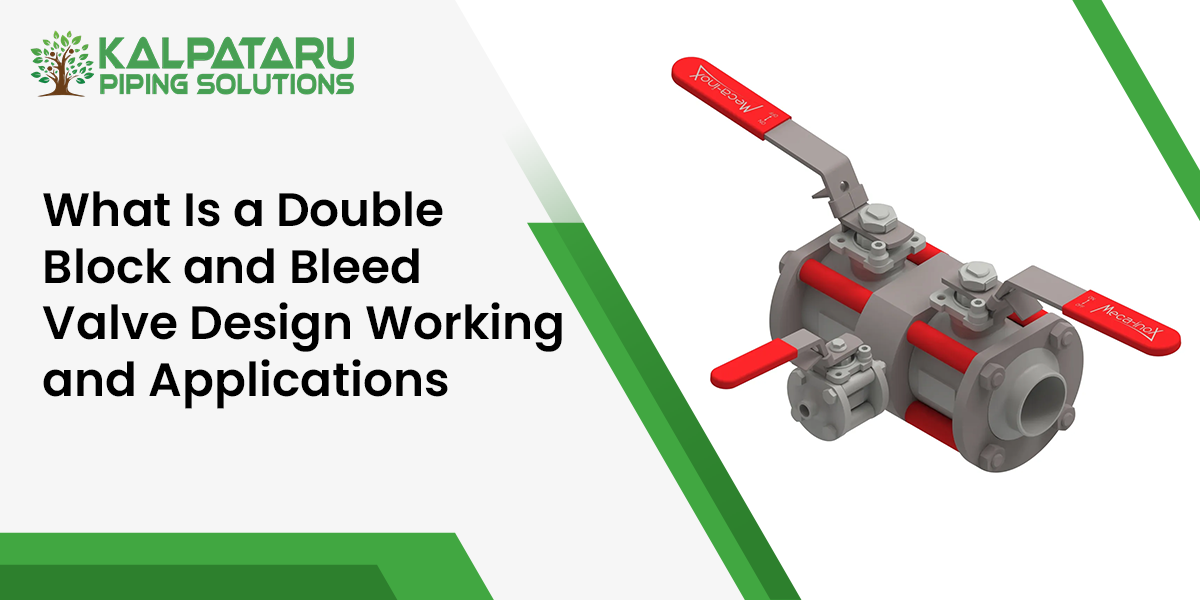
A double block and bleed valve gives you two seals in the line and a vent between them, so you can shut off a section of pipe and then prove that the shutoff is real. The valve is closed, the bleed is opened, and if nothing keeps flowing out, both seals are holding. That simple check is why the DBB valve is trusted wherever a leaking isolation valve could injure people or damage a plant.
Kalpataru Piping Solution supplies valves, pipe fittings, and flanges made of stainless steel, duplex, super duplex, and nickel alloy grades for industrial piping. This article will explain the concept of double block and bleed valves along with the DBB valve working principle, differences between DBB and double isolation, common types of DBB valve, design features, standards, and applications.
What Is a Double Block and Bleed Valve?
The phrase double block and bleed describes an isolation arrangement with three parts. There are two blocks, meaning two sealing points that stop flow. There is a bleed, meaning an opening between the two blocks through which trapped pressure or fluid can be released and checked.
The confusing part is that different organisations use the term for different things:
- API describes a DBB valve as a single valve with two seating surfaces. In the closed position it seals against pressure from both ends, and it has a way to vent the cavity between the seats.
- OSHA describes double block and bleed as a procedure. Two in line valves are closed and locked or tagged, and a drain or vent valve between them is opened and locked or tagged.
- The British Valve and Actuator Association describes a DBB as a compact manifold that combines isolation valves, usually ball valves, with bleed components in one assembly. It is common on instrument lines.
All three describe the same idea at different scales. A single body valve, a pair of valves with a spool piece between them, and an instrument manifold all give two blocks and a bleed. When you read a specification, check which arrangement the project actually means.
How Does a DBB Valve Work?
The DBB valve working principle is easy to follow once you picture the cavity. When the valve is closed, there is a small space between the two seats. That space is the cavity, and the bleed connection opens into it. The usual sequence looks like this:
- Close the valve so that both seats seal against the body or the closure element.
- Open the bleed or vent connection to release any pressure and fluid from the cavity.
- Watch the bleed. If the flow stops and stays stopped, both seals are holding.
- If fluid keeps coming from the bleed, one of the seats is leaking. The isolation cannot be trusted and the valve should be repaired or replaced.
- Keep the bleed open while work goes on downstream, so any leak shows up straight away and cannot build pressure behind the seat.
API notes that a single DBB valve does not give positive double isolation when only one side of the valve is under pressure. In that case only one seat is doing the sealing, and the bleed is what tells you whether it holds. This sequence is a general outline. Your site procedure and permit to work decide the real steps.
What Happens to Pressure Inside the Cavity?
The cavity is a closed space, and fluid trapped inside it can heat up and expand. If it has nowhere to go, the pressure can climb well above line pressure. This is called cavity overpressure, and it is one reason valve design matters.
Many DBB valves use self relieving seats. If cavity pressure rises above line pressure, the seat lifts slightly and lets the excess escape into the line, so no outside relief device is needed. Double isolation and bleed designs use seats that seal in both directions, so they cannot relieve cavity pressure past the seats and need an external relief arrangement instead. Which behaviour a valve has depends on its design, so always read the manufacturer data sheet.
DBB vs Double Isolation: What Is the Difference?
Double isolation and bleed, shortened to DIB, is a separate classification from DBB. API describes a DIB valve as a single valve with two seating surfaces, each of which seals against pressure from a single source. It is chosen when an independent second barrier matters, for example when leakage tolerance is very low or when the fluid must stay clean. The table below puts the arrangements side by side.
Arrangement | What it does | Cavity relief | Typical use |
Single block and bleed | One seal with a bleed connection | Depends on design | Lower risk lines where one barrier is accepted |
Double block and bleed | Two seals, seals against pressure from both ends, vent between them. | Often self-relieving through the seats | Isolation for maintenance with checked seals |
Double isolation and bleed | Two seats, each sealing against pressure from a single source, bleed between them. | Usually needs an external relief arrangement | Services needing an independent second barrier |
API 6D further divides DIB valves into subtypes. Take their exact definitions from the current edition of the standard rather than from secondary sources.
Types of DBB Valves
There are two useful ways to sort DBB valve types. The first is by valve family. The second is by how the double block is built.
By valve family
Valve family | DBB capability | Notes |
Possible, depends on seat design | Widely used in pipelines and process lines | |
Slab gate valve | Generally suitable | Used in transmission and storage |
Expanding gate valve | Generally suitable | Seals by mechanical expansion against the seats |
Expanding plug valve | Generally suitable | Used where tight shutoff is needed |
Floating ball valve and standard plug valve | Generally not, unless specially designed | Do not assume DBB capability |
A double block and bleed ball valve is one of the most widely used forms in pipelines. It is normally a trunnion-mounted design, because the fixed ball lets each spring-loaded seat seal on its own against line pressure. A floating ball valve does not give the same independent seat action.
By arrangement
- Single body DBB valve: one valve with two seats and a cavity bleed.
- Twin valve in one body: two valves built into a single casting, which cuts weight and leak paths.
- Two valves with a spool piece: two separate valves with a short pipe section and a bleed between them. This is the arrangement OSHA describes.
- Instrument DBB manifold: a compact block of isolation valves and a bleed valve used on instrument connections.
For instrument lines, the monoflange valve is a common compact form of the DBB manifold, and our guide to monoflange valve types and where they are used explains it in detail. If you are choosing between a monoflange valve and a three-valve manifold, our monoflange valve vs 3 valve manifold selection guide can help.
Check valves do not belong in this list. They only allow flow in one direction, so they cannot give the two-way isolation a DBB arrangement needs.
Design Features and Materials
A DBB valve is selected for the line it sits in, so the design starts with the service. The main points are:
- Pressure and temperature class, checked against ASME B16.34 ratings.
- Line size and the pressure drop the system can accept.
- Seat and seal materials that suit the fluid, temperature and cycling.
- Actuation, which can be manual, pneumatic, electric or hydraulic.
- Fire safe construction and sour service requirements where the service calls for them.
Body and trim materials follow the same logic as the rest of the piping. Carbon steel suits many non corrosive services, stainless steel handles more corrosive fluids, and duplex grades are chosen for chloride heavy environments. Our guide on stainless steel flanges and carbon steel flanges compared explains how to weigh the two, and our article on duplex steel flanges, grades and uses covers the duplex option. For specialised alloys, see our nickel alloy grades chart and selection guide. Pressure class matters too, and our guide to raised face and ring type joint flange ratings explains how pressure and temperature ratings work. If you are comparing valve materials, take a look at our stainless steel valves, duplex steel valves, Inconel valves and Monel valves.
Standards That Apply to DBB Valves
Standard | What it covers |
API 6D | Pipeline and piping valves, including DBB and DIB definitions |
ISO 14313 | The international pipeline valve standard closely related to API 6D |
ASME B16.34 | Pressure and temperature ratings for valves |
API 598 | Inspection and testing of valves |
ISO 5208 | Pressure testing of metallic valves |
PED | The European pressure equipment directive, relevant for supply into Europe |
A standard name on a data sheet is only useful when you know what it controls. Some describe the design, some set the ratings and some set the tests. Always take the exact scope and edition from the standard itself or from the project specification.
DBB Valve Applications
A DBB valve is used wherever a section of line has to be isolated with proof that the isolation works. Typical DBB valve applications include:
- Oil and gas pipelines, tank farms and storage terminals, where sections must be isolated for maintenance.
- LNG and industrial gas systems, where leaks are costly and dangerous.
- Petrochemical and chemical plants that handle toxic, corrosive or flammable fluids.
- Power plants, for steam, fuel gas and water systems.
- Meter calibration and proving lines, where a leaking valve changes the meter factor and spoils the result.
The piping around these valves matters just as much. Our post on stainless steel pipe fittings used in industrial plants shows where different fittings are used, and our guide to butt weld fittings, features and applications covers the fittings that join them. For a broader view of valve types, read our guide to industrial valves, types, functions and applications.
Advantages and Limits of DBB Valves
The main advantages are practical. One DBB valve can replace several separate valves, flanges and fittings. That means fewer potential leak points, less space and less weight. The seals can be checked through the bleed, and maintenance crews work with more confidence.
There are limits as well. A DBB valve usually costs more than a single valve, it can be heavier, and it has more parts to maintain. It also needs correct relief arrangements and regular testing. Even so, the higher valve cost often works out lower than the combined cost of buying, fitting and maintaining several separate valves.
How to Choose a DBB Valve
Run through these points before you order or specify one:
- Fluid and hazard level, including toxicity, flammability and corrosiveness.
- Design pressure and temperature, and the matching pressure class.
- Line size and flow direction, and which side will be pressurised during isolation.
- Whether the project calls for DBB or DIB, and how cavity pressure will be relieved.
- Body, trim and seat materials suited to the fluid.
- The standards and tests required, such as API 6D and API 598.
- Actuation and operating conditions.
- Documents needed, such as material test certificates to EN 10204 3.1.
The material side of the paperwork is where mistakes often creep in. Our quality checklist for genuine stainless steel flanges shows how to verify material and documents before accepting a consignment. For the standards behind the paperwork, read ASTM vs ASME standards for pipes, tubes and fittings.
Testing and Maintenance
The bleed is the best test tool the valve has. Each time the valve is closed, a quick check of the bleed shows whether the seats are sealing. Beyond that, plants usually schedule periodic seat leak tests and stroke tests, and keep records so a slow decline in sealing is spotted early. Factory testing normally follows API 598 or the project standard. If a bleed shows a steady flow, treat the isolation as failed and do not rely on it.
A double block and bleed valve is a valve or valve arrangement that gives two sealing points in a line with a vent or bleed connection between them. When both seals are closed, the bleed is opened to drain the space between them. This lets operators isolate a section of pipe and check that the seals are holding.
The valve is closed so that both seats seal. The bleed or vent is then opened to release any pressure in the cavity between the seats. If nothing keeps flowing from the bleed, both seals are holding. If fluid keeps coming out, one seat is leaking and the isolation cannot be trusted.
A DBB valve seals against pressure from both ends and has a way to vent the cavity. A DIB valve, short for double isolation and bleed, has two seats that each seal against pressure from a single source. DIB designs usually need an external way to relieve cavity pressure, while many DBB designs relieve it through the seats.
Not exactly. Double isolation and bleed, or DIB, is a separate classification with different seat behaviour. People often use the two terms loosely, but a project specification should state clearly which one is required.
DBB valves can be grouped by valve family, such as trunnion ball, expanding gate and plug valves, and by arrangement, such as a single body valve, a twin valve in one body, two separate valves with a spool piece, and an instrument manifold. The right type depends on the service and the specification.
They are used where a section of line must be isolated with checked seals. Common examples are oil and gas pipelines and storage, LNG, petrochemical and chemical plants, power plants, industrial gas systems and meter calibration or proving lines.
Choosing the Right Isolation for Your Line
A double block and bleed valve earns its place by proving its own isolation. It gives two seals, a bleed to check them and, in many designs, a way to relieve cavity pressure. Know whether your project needs DBB or DIB, match the valve to the service and the standard, and test the seals every time they are used.
If you are planning a piping project and need valves, fittings or flanges for it, explore our full product range or get in touch with our team with your valve type, size, pressure class and material, and we will help you confirm the right specification.
Enquire Now
Related Blogs
What is Stainless Steel Valve?
What Is Monel Alloy? Composition, Properties & Uses (Guide)