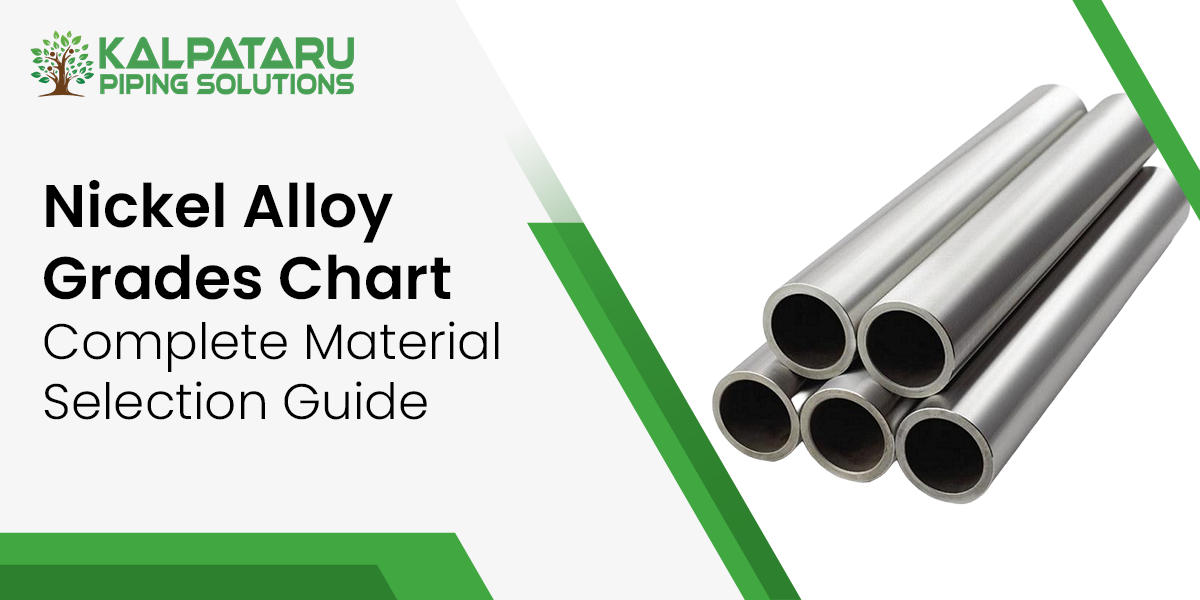
Get the alloy wrong on a piping spec and you don’t find out for months — usually when a heat exchanger tube starts pitting from the inside, or a flange face corrodes faster than the gasket it’s holding. Nickel alloys exist precisely for the jobs where stainless steel gives up: hot chlorides, concentrated acids, seawater, sour gas, anything running past 1000°F. At Kalpataru Piping Solution, we stock and supply tubes, flanges, and fittings across every major nickel alloy family, and this chart pulls together what we actually see engineers and buyers cross-checking before they place an order — UNS numbers, governing ASTM specs, composition, mechanical properties, and which grade fits which environment. Use it as a working reference, not just a one-time read.
What Nickel Alloys Actually Do?
Nickel alloys are made up of nickel which is the main metal in this material and other with that some other metals is also added such as chromium, molybdenum, copper, iron, or niobium, depending on the requirements of the final alloy. Addition of chromium provides resistance to oxidation, molybdenum provides resistance to crevice and pitting corrosion due to chlorides, and Monel provides resistance to seawater due to the presence of copper. The following are some examples of alloys specifically designed to resist various types of corrosion. Each of them has its own purpose, answering the question of what the pipe, tube, or fitting is going to sit in for the next twenty years. Stainless steels have their limitations, too. After a specific chloride concentration or acidity, and especially at a particular temperature, 316L stainless starts pitting and 321 starts creeping. Nickel alloys cover the remaining needs; and several of them, including Inconel 625, can cope with that, maintaining their mechanical strength at high temperatures when steel would be softened. Nevertheless, nickel alloys is not a single material. It is rather a group of alloys aimed to prevent specific failure modes.
Overview of Major Nickel Alloy Families
Alloy Family | Typical Base Elements | Key Characteristics | Typical Applications |
Inconel | Nickel-chromium-iron, some with molybdenum or niobium | High-temperature strength and oxidation resistance | Reactors, exhaust systems, high-pressure heat exchangers |
Incoloy | Nickel-iron-chromium | Cost-effective corrosion and oxidation resistance | Sour gas service, sulfuric acid plants, heat-treating equipment |
Monel | Nickel-copper | Seawater and hydrofluoric acid resistance | Marine hardware, pump shafts, valve trim |
Hastelloy | Nickel-molybdenum-chromium | Resistance to both reducing and oxidizing acids | Chemical processing, flue gas desulfurization, pickling |
Commercially Pure Nickel (200/201) | 99%+ nickel | Caustic soda handling, magnetic and electrical properties | Caustic evaporators, food processing, electronic components |
Nickel Alloy Grades UNS Numbers & Governing ASTM Specs by Grade
Trade Name | UNS No. | Common Governing ASTM Spec | Approx. Ni Content |
Nickel 200 | N02200 | ASTM B160 / B161 / B163 | 99% min |
Nickel 201 | N02201 | ASTM B160 / B162 / B163 | 99% min (low carbon) |
Monel 400 | N04400 | ASTM B127 / B163 / B165 | 63–70% |
Inconel 600 | N06600 | ASTM B163 / B167 / B168 | 72% min |
Inconel 601 | N06601 | ASTM B163 / B166 / B168 | 58–63% |
Inconel 625 | N06625 | ASTM B443 / B444 / B446 | 58% min |
Incoloy 800 | N08800 | ASTM B163 / B407 / B409 | 30–35% |
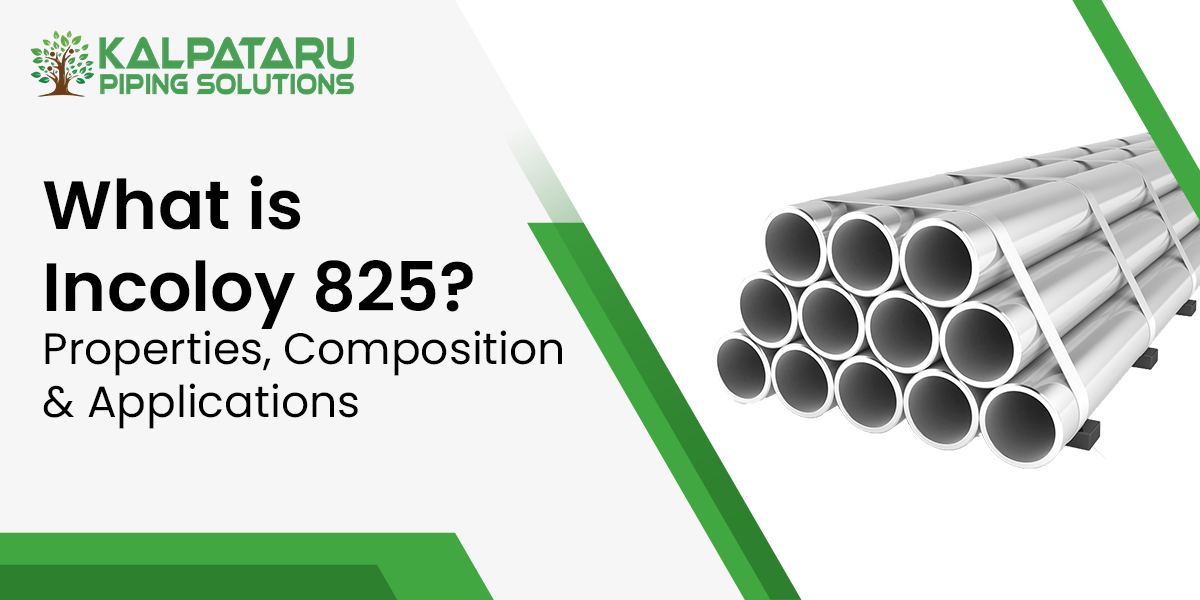
Incoloy 825 | N08825 | ASTM B163 / B423 / B424 | 38–46% |
Hastelloy C-276 | N10276 | ASTM B575 / B619 / B622 | Balance (~57%) |
Alloy 20 | N08020 | ASTM B463 / B464 / B729 | 32–38% |
Chemical Compositions of Nickel Alloy Grades Chart
Grade | Ni (%) | Cr (%) | Mo (%) | Fe (%) | Other Alloying Elements |
Nickel 200/201 | 99.0 min | — | — | 0.4 max | Cu 0.25 max |
Monel 400 | 63–70 | — | — | 2.5 max | Cu 28–34 |
Inconel 600 | 72 min | 14–17 | — | 6–10 | — |
Inconel 601 | 58–63 | 21–25 | — | Balance | Al 1–1.7 |
Inconel 625 | 58 min | 20–23 | 8–10 | 5 max | Nb+Ta 3.15–4.15 |
Incoloy 800 | 30–35 | 19–23 | — | 39.5 min | Al+Ti 0.3–1.2 |
Incoloy 825 | 38–46 | 19.5–23.5 | 2.5–3.5 | Balance | Cu 1.5–3.0 |
Hastelloy C-276 | Balance | 14.5–16.5 | 15–17 | 4–7 | W 3–4.5 |
Alloy 20 | 32–38 | 19–21 | 2–3 | Balance | Cu 3–4 |
Mechanical Properties by Grade: Tensile, Yield & Elongation
Grade | Tensile Strength | Yield Strength (0.2% Offset) | Elongation (%) | Condition |
Nickel 200/201 | 55,000 psi (380 MPa) | 15,000 psi (100 MPa) | 40–50% | Annealed |
Monel 400 | 70,000–85,000 psi (480–585 MPa) | 25,000–40,000 psi (170–275 MPa) | 35–50% | Annealed |
Inconel 600 | 80,000–100,000 psi (550–690 MPa) | 30,000–45,000 psi (205–310 MPa) | 30–40% | Annealed |
Inconel 625 | 120,000 psi min (825 MPa) | 60,000 psi min (415 MPa) | 30% min | Annealed |
Incoloy 800 | 65,000–95,000 psi (450–655 MPa) | 25,000–40,000 psi (170–275 MPa) | 30% min | Annealed |
Incoloy 825 | 85,000 psi min (585 MPa) | 35,000 psi min (240 MPa) | 30% min | Annealed |
Hastelloy C-276 | 100,000 psi min (690 MPa) | 41,000 psi min (283 MPa) | 40% min | Annealed |
Alloy 20 | 80,000 psi min (550 MPa) | 35,000 psi min (240 MPa) | 30% min | Annealed |
How to Choose the Right Nickel Alloy
Skip the chart for a second and ask four questions in this order. It’ll narrow the field faster than comparing spec sheets grade by grade.
Temperature Range
If the line runs above roughly 1000°F, you’re looking at Inconel or Incoloy before anything else Monel and the straight nickel grades aren’t built for sustained high-temperature service.
Check the Metal
Seawater and hydrofluoric acid point to Monel. Sulfuric acid points to Alloy 20. A mix of acids, or you’re not entirely sure what the process stream will do over its lifetime, points toward Inconel 625 or Hastelloy C-276 — the two most forgiving all-rounders.
Mechanical load and fabrication method
Welded joints, cold-formed fittings, and high-pressure service each favor slightly different tempers and grades — this is usually where a quick call to a supplier who stocks the material saves more time than reading another datasheet.
Cost and lead time
Nickel 200 and Monel 400 are generally the most available and cost-effective; Hastelloy C-276 and Inconel 625 carry a premium that’s easy to justify when failure is expensive, and hard to justify when it isn’t.
Nickel Alloy Applications by Industry
Industry | Primary Alloys Specified | Typical Component Applications |
Oil & Gas | Inconel 625, Incoloy 825, Monel 400 | Sour service environments, downhole tubing, and valve trim exposed to seawater or brine |
Chemical Processing | Hastelloy C-276, Alloy 20, Incoloy 825 | Mixed acid streams (Hastelloy C-276), sulfuric acid handling (Alloy 20), and phosphoric acid processing (Incoloy 825) |
Marine | Monel 400, Copper-Nickel Alloys | Propeller shafting, high-strength fasteners, seawater piping systems, and condenser tubing |
Power & Nuclear | Inconel 600, Inconel 690, Incoloy 800H | Nuclear steam generator tubing (600/690) and high-temperature furnace structural components (800H) |
Aerospace | Inconel 625, Inconel 718 | Aircraft exhaust systems, turbine engine components, and fasteners requiring elevated temperature strength |
Nickel Alloy Grades Kalpataru Supplies
Every grade covered above is available from Kalpataru Piping Solution in tube and flange form, cut and finished to the standard your project calls for. Product-specific pages, with dimensions and specifications, are linked below:
- Nickel 200 tubes and Nickel 200/201 flanges
- Nickel 201 tubes
- Monel 400 tubes and Monel 400 / K-500 flanges
- Inconel 600 tubes, Inconel 601 tubes, and Inconel 600/601 flanges
- Inconel 625 tubes and Inconel 625 flanges
- Incoloy 800 tubes and Incoloy 800 flanges
- Incoloy 825 tubes and Incoloy 825 flanges
- Hastelloy C-276 tubes
- Alloy 20 tubes
Frequently Asked Questions
Inconel generally has higher nickel content, giving it better high-temperature strength and oxidation resistance. Incoloy contains more iron and is often a more cost-effective option for less demanding conditions.
Monel 400 (UNS N04400) is widely used for continuous seawater exposure because of its excellent resistance to corrosion in marine environments.
The UNS number for Monel 400 is N04400. Common standards include ASTM B127 for plate and sheet, B163 for seamless tube, and B165 for pipe.
Not always. Inconel 625 offers excellent corrosion resistance and high-temperature strength, but it costs more. It is best when the application requires its higher performance.
Yes. Nickel alloys and stainless steel can be welded together using a suitable nickel-alloy filler metal and a qualified welding procedure.
Alloy 20 is commonly selected for sulfuric acid service. Hastelloy C-276 may be preferred when the environment also contains chlorides or strong oxidizing conditions.
Enquire Now
Related Blogs
What is Stainless Steel Valve?
What Is Monel Alloy? Composition, Properties & Uses (Guide)