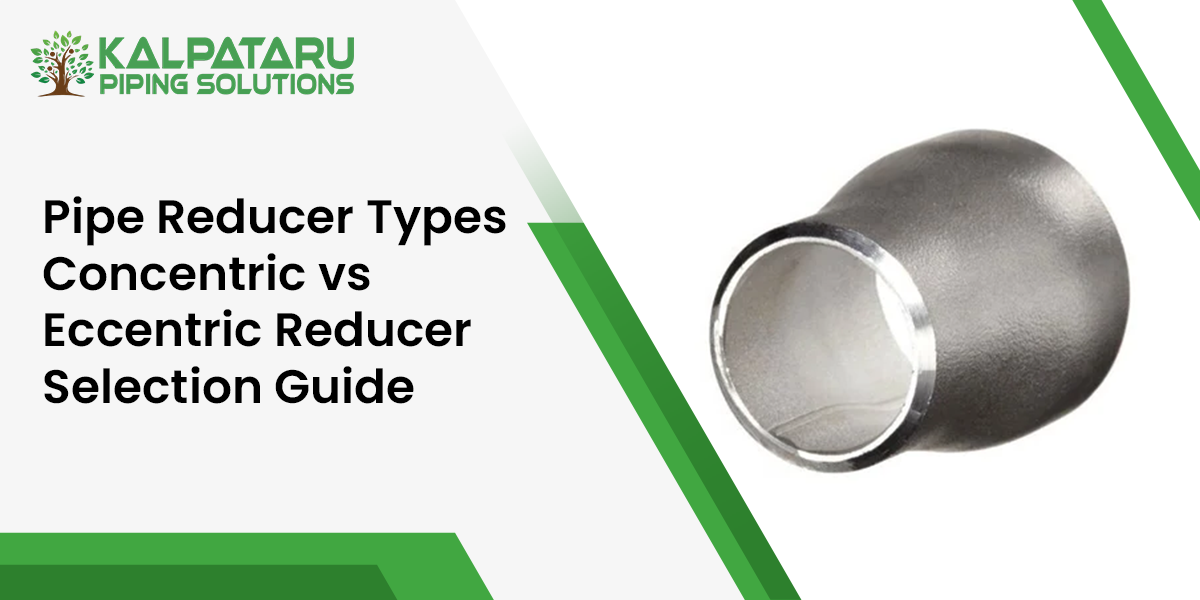
The structural difference between a concentric reducer and an eccentric reducer plays an essential role in determining whether a liquid, gas, or any other substance is trapped in the pipes and whether suction is acting properly in pumps. The wrong choice of a pipe reducer can make it impossible to correct the situation once the pipes have already been welded.
Pipe reducer fitting supplier Kalpataru Piping Solution offers a wide range of butt weld pipe fittings including eccentric and concentric reducers made of stainless steel, duplex, super duplex, nickel alloy, Inconel, Monel. This guide also highlights major pipe reducer types, the real difference between a concentric and an eccentric reducer, concentric and eccentric reducer uses, proper orientation of the flat side, and a brief description about the reducer dimensions.
What Is a Pipe Reducer?
A pipe reducer is a fitting that joins two pipes of different sizes. It narrows the flow path from a larger pipe to a smaller one. Plants use reducers to match a pipe to a pump nozzle, a valve or equipment, to control flow velocity and to step a line down as demand falls along its length.
Reducers are written with the larger size first and the smaller size second, for example NPS 6 by NPS 4. When the same fitting is used in the opposite direction, so that flow goes from the small end to the large end, it is called an expander. We come back to that further down.
Pipe Reducer Types
There are a few ways to sort pipe reducer types. The first is by shape, which gives us the two types this guide is about. The second is by how the reducer connects to the pipe. A third group is related parts that do a similar job.
Group | Type | Notes |
By shape | Concentric reducer | Symmetrical cone, both ends on one centreline |
By shape | Eccentric reducer | Offset design with one flat side |
By connection | Butt weld reducer | Welded to the pipe end, standard in process piping and larger sizes |
By connection | Socket weld reducer | Small bore forged fitting, pipe enters a socket and is fillet welded |
By connection | Threaded reducer | Small bore fitting joined by screwed threads |
Related part | Swage nipple | A shorter, heavier reducing piece used mostly on small bore lines |
Butt weld reducers are the ones most people mean when they talk about reducers on process lines. They are made in a wide range of materials, as covered in our guide tobutt weld fittings, features and applications and our article onstainless steel pipe fittings, types, grades and standards. For the full range of fitting shapes, see our guide to thetypes of pipe fittings.
Concentric Reducer: Design and Applications
A concentric reducer has a cone shape that tapers evenly from the large end to the small end. Both ends share one centreline, so the pipe on either side lines up in the middle. Flow moves smoothly through the cone and the fitting looks the same from every side, which means it has no top or bottom to worry about.
Common concentric reducer applications include:
- Vertical lines, where the centreline stays fixed and gas or liquid does not collect on one side.
- Pump discharge lines, where flow leaves the pump and steps down in size.
- General process piping where a line changes size and there is no pocket risk.
- Lines running between equipment connections that are already on the same axis.
Concentric reducers are not limited to vertical pipes. They also work in horizontal runs, but if gas or liquid can get trapped behind the step in a horizontal line, an eccentric reducer is usually the better choice.
Eccentric Reducer: Design and Applications
An eccentric reducer is offset. The smaller end is shifted to one side so that one edge of the fitting stays straight from end to end. The centrelines of the two pipes no longer match, and the flat side becomes either the top or the bottom of the line once the fitting is installed.
Typical eccentric reducer applications include:
- Pump suction lines, where trapped air or vapour must not reach the pump.
- Horizontal lines where pockets of gas, vapour or liquid would otherwise collect.
- Pipe racks, where the bottom of the pipe must stay at one level so every pipe can sit on the same support.
- Drain and slurry lines, where liquid needs a clear path along the bottom of the pipe.
An eccentric reducer reduces the chance of pockets. It does not remove it entirely, because good layout and slope matter too.
Concentric vs Eccentric Reducer: Key Differences
Feature | Concentric reducer | Eccentric reducer |
Shape | Symmetrical cone | Offset with one flat side |
Centreline | Stays the same on both sides | Shifts between the large and small ends |
Flat side | None | One side, top or bottom |
Flow | Even, centred | Stays level on one side |
Air and liquid pockets | Can collect in horizontal lines | Reduces the chance of pockets |
Pipe level | Centre stays fixed | Top or bottom stays fixed |
Typical orientation | Vertical or horizontal | Mostly horizontal |
Typical use | Pump discharge, vertical lines, general process piping | Pump suction, pipe racks, drains, horizontal lines |
A simple way to remember it: choose concentric when the line should stay centred and no pocket can form. Choose eccentric when one side of the pipe must stay flat.
Flat on Top or Flat on Bottom?
This is the question people ask most often. The answer follows from what the line carries and where gas or liquid will try to settle.
A flat top keeps the top of the pipe level, so gas has no step to hide under. That is why a flat top suits liquid lines and horizontal pump suction. A flat bottom keeps the bottom of the pipe level, so liquid has no step to pool behind. That is why a flat bottom suits gas or vapour lines and pipe racks, where every pipe needs the same bottom of pipe level to sit on a shared support.
Service | Typical orientation | Reason |
Horizontal pump suction | Flat on top | Stops air and vapour collecting and reaching the pump |
Horizontal liquid line | Flat on top | Gas cannot collect under a step |
Horizontal gas or vapour line | Flat on bottom | Liquid cannot pool behind a step |
Pipe rack | Flat on bottom | Keeps the bottom of pipe level constant for supports |
Drain line | Flat on bottom | Lets liquid run out fully |
Vertical line | Concentric | Orientation of an eccentric reducer makes little difference |
These are general practice rules, not laws. Your project piping specification and your piping engineer decide the final orientation for every reducer in the line.
Reducer Dimensions: How to Read Them
Buyers often ask for a table of reducer dimensions, but the numbers only make sense once you know what each one means. Three things define a reducer.
- Size pair. The larger size comes first, then the smaller size, as in NPS 8 by NPS 6.
- Wall thickness. This is set by the pipe schedule at each end, and the two ends can have different schedules.
- Overall length. This is the distance from the large end to the small end, and it depends on the size pair.
For butt weld reducers the dimensional standard is ASME B16.9, and it gives the length for each size pair. It is a common mistake to think the length is simply the average of the two diameters. It is not. Always take the length from the standard chart, not from a rule of thumb.
Weld ends are prepared to ASME B16.25, so the bevel matches the pipe it joins. To see how the standards divide the work, read our guide toASTM vs ASME standards for pipes, tubes and fittings. The pipe the reducer joins also matters, and our comparison ofseamless pipe vs welded pipe explains how each is made.
Materials, Standards and Connections
The material standard and the dimensional standard do different jobs, and a reducer specification normally lists both. The dimensional standard says how big the fitting is. The material standard says what it is made of and how it is tested.
Standard | What it covers |
ASME B16.9 | Dimensions and tolerances of factory made butt weld fittings, including reducers |
ASME B16.25 | Weld end preparation |
ASTM A234 WPB | Carbon steel fittings for moderate and higher temperature service |
ASTM A403 | Wrought austenitic stainless steel fittings, such as WP304 and WP316 |
ASME B16.11 | Forged socket weld and threaded fittings for small bore lines |
Alloy steel and duplex reducers follow their own ASTM specifications where the service needs them. Take a look at our range ofstainless steel pipe fittings,duplex steel pipe fittings,nickel alloy pipe fittings,Inconel pipe fittings andMonel pipe fittings for the material families, and see how duplex grades compare in our guide toduplex vs super duplex pipe fittings.
How to Install a Reducer
Most reducer problems start at installation. A few simple habits avoid them:
- Check the orientation before welding. An eccentric reducer fitted the wrong way up cannot be fixed without cutting it out.
- Mark the flat side on the pipe, so the fitter and the inspector can both see it.
- Match the wall thickness and bevel at each weld end, and keep the alignment tight.
- Support the pipe close to the reducer so the weld does not carry the weight.
- Follow the approved welding procedure for the material.
Reducer vs Expander
A reducer and an expander are the same fitting used in opposite directions. Flow that moves from the large end to the small end sees a reducer. Flow that moves from the small end to the large end sees an expander. The two can behave differently, because flow slows down in an expander and can separate from the wall, so the design should take the direction of flow into account.
How to Choose Between a Concentric and Eccentric Reducer
Work through these points in order:
- What does the line carry, a liquid, a gas, a vapour or a slurry?
- Is the line horizontal or vertical?
- Is it a pump suction line?
- Does it sit on a pipe rack where the bottom of the pipe level must stay constant?
- Can gas or liquid get trapped behind the step?
- What is the size pair, and what are the schedules at each end?
- What material and standard does the line need?
Here is a worked example. A horizontal water line feeds a pump suction, and the pipe steps down from NPS 8 to NPS 6 just before the pump. The line is horizontal and it is a suction line, so air could collect behind a step. The right choice is an eccentric reducer with the flat side on top, so the top of the pipe stays level and air passes straight through. On a vertical section further along, a concentric reducer would do the job.
Frequently Asked Questions
A concentric reducer is symmetrical, so the centrelines of the large and small pipes stay in line. An eccentric reducer is offset, so one side of the fitting stays flat and the centrelines do not match. The shape you choose decides where air, gas or liquid can collect in the line.
Eccentric reducers are used on horizontal lines where pockets of air, gas or liquid must be avoided. Common places are pump suction lines, pipe racks where the bottom of the pipe must stay at one level, and drain lines. The flat side is set on top or at the bottom according to the service.
On a horizontal pump suction line the flat side is normally placed on top. This keeps the top of the pipe level, so air and vapour cannot gather under a step and enter the pump. Always confirm with the project piping specification.
A concentric reducer is used where the centreline can stay the same and pockets are not a concern. Typical places are vertical lines, pump discharge lines and general process piping where flow runs evenly through the reduction.
A reducer is named by its larger size followed by its smaller size, along with the wall thickness or schedule at each end. The overall length is set by the dimensional standard, ASME B16.9 for butt weld reducers, and depends on the size pair. Always read it from the standard chart.
Yes. The fitting is the same, and the name depends on the direction of flow. A reducer becomes an expander when flow goes from the small end to the large end, so the design should account for that change in flow direction.
Choosing the Right Reducer for Your Line
The decision between a concentric vs eccentric reducer comes down to one question: can anything get trapped behind the step? If not, a concentric reducer keeps things simple. If yes, an eccentric reducer with the flat side set correctly keeps the line clear. Check the reducer dimensions against the standard, match the material and schedule at both ends and record the orientation before welding.
If you are planning a piping project and need reducers or other butt weld fittings for it, explore our full product range or get in touch with our team with your size pair, schedule and material, and we will help you confirm the right specification.
Enquire Now
Related Blogs
What is Stainless Steel Valve?
What Is Monel Alloy? Composition, Properties & Uses (Guide)