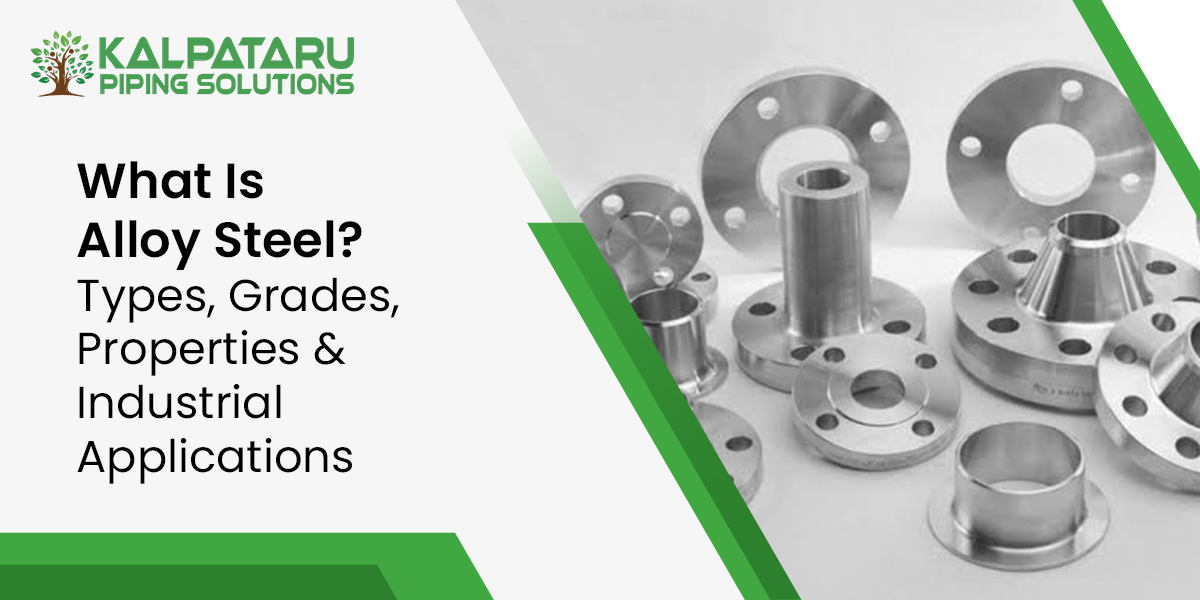
Quick answer: Alloy steel is iron-based steel engineered with selected alloying elements to improve strength, toughness, hardenability, wear resistance or performance at temperature. The right grade is chosen by service conditions, fabrication needs and the governing material standard – not by strength alone. |
Steel looks simple on a purchase order until the service conditions stop being simple. A shaft may need a hard, wear-resistant surface but a tough core. A high-temperature line may need to retain strength after years of thermal cycling. A pressure component may need predictable weldability, impact toughness and full traceability. This is where alloy steel becomes important.
For engineering teams, EPC contractors, fabricators and industrial buyers, alloy steel is not one material. It is a broad family of steels whose chemistry is deliberately adjusted to produce a specific balance of mechanical and fabrication properties. Kalpataru Piping Solutions supplies industrial metal products across categories such as steel tubes, steel flanges, pipe fittings and round bars for project requirements where material grade and specification matter as much as size.
What Is Alloy Steel?
Alloy steel is steel made primarily from iron and carbon with one or more additional elements introduced in controlled amounts to modify performance. Common alloying elements include chromium, molybdenum, nickel, manganese, silicon, vanadium and tungsten. Each changes the steel in a different way, and combinations are selected to meet a design objective.
The term should not be confused with a single grade. A chromium-molybdenum pressure pipe, a case-hardening gear steel and a quenched-and-tempered shaft steel can all be alloy steels, yet their chemistry, heat treatment and applications may be very different.
Why Are Alloying Elements Added to Steel?
Alloying element | Typical contribution to steel performance |
Chromium | Improves hardenability, wear resistance and oxidation/corrosion behaviour depending on content. |
Molybdenum | Supports high-temperature strength, hardenability and resistance to temper embrittlement. |
Nickel | Improves toughness, especially at lower temperatures, and can support corrosion resistance in suitable alloy systems. |
Manganese | Improves hardenability and strength and also plays an important role during steelmaking. |
Vanadium | Refines grain structure and forms hard carbides that can improve strength and wear resistance. |
Silicon | Used as a deoxidiser and can contribute to strength and oxidation resistance in selected grades. |
The important point is interaction. More alloying is not automatically better. A grade is useful because its chemistry, heat treatment and product specification work together to deliver predictable properties.
Main Types of Alloy Steel
1. Low-Alloy Steel
Low-alloy steels use relatively modest alloy additions to improve mechanical performance beyond plain carbon steel. They are widely used for pressure equipment, structural components, gears, shafts, heavy machinery and pipelines because they can offer a practical combination of strength, toughness, weldability and cost.
2. Chromium-Molybdenum Alloy Steel
Chromium-molybdenum, or Cr-Mo, steels are especially important where elevated-temperature strength and oxidation resistance are required. In piping and power applications, grades specified under standards such as ASTM A335 are used for high-temperature service. Grade selection must follow the design code because allowable stress changes with temperature and material condition.
3. Nickel Alloyed Steels
Nickel additions can improve toughness and help steels maintain performance at low temperatures. Nickel may also be combined with chromium and molybdenum in high-strength engineering grades such as 4340.
4. Case-Hardening Alloy Steels
Grades such as 8620 are designed so the surface can be hardened while the core remains comparatively tough. This makes them useful for gears, pins and wear components where a hard contact surface and shock-resistant core are both valuable.
5. High-Alloy and Stainless Steel Families
High-alloy steels contain larger proportions of alloying elements. Stainless steel is a distinct high-alloy family in which chromium creates the passive surface behaviour associated with corrosion resistance. For corrosion-focused piping systems, explore Kalpataru’s stainless steel flanges, stainless steel tubes and stainless steel pipe fittings.
Common Alloy Steel Grades and Where They Are Used
Grade / family | Typical characteristics | Common applications |
AISI 4130 | Chromium-molybdenum steel with good strength-to-weight potential and weldability in suitable conditions | Structural tubing, pressure components, automotive and aerospace parts |
AISI 4140 | Higher carbon than 4130; good hardenability, strength and wear resistance after heat treatment | Shafts, bolts, gears, tooling, machinery components |
AISI 4340 | Nickel-chromium-molybdenum steel known for high strength and toughness | Heavy-duty shafts, landing gear components, high-stress machinery |
AISI 8620 | Nickel-chromium-molybdenum case-hardening steel | Gears, camshafts, pins and components requiring a hard case with tough core |
ASTM A335 P11/P22 | Cr-Mo piping grades for elevated-temperature service | Power generation, refineries, petrochemical and process piping |
ASTM A335 P91 | High-strength creep-resistant alloy steel piping grade for high-temperature service | High-temperature power and process piping under code-controlled design |
These examples are useful for orientation, but procurement should always start with the exact product specification. A bar grade, forged flange grade and pipe grade may use related chemistry yet be controlled by different ASTM or ASME requirements. When the piping specification permits more than one manufacturing route, see Seamless Pipe vs Welded Pipe for the practical differences buyers should review.
Key Properties of Alloy Steel
- Higher hardenability: many alloy steels can develop strength deeper through a section during heat treatment than plain carbon steels.
- Strength and toughness: selected grades provide high tensile and yield strength while retaining useful impact resistance.
- Wear resistance: carbide-forming elements and heat treatment can improve resistance in gears, shafts and high-contact components.
- Elevated-temperature performance: Cr-Mo and other alloy systems can retain strength and resist creep better than ordinary carbon steel in suitable applications.
- Fatigue performance: clean steel, correct heat treatment and good surface condition can support long cyclic service life.
- Controlled machinability and weldability: both depend strongly on carbon equivalent, alloy content, section size and heat-treatment condition.
Alloy Steel vs Carbon Steel vs Stainless Steel
Factor | Carbon steel | Alloy steel | Stainless steel |
Primary objective | General strength, fabrication and cost efficiency | Tailored mechanical, heat or wear performance | Corrosion resistance with useful mechanical performance |
Typical alloying level | Relatively low | Varies from low-alloy to high-alloy | High chromium; may also contain nickel, molybdenum and other elements |
Heat treatment response | Grade dependent | Often a major design advantage | Depends on stainless family |
Corrosion resistance | Usually requires coating or allowance in corrosive environments | Varies widely by grade | Generally high due to chromium-rich passive film |
Common use | Structures, general piping, fabrication | High-stress machinery, pressure/high-temperature service, gears, shafts | Chemical, food, marine, pharmaceutical and corrosion-sensitive systems |
Material choice is therefore a trade-off. If corrosion is the dominant risk, stainless or corrosion-resistant nickel alloys may be the right direction. If high strength, hardenability or temperature performance is the priority, an alloy steel grade may be more economical and technically appropriate.
Industrial Applications of Alloy Steel
- Oil and gas: pressure-containing components, drilling equipment, high-strength fasteners and selected pipeline or process service.
- Power generation: high-temperature piping, boiler components and pressure-system parts made to code-controlled specifications.
- Petrochemical and refining: process piping and equipment exposed to pressure, temperature and cyclic operation.
- Automotive and heavy engineering: gears, axles, crankshafts, shafts and transmission components.
- Construction and infrastructure: high-strength structural and mechanical components where design specifications call for alloy steel.
- Mining and industrial machinery: wear parts, pins, rollers, shafts and high-load components.
How to Select Alloy Steel for an Industrial Project
- Start with the governing standard. Identify the ASTM, ASME, EN, DIN, API or client specification before comparing commercial grades.
- Define temperature and pressure. These values affect allowable stresses, heat-treatment requirements and whether creep or low-temperature toughness must be considered.
- Check corrosion exposure. Alloy steel is not automatically corrosion resistant. Coatings, corrosion allowance or a different alloy family may be needed.
- Review fabrication. Welding procedure, preheat, post-weld heat treatment, machining and forming can influence grade selection and total project cost.
- Specify the product form correctly. Pipe, tube, forging, flange, fitting, plate and bar standards are not interchangeable.
- Request traceability. Material test certificates, heat numbers, testing requirements and inspection documentation should match the purchase specification.
For projects that require multiple piping components, consolidating the material review across flanges, tubes and fittings helps reduce mismatches between grade, pressure class, dimensions and certification.
Why Material Certification Matters in International Procurement
For buyers sourcing across the Middle East, the UK, Africa, North America and other international markets, documentation is often as important as the physical product. Project packages may require EN 10204 3.1 certificates, PMI, hardness testing, impact testing, NDT or third-party inspection depending on the specification. The purchase order should state these requirements before production or dispatch, not after the material reaches site.
Final Takeaway
Alloy steel earns its place in demanding engineering because its properties can be tailored far beyond those of ordinary carbon steel. But that flexibility also makes specification discipline essential. Start with the operating conditions and governing code, then select the grade, heat treatment, product form and certification package as one system.
Kalpataru Piping Solutions supports industrial sourcing across steel tubes, flanges, pipe fittings and other engineered metal products. For project-specific material, size, standard and documentation requirements, contact the team for a quotation.
Frequently Asked Questions
Alloy steel is steel in which controlled amounts of elements such as chromium, molybdenum, nickel, manganese, silicon or vanadium are added to achieve properties beyond those of ordinary carbon steel, such as higher strength, hardenability, wear resistance or elevated-temperature performance.
Low-alloy steels contain relatively modest total alloy additions and are commonly selected for strength, toughness and hardenability. High-alloy steels contain larger alloy additions and are designed for more specialised behaviour. Stainless steel is a major high-alloy family defined by sufficient chromium to provide corrosion resistance.
Common engineering grades include 4130, 4140, 4340 and 8620, while pressure and high-temperature piping may use ASTM grades such as A335 P11, P22 or P91. The correct grade depends on the governing specification, product form, temperature, pressure and fabrication route.
Many alloy steels can achieve higher strength, hardness or hardenability than conventional carbon steels, especially after heat treatment. However, performance depends on the exact grade and condition, so material selection should be based on the design specification rather than the alloy label alone.
Start with the applicable ASTM, ASME, EN or project specification, then check design temperature, pressure, corrosion exposure, weldability, heat-treatment requirements, product form and required certification. Material traceability and test certificates should be confirmed before procurement.
Enquire Now
Related Blogs
What is Stainless Steel Valve?
What Is Monel Alloy? Composition, Properties & Uses (Guide)