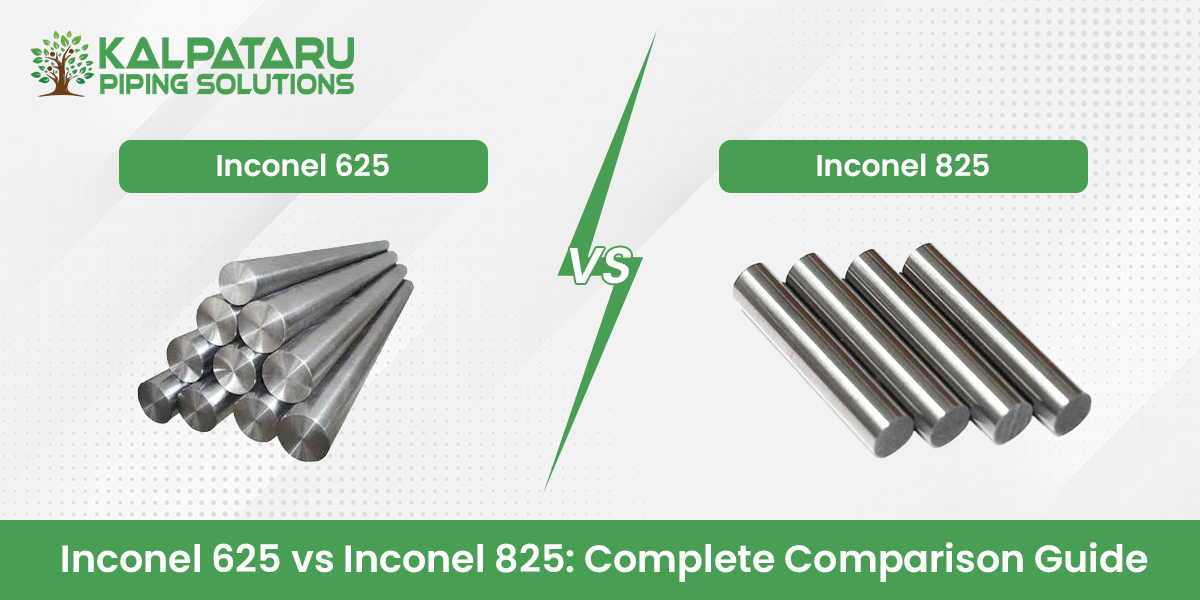
In working with different piping structure, there are chances that you come across alloys such as Inconel 625 and Incoloy 825, which can also be called Inconel 825. if you choose the wrong alloy it will cause a major project failure and also cost much more than the actual cost. Inconel 625 is nickel chromium molybdenum alloy that has around 58 percent of nickel. It has high strength, chloride pitting and stress corrosion cracking resistance and high temperature properties. Incoloy 825 is a nickel-iron-chromium alloy with approximately 38 – 46% Ni. It is resistant to sulfuric acid, phosphoric acid and general aqueous corrosion, suitable for many applications in chemical processing industry. The following sections provide a comparison of the chemical composition, mechanical properties, corrosion resistance, standards, welding, applications and cost of the various alloys, to assist you in selecting the appropriate alloy for your project. Kalpataru Piping Solutions offers supply and export of both alloys in pipes, tubes, flanges, plates and bars in a variety of grades and specifications.
What Is Inconel 625?
Inconel 625 (UNS N06625) is a nickel-based superalloy that contains chromium, molybdenum and is reinforced by niobium and molybdenum. High strength and toughness properties and very resistant to pitting, crevice and stress corrosion due to chlorides. Inconel 625 is able to work across a wide range of temperatures from cryogenic to about 982°C (1800°F). Its outstanding weldability, formability and high oxidation and reduction resistance properties allow using this alloy in marine, chemical processing, subsea and high pressure applications. KPS stocks Inconel 625 in seamless and welded tubes and flanges, along with plates, sheets, and round bars, ready for export.
What Is Incoloy 825 (Inconel 825)?
Incoloy 825 (UNS N08825) also referred as Alloy 825 is a nickel-iron-chromium alloy that contains molybdenum, copper and titanium. This alloy is designed to withstand severe service in sulfuric acid and phosphoric acid environments. It also provides high resistance to pitting corrosion, crevice corrosion, intergranular corrosion and stress corrosion cracking caused by chlorides. Weldability and titanium stabilization allow using Incoloy 825 in chemical processing, pollution control and aqueous corrosion applications. KPS supplies Incoloy 825 in tubes and pipes and flanges, as well as plates, sheets, and bars. For a deeper look at this alloy specifically, see our guide on what Incoloy 825 is.
Inconel 625 vs Incoloy 825: Chemical Composition Comparison
| Element (% by mass) | Inconel 625 (UNS N06625) | Incoloy 825 (UNS N08825) |
| Nickel (Ni) | 58.0 min | 38.0 – 46.0 |
| Chromium (Cr) | 20.0 – 23.0 | 19.5 – 23.5 |
| Iron (Fe) | 5.0 max | 22.0 min |
| Molybdenum (Mo) | 8.0 – 10.0 | 2.5 – 3.5 |
| Niobium (Nb) | 3.15 – 4.15 | — |
| Titanium (Ti) | 0.4 max | 0.6 – 1.2 |
| Copper (Cu) | 0.4 max | 1.5 – 3.0 |
| Aluminum (Al) | 0.4 max | 0.2 max |
| Manganese (Mn) | 0.5 max | 1.0 max |
| Silicon (Si) | 0.5 max | 0.5 max |
| Carbon (C) | 0.1 max | 0.05 max |
| Sulfur (S) | 0.015 max | 0.03 max |
Mechanical Properties Comparison Between Inconel 625 vs Inconel 825
Property | Inconel 625 | Incoloy 825 |
Density | 8.4 g/cm³ | 8.14 g/cm³ |
Melting Point | 1350°C (2460°F) | 1400°C (2550°F) |
Tensile Strength | 930 MPa (135,000 psi) | 550 MPa (80,000 psi) |
Yield Strength (0.2% offset) | 517 MPa (75,000 psi) | 220 MPa (32,000 psi) |
Elongation | 42.5% | 30% |
Corrosion Resistance of Inconel 625 vs Inconel 825
Corrosion Type | Inconel 625 | Incoloy 825 |
Pitting / Crevice Corrosion (Chlorides) | Excellent — among the best of all nickel alloys | Very good, but generally lower than 625 |
Chloride Stress-Corrosion Cracking | Excellent resistance, even in hot chloride brines | Good resistance |
Sulfuric Acid | Moderate | Excellent — a primary design purpose of this alloy |
Phosphoric Acid | Moderate | Excellent |
Oxidizing Acids (Nitric Acid) | Good | Good |
Seawater / Marine Immersion | Excellent | Very good |
Intergranular Corrosion (Post-Welding) | Excellent, no post-weld heat treatment required | Good — titanium-stabilized against sensitization |
Equivalent Grades & Governing Standards of Inconel 625 vs Inconel 825 (UNS, Werkstoff, EN, JIS)
Standard | Inconel 625 | Incoloy 825 |
UNS | N06625 | N08825 |
Werkstoff Nr. | 2.4856 | 2.4858 |
EN | NiCr22Mo9Nb | NiCr21Mo |
BS | NA 21 | NA 16 |
JIS | NCF 625 | NCF 825 |
Welding & Fabrication Differences
Both alloys can be welded using either of the conventional GMAW or GTAW methods, with the selection of the filler metal being based on the particular alloy to be welded: Inconel 625 is usually welded using ERNiCrMo-3 filler metal (AWS A5.14), whose composition is comparable with that of Inconel 625; Incoloy 825 is usually welded using ERNiFeCr-1 filler metal (AWS A5.14) for preserving the Ti stabilization and acid resistance of the alloy in the HZ. Though both alloys have corrosion resistance properties even after welding without heat treatment, controlling the interpass temperature during welding of Incoloy 825 is essential, while Inconel 625 does not require much of it.
Applications Uses of Inconel 625 vs Inconel 825
Inconel 625 Is Typically Used In:
- Subsea flexible risers, umbilicals, and control lines in offshore oil & gas
- Chemical processing equipment exposed to mixed acids and chlorides
- Aerospace ducting, exhaust systems, and combustor components
- Marine propulsion shafts and seawater piping
- Flue-gas desulfurization (FGD) components in power generation
- Nuclear fuel-element spacers and reactor components
Incoloy 825 Is Typically Used In:
- Sulfuric acid and phosphoric acid production and handling equipment
- Sour oil & gas tubing and downhole components (NACE MR0175-compliant service)
- Pickling equipment and vessels in metal-finishing plants
- Nuclear fuel reprocessing equipment
- Seawater cooling systems and heat exchangers
- Chemical processing piping where acid resistance outweighs raw strength requirements
How to Choose Between Inconel 625 and Incoloy 825
Choose Inconel 625 if:
- Your application involves high mechanical stress combined with corrosive service (e.g., subsea flexible pipe)
- You need maximum resistance to chloride pitting and stress-corrosion cracking
- Operating temperatures exceed what Incoloy 825 is rated for
- You need high fatigue strength or are welding without the option for post-weld treatment
Choose Incoloy 825 if:
- Your process involves sulfuric acid, phosphoric acid, or similar reducing acid environments
- You need a cost-effective alloy that still resists chlorides and general seawater corrosion
- You’re working in sour oil & gas service requiring NACE-compliant materials
- Mechanical strength requirements are moderate rather than extreme
If your application sits at the boundary of both use cases, it’s worth comparing against other high-performance alloys too see our comparison of. If your application sits at the boundary of both use cases, it’s also worth comparing against other high-performance alloys — see our guides on Inconel 625 vs Hastelloy C276 and Inconel vs Hastelloy for a broader view of your options.
Frequently Asked Questions
Yes. Incoloy 825, Inconel 825, and Alloy 825 all refer to the same material, UNS N08825. “Incoloy” is a trademarked name used for this family of iron-nickel-chromium alloys, but the terms are used interchangeably across the industry.
Inconel 625 is significantly stronger. It has a tensile strength of about 930 MPa versus 550 MPa for Incoloy 825, and more than double the yield strength (517 MPa versus 220 MPa).
Yes, dissimilar welds between the two alloys are possible and are done in industry, typically using ERNiCrMo-3 filler metal to match the stronger, more corrosion-resistant properties of the joint. Always follow a qualified welding procedure specification (WPS) for the specific application.
Both perform well in seawater, but Inconel 625 offers superior resistance to pitting and chloride stress-corrosion cracking, making it the preferred choice for the most demanding marine and subsea environments.
Generally, yes. Inconel 625 contains significantly more nickel, molybdenum, and niobium, all of which are more costly than the iron that partially replaces nickel in Incoloy 825’s composition.
Inconel 625 can be used from cryogenic temperatures up to approximately 982°C (1800°F). Incoloy 825 is generally limited to more moderate service temperatures and is selected primarily for its acid resistance rather than extreme-temperature strength.
Only in applications where the primary threat is acidic corrosion (such as sulfuric or phosphoric acid) rather than extreme mechanical stress, high temperature, or severe chloride pitting. For subsea, high-pressure, or high-temperature service, Inconel 625 should not be substituted with Incoloy 825 without a full engineering review.
Enquire Now
Related Blogs
What is Stainless Steel Valve?
What Is Monel Alloy? Composition, Properties & Uses (Guide)