A piping system can have the right pipe and still fail if the fittings are selected incorrectly. The wrong grade can accelerate corrosion. The wrong connection can create installation problems. Poor dimensional control can make alignment difficult and increase the risk of leakage.
This is why stainless steel pipe fittings must be selected according to the fluid, pressure, temperature, pipe size, connection method and applicable specification. Kalpataru Piping Solution supplies and exports stainless steel pipe fittings for industrial applications across a range of grades, sizes, and specifications. This guide explains the main types of SS pipe fittings, commonly used stainless steel pipe fitting grades, ASTM and ASME standards, and practical grade selection for industrial piping.
Understanding Stainless Steel Pipe Fittings
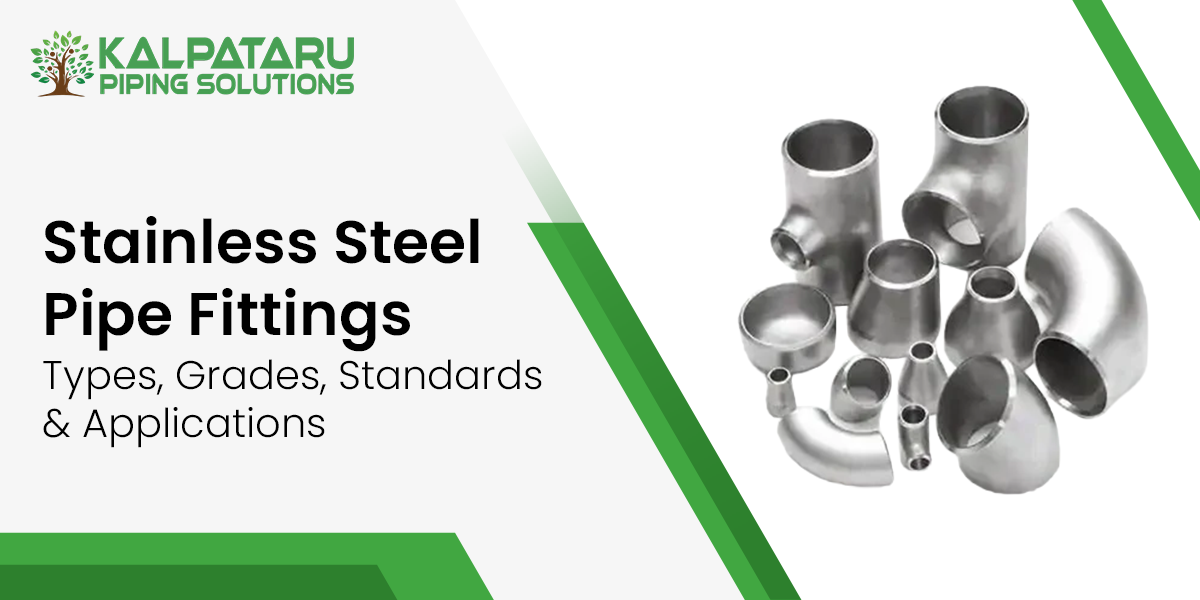
Stainless Steel Pipe Fittings are the items that connect, change the direction, decrease, or end stainless steel pipes. The most widely used fittings include elbows, tees, reducers, caps, crosses, and stub ends. Stainless steel contains the chemical element chromium which creates a passive oxide layer on the surface of a stainless steel fitting. Nickel and molybdenum can further improve the anti-corrosion performance of stainless steel materials.
For industrial purposes, requirements for the materials and sizes are separate. For instance, ASTM A403 pipe fittings covers the production of wrought austenitic stainless steel fittings, while ASME B16.9 stainless steel fittings specifies dimensions and tolerances for prefabricated wrought butt-welded fittings.
Types of Stainless Steel Pipe Fittings
The connection method affects installation, maintenance and service performance.
Fitting Type | How It Connects | Common Use |
Butt Weld SS fittings | Pipe and fitting ends are welded together | Process and high integrity piping |
Socket Weld stainless steel fittings | The pipe enters the fitting socket and is fillet welded | Small bore piping |
Threaded | Components are joined through threads | Utility and low to moderate size piping |
Forged | Manufactured from forged material | High-pressure small-bore service |
Compression | Mechanical ferrule connection | Instrumentation and small-bore tubing |
Butt Weld SS Fittings
Butt weld SS fittings are welded directly to the pipe. They provide a continuous welded connection and are widely used for process piping. Common forms include 45-degree and 90-degree elbows, tees, reducers, caps, crosses, stub ends, and pipe bends. ASME B16.9 stainless steel fittings are commonly used for factory-made wrought butt-welding fittings.
Socket Weld Stainless Steel Fittings
Socket-weld stainless steel fittings have a socket into which the pipe is inserted before fillet welding. They are commonly selected for small-bore piping where compact construction and a welded connection are required. ASME B16.11 covers forged socket welding and threaded fittings and includes pressure classes such as 3000, 6000 and 9000.
Threaded Stainless Steel Fittings
Threaded fittings connect through a screwed joint rather than welding. They are useful where welding is not required or where installation and maintenance conditions favour a threaded connection. Thread requirements must match the piping specification and applicable thread standard.
Forged SS Pipe Fittings
Forged SS pipe fittings are produced from forged material and are commonly used for smaller diameter, higher pressure applications. Typical products include couplings, unions, bushings, nipples and socket weld fittings. For a broader explanation of fitting configurations, link this section to Kalpataru’s existing pipe fittings guide.
Common Types by Function
Fitting | Main Function |
Elbow | Changes pipe direction |
Tee | Creates a branch connection |
Reducer | Changes pipe diameter |
Coupling | Joins two pipe sections |
Cross | Provides four pipe connections |
Cap | Closes the end of a pipe |
Stub End | Used with a lap joint flange |
Union | Allows easier disconnection |
Pipe Bend | Provides a larger radius direction change |
Stainless Steel Pipe Fittings Grades
The correct grade depends on corrosion exposure, temperature, welding requirements and mechanical demands.
Grade | UNS | Key Characteristic | Typical Selection |
S30400 | General corrosion resistance | Food, water and general process service | |
S30403 | Lower carbon | Welded piping | |
S31600 | Molybdenum improves resistance to localized corrosion | Chemical and marine service | |
S31603 | Low carbon 316 | Welded process piping | |
SS 317L | S31703 | Higher molybdenum than 316L | More aggressive chemical environments |
SS 310S | S31008 | High temperature oxidation resistance | High temperature service |
SS 321 | S32100 | Titanium stabilized | Elevated temperature applications |
SS 347H | S34709 | Stabilized grade with elevated temperature strength | High temperature service |
N08904 | Highly alloyed corrosion-resistant stainless steel | Severe chemical environments | |
Duplex 2205 | S31803 or S32205 | High strength with corrosion resistance | Oil and gas and chloride service |
S32750 | Very high corrosion resistance and strength | Seawater and severe chloride service | |
Super Duplex | S32760 | High strength and corrosion resistance | Severe marine and process service |
Kalpataru currently lists stainless steel pipe fittings in grades including 304, 304L, 304H, 316, 316L, 316H, 321, 321H, 310, 310S, 347 and 904L. Its wider piping range also covers duplex and super duplex materials.
SS 304 vs SS 316 Pipe Fittings
The main difference between SS 304 vs SS 316 pipe fittings is the addition of molybdenum in 316. This gives 316 better resistance to certain forms of localized corrosion, particularly in chloride-containing environments.
For general service, 304 can be a practical choice. For marine, chemical, and chloride-exposed systems, 316L or a higher alloy may be more appropriate depending on the actual service conditions.
What Does the L Mean?
The L in 304L and 316L indicates a low carbon version. The lower carbon content helps reduce the risk of sensitization during welding.
This does not mean that an L grade is lower quality. It is selected when welding and corrosion resistance around welded areas are important.
What Does the H Mean?
H grades such as 347H contain controlled higher carbon compared with the standard grade and are intended for elevated temperature applications where creep and stress rupture properties are important.
ASTM and ASME Standards for SS Pipe Fittings
A common procurement mistake is treating the material specification and dimensional standard as the same thing.
Standard | Main Purpose |
ASTM A403 | Wrought austenitic stainless steel fittings |
ASTM A182 | Forged or rolled stainless steel and alloy components |
ASTM A815 | Wrought ferritic, martensitic and duplex stainless steel fittings |
ASTM A774 | As welded austenitic stainless steel fittings for low pressure applications |
ASME B16.9 | Dimensions and tolerances for factory made wrought butt welding fittings |
ASME B16.11 | Forged socket weld and threaded fittings |
MSS SP 43 | Stainless steel butt welding fittings for selected lightweight applications |
MSS SP 79 | Reducer inserts |
MSS SP 83 | Unions |
EN 10253 | Butt welding fittings |
For example, an ASTM A403 pipe fitting may also be dimensionally manufactured to ASME B16.9. ASTM A403 identifies the material requirements while ASME B16.9 addresses the fitting dimensions and related requirements.
Kalpataru lists ASTM A403 and ASME B16.9 together on its stainless steel fitting product information, which reflects this distinction.
Stainless Steel Pipe Fittings for Different Industries
Grade selection should begin with the service environment rather than simply choosing the most expensive stainless steel.
Industry or Service | Common Starting Point |
Oil and Gas | 316L, duplex 2205 or super duplex where specified |
Chemical Processing | 316L, 317L or 904L depending on chemical exposure |
Marine | 316L for many applications, higher alloys for severe service |
Desalination | Duplex or super duplex for demanding chloride exposure |
Food Processing | 304L or 316L |
Pharmaceutical | 316L with specified surface and fabrication requirements |
Power Generation | 321, 347H or other specified high temperature grades |
Water Treatment | 304L, 316L or higher alloy grades according to water chemistry |
How to Choose the Right SS Pipe Fittings
A practical selection process starts with four questions.
First, what is the service?
Identify the fluid, concentration, temperature and corrosion environment.
Second, what grade is specified?
Select the material based on the project specification and actual service conditions. Do not substitute 316 for 304 or a duplex grade simply because it has a higher alloy content.
Third, what connection is required?
Choose between butt weld, socket weld, threaded or another connection according to pipe size, pressure, design and project requirements.
Fourth, what documentation is required?
Confirm the material test certificate, heat number, chemical composition, mechanical properties, heat treatment and inspection requirements before dispatch.
Checking MTCs for Stainless Steel Pipe Fittings
Before accepting the Stainless Steel Pipe Fittings, buyers should verify:
Check | What to Confirm |
Grade | Correct material designation |
Heat Number | Matches the product marking |
Chemistry | Meets the specified grade |
Mechanical Properties | Meets applicable requirements |
Dimensions | Match drawing and standard |
Heat Treatment | Meets the material specification |
Inspection | Meets project requirements |
Identification | Product marking remains traceable |
For critical projects, additional third-party inspection or testing may be specified.
Stainless Steel Pipe Fittings from Kalpataru
Kalpataru Piping Solutions supplies stainless steel pipe fittings in multiple grades and configurations for industrial piping requirements. Its product range includes butt weld elbows, tees, reducers, caps, crosses, stub ends and bends, with seamless and welded options listed across different sizes and schedules.
For a project enquiry, explore our stainless steel pipe fittings range or get in touch with our technical team to talk through your project’s grade and standard requirements. This allows the supplier to confirm the correct material and documentation rather than quoting only by fitting name.
Frequently Asked Questions
A good supplier should clearly state which documents are supplied, such as the MTC, chemical and mechanical test results, dimensional records and inspection reports where applicable.
Closing
Choose the right stainless steel pipe fittings based on grade, size, fitting type, connection and service conditions. Explore Kalpataru’s stainless steel pipe fittings and pipe fittings range for your industrial requirements.
Enquire Now
Related Blogs
What is Stainless Steel Valve?
What Is Monel Alloy? Composition, Properties & Uses (Guide)