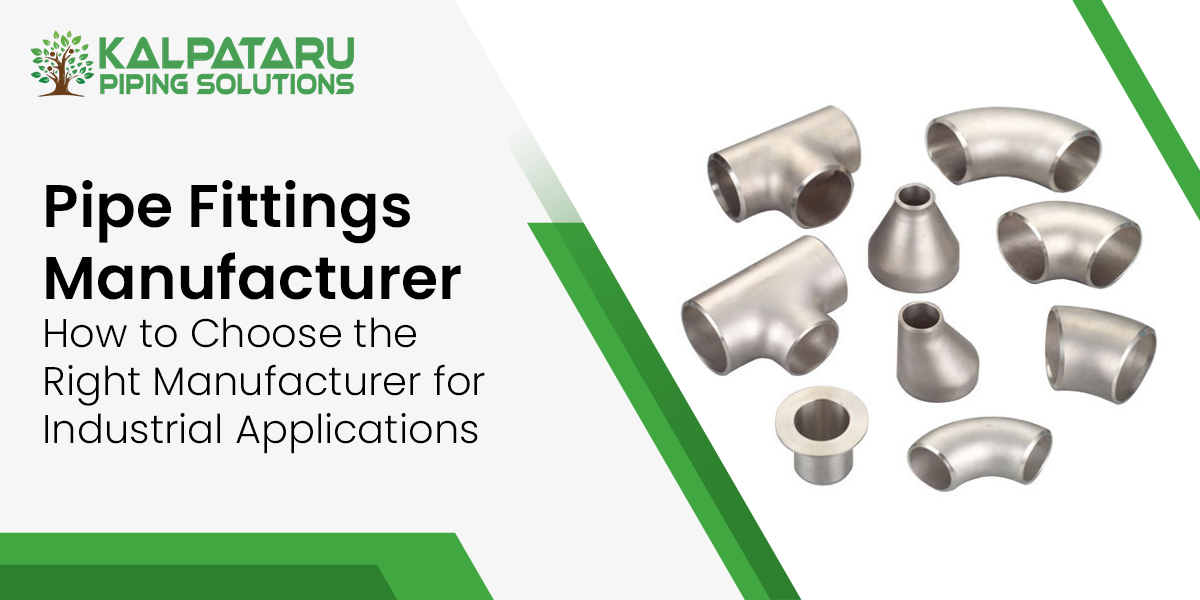
When it comes to getting a simple elbow in a commonly used size, choosing a pipe fittings manufacturer is simple. If the order has different material grades, several standards, inspection requirements, project documentation, and an export deadline, the choice of a manufacturer becomes significantly more complex. The material certificate may be unattached to the actual supplied heat. The date of supply may apply to an item that is not in stock yet. When all these issues are discovered, replacing the fittings may be considerably more expensive than the difference in price for the simple fittings.
Kalpataru Piping Solution supplies industrial pipe fittings in stainless steel, duplex, super duplex, nickel alloys, and other specialised materials, with support for project specifications, inspection requirements, and export documentation. In this guide, we will explain what a industrial pipe fittings supplier is in reality, how manufacturers differ from stockists and traders, what is important for manufacturers, and how to choose a pipe fittings manufacturer for demanding applications.
What Does an Industrial Pipe Fittings Supplier Actually Do?
A pipe fittings manufacturer uses the necessary raw materials to prepare the required fittings with the appropriate dimensions, materials, and inspection. Each product’s production may involve many processes, such as shaping, forging, heat treatment, machining, welding, and finishing. What is important for a buyer is not the fact that a supplier calls itself a manufacturer. It is crucial that the supplier proves that the delivered products are as per the specifications and that the materials can be traced accordingly.
The operations of a stockist or a distributor are different. They buy ready products from manufacturers and hold a stock for delivery to clients. This is particularly handy when a project needs several sizes and grades of products with a short delivery time. Good stockists should have documents from the originals and provide traceability of materials.
Supplier Type | Main Role | What Buyers Should Check |
Manufacturer | Produces the fittings | Manufacturing capability, quality system, testing and traceability |
Stockist or Distributor | Maintains inventory sourced from manufacturers | Original manufacturer certificates, stock traceability and availability |
Trader | Purchases and resells products | Source of material, documentation and traceability |
The key point is simple. A manufacturer is not automatically better than a stockist. For many industrial orders, a reliable stockist with genuine documentation, traceability, and access to the required grades can be the more practical choice.
Types of Industrial Pipe Fittings You May Need
Pipe Fitting Type | Common Standards | Typical Use |
Elbows | ASME B16.9, ASME B16.11 | Change the direction of piping, commonly at 45° or 90° |
Tees | ASME B16.9, ASME B16.11 | Create a branch connection from the main pipeline |
Reducers | ASME B16.9 | Connect pipes of different diameters while maintaining flow |
Couplings | ASME B16.11 | Join two pipes, particularly in smaller diameter piping systems |
Stub Ends | ASME B16.9 | Used with lap joint flanges for systems requiring frequent dismantling |
Caps | ASME B16.9, ASME B16.11 | Close or terminate the end of a pipe |
Crosses | Applicable ASME standards | Create multiple branch connections in piping systems. |
Pipe Bends | Project and application-specific | Provide gradual changes in pipeline direction, particularly in larger piping systems |
Eight Questions to Ask Before You Choose a Supplier
A reliable pipe fittings supplier should make it easy for a buyer to answer eight basic questions.
Ask what inspection and testing options are available for the Stainless Steel Pipe Fittings, including PMI, dimensional checks, radiography or third party inspection when required by the project.
Pipe Fittings Material Grade Range
| Material Group | Common Grades / UNS Grades | Typical Applications |
| Stainless Steel | 304, 304L, 304H, 316, 316L, 316H, 321, 347, 309S, 310S, 317L, 904L | Chemical processing, food processing, pharmaceutical, petrochemical and general corrosion service |
| Duplex Stainless Pipe Steel | S31803, S32205, F51 | Oil and gas, chemical processing, marine and chloride containing environments |
| Super Duplex Stainless Pipe Steel | S32750, S32760, F53, F55 | Offshore, desalination, seawater systems, oil and gas and highly corrosive environments |
| Carbon Steel | ASTM A234 WPB, WPHY 42, WPHY 46, WPHY 52, WPHY 60, WPHY 65, WPHY 70 | Oil and gas, pipelines, power plants and general industrial piping |
| Alloy Steel | F11, F22, F5, F9, F91, P11, P22, P5, P9, P91, P92 | High temperature piping, power generation, refineries and process plants |
Quality Certifications
Certification should support the buyer’s decision, not replace it. ISO 9001 confirms a quality management system, while projects may require PED, NACE or API compliance. Always verify the current certificate, including the company name, scope, certificate number, issuing body and validity date. A certification logo alone is not sufficient evidence.
Material and Product Standards
A good pipe fittings manufacturer should understand the difference between material standards and dimensional standards.
ASTM specifications commonly define material requirements such as chemical composition, mechanical properties and testing.
ASME standards commonly define dimensions, tolerances and other requirements applicable to fittings.
For example, ASTM A403 can apply to wrought stainless steel fittings while ASME B16.9 covers dimensions and tolerances for factory-made wrought butt weld fittings.
This means a purchase specification can legitimately contain both standards.
A buyer may request ASTM A403 WP316L fittings manufactured to ASME B16.9 dimensions and supplied with an EN 10204 3.1 inspection certificate.
These requirements are not competing standards. They address different parts of the product specification.
Inspection and Testing
The amount of inspection required depends on the service and purchase specification.
Dimensional inspection confirms that the fitting corresponds to the required dimensions and tolerances.
PMI, or Positive Material Identification, can be useful for stainless steel, duplex, super duplex and nickel alloy products where confirming the alloy family is important.
Other testing may include hydrostatic testing or radiographic examination where specified by the applicable standard or project.
For critical industrial orders, inspection requirements should be agreed before the order is placed.
Waiting until the material is ready for dispatch can create unnecessary delays if additional testing has not been planned.
MTC and Material Traceability
The Mill Test Certificate is one of the most important documents associated with an industrial fitting order.
An MTC can provide information such as chemical composition, mechanical properties, heat treatment information and the relevant heat number.
The heat number allows the buyer to connect the physical material with the documentation.
EN 10204 defines different types of inspection documents. A 3.1 certificate is issued with validation by the manufacturers authorised inspection representative. A 3.2 certificate includes additional validation involving an independent inspection representative or purchasers representative as applicable.
The requirement should be specified before purchasing.
A buyer should also check whether the heat number shown on the MTC corresponds with the marking on the physical fitting.
This simple check can prevent a surprisingly serious documentation problem. For buyers comparing material certificates and standards, our guide toASTM vs ASME standards for pipes, tubes and fittings explains how material specifications and dimensional or design standards work together
Technical Support
A supplier should be able to understand the technical information supplied with the enquiry.
This becomes important when the requirement involves unusual dimensions, a less common alloy, a particular end preparation or several standards in one specification.
A technically experienced supplier can identify inconsistencies before the order is processed.
For example, if a buyer requests a particular material grade but specifies a standard that does not cover the requested product form, that should be identified before the quotation is finalised.
Industry Experience
The same pipe fitting can behave very differently depending on where it is installed.
- Oil and gas systems can involve pressure, sour service and demanding traceability requirements.
- Chemical plants may expose fittings to acids, alkalis and mixed chemical streams.
- Marine installations can involve continuous exposure to seawater.
- Pharmaceutical systems may place greater emphasis on surface condition and cleanliness.
A supplier that understands the application is therefore more useful than one that simply supplies a catalogue product.
Lead Time and Export Support
Confirm stock status and lead time before placing an order. A reliable pipe fittings manufacturer or industrial pipe fittings supplier should clarify whether fittings are in stock, being sourced, or require production. For international orders, confirm Incoterms, Certificate of Origin, packing list, and required export documents. Timely delivery is essential to avoid project delays.
ASTM, ASME, DIN, JIS, and EN Standards for Pipe Fittings
Buyers may see several standards listed for the same fitting, but each serves a different purpose. Understanding them helps when selecting a reliable pipe fittings manufacturer or industrial pipe fittings supplier.
| Standard | Main Role | Pipe Fitting Example |
| ASTM | Material requirements | ASTM A403 stainless steel fittings |
| ASME | Dimensions and construction requirements | ASME B16.9 butt weld fittings |
| DIN | German standard system | Material and dimensional requirements |
| JIS | Japanese standard system | Material and dimensional requirements |
| EN | European standard system | EN 10253 fittings, EN 10204 inspection documents |
For example, a buyer may specify an ASTM A403 fitting with ASME B16.9 dimensions and require an EN 10204 3.1 MTC. A knowledgeable pipe fittings manufacturer must understand each requirement and provide matching documentation. This reduces specification errors during industrial procurement.
Warning Signs of a Poor Pipe Fittings Supplier
Choosing the lowest quotation is not always the safest approach when selecting a pipe fittings manufacturer or industrial pipe fittings supplier. Look for these warning signs before placing an order:
No MTC Available: A supplier that cannot provide a relevant MTC or explain material traceability requires further investigation.
Generic Documentation: Certificates should identify the applicable material and heat number rather than relying on generic documents.
Unusually Low Pricing: A significantly lower quotation may indicate differences in material, inspection, documentation or product sourcing.
No Testing Support: Projects requiring PMI, dimensional inspection or other testing should be handled by a supplier capable of arranging the required checks.
Unclear Delivery: Confirm whether fittings are physically in stock, being sourced or require manufacturing.
Poor Product Identification: Product markings should correspond with the applicable specification and documentation.
Avoids Technical Questions: A reliable pipe fittings stockist exporter should be willing to discuss grades, standards, inspection and documentation before confirming the order.
How to Check a Pipe Fittings Manufacturer Before Ordering
The following checklist can be used during supplier qualification.
| Check | What to Verify |
| Material grade | Confirm the exact grade, product form and applicable material specification |
| Product dimensions | Confirm size, wall thickness, schedule and fitting configuration |
| Applicable standard | Check material and dimensional standards separately |
| MTC | Confirm the required inspection certificate |
| Traceability | Match heat number and product identification |
| Quality certification | Check certificate scope and validity |
| PMI | Confirm whether positive material identification is required |
| Inspection | Establish dimensional and other testing requirements |
| Delivery | Confirm actual availability and expected dispatch |
| Export documents | Confirm Certificate of Origin, packing list and other requirements |
| Commercial terms | Confirm price basis and Incoterms |
| Project experience | Check experience with the relevant industry |
Pipe Fittings Used Across Major Industrial Industries
- Oil and Gas: In the oil and gas industry, it is imperative to partner with a reliable supplier of industrial pipe fittings, as these facilities face challenging environmental conditions in terms of pressure, temperature, and corrosion. As such, the use of stainless steel, duplex, and super duplex and nickel alloy fittings is standard according to specifications.
- Petrochemical: Petrochemical facilities work with hydrocarbons and harmful chemical materials, which require right material choices to be done in order to meet the operational requirements. For this purpose, the experience of a pipe fittings manufacturer should be utilized to procure the required fittings that comply with the standards of materials.
- Power Generation: Power generation relies on steam, cooling water, and process pipes, whose fittings must be capable of withstanding high temperature and pressure.
- Pharmaceutical and Biotechnology: Stainless steel fittings are commonly used where corrosion resistance, cleanliness, and suitable surface condition are important.
- Marine and Offshore: Duplex and super duplex fittings, along with copper nickel and selected nickel alloys, can be considered for seawater and chloride exposure.
- Desalination: Desalination systems require corrosion resistant fittings selected according to water chemistry, pressure and temperature. Buyers should work with a duplex pipe fittings supplier when duplex grades are specified for demanding seawater service.
Pipe Fittings Available From Kalpataru Piping Solution
Kalpataru Piping Solution supplies industrial pipe fittings across stainless steel, duplex, super duplex, nickel alloys, Inconel, Monel, Hastelloy, and other specialised materials. Product-specific pages, with material grades, fitting types and specifications, are linked below:
- Stainless Steel Pipe Fittings in grades such as 304, 304L, 316, 316L, 316Ti, 317L, 321, 347H and 904L
- Duplex Steel Pipe Fittings in grades including S31803 and S32205
- Super Duplex Steel Pipe Fittings in grades S32750 and S32760
- Nickel Alloy Pipe Fittings in grades such as Nickel 200 and Nickel 201
- Inconel Pipe Fittings including Inconel 600, 601 and 625
- Incoloy Pipe Fittings including Incoloy 800 and 825
- Monel Pipe Fittings including Monel 400 and K500
- Hastelloy Pipe Fittings including Hastelloy C22 and C276
- Copper Nickel Pipe Fittings for marine, seawater and desalination applications
- Alloy 20 Pipe Fittings for chemical processing and corrosion resistant applications
Frequently Asked Questions
A manufacturer produces the fittings, while a stockist maintains inventory sourced from manufacturers. A stockist can be a practical choice when buyers need several sizes and grades quickly. The important checks are the source of the material, documentation, traceability and ability to meet the project specification.
Closing
Choosing the right pipe fittings manufacturer means checking material grades, standards, MTCs, traceability, inspection, technical support and delivery capability. Kalpataru Piping Solution supplies industrial pipe fittings for diverse project and application requirements.
Enquire Now
Related Blogs
What is Stainless Steel Valve?
What Is Monel Alloy? Composition, Properties & Uses (Guide)