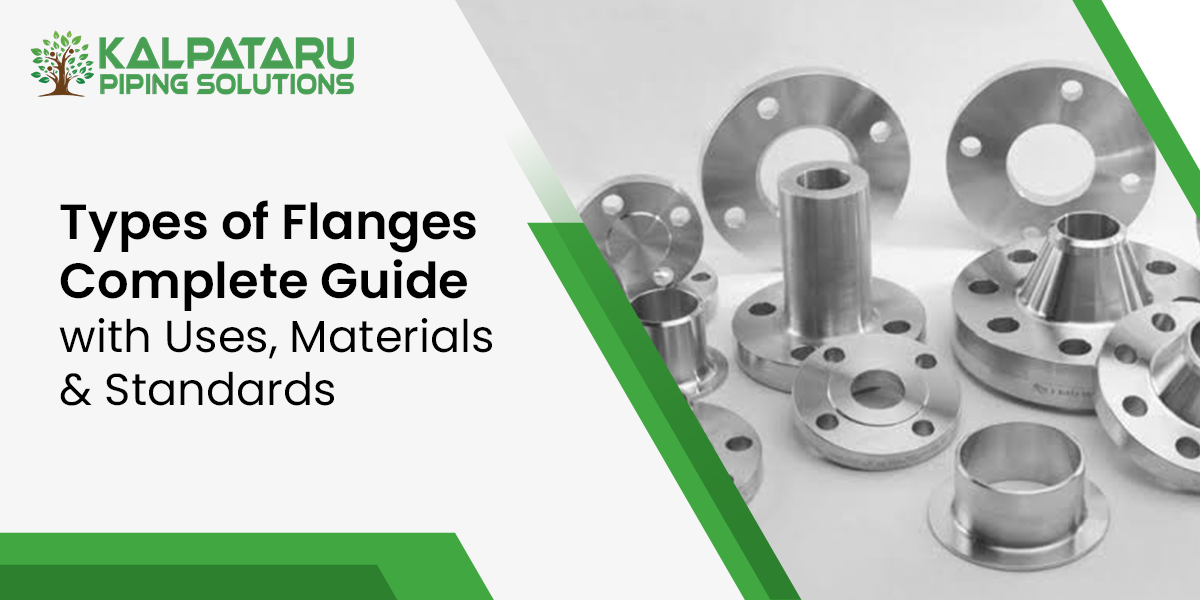
Quick answer: The six flange types most buyers encounter are weld neck, slip-on, blind, socket weld, threaded and lap joint. Selection depends on pressure class, temperature, pipe size, material, corrosion risk, maintenance needs and the governing standard. |
A flange is a mechanical connection point, but choosing one is not a cosmetic decision. The flange body, facing, pressure class, material and joining method all affect whether a piping joint can be assembled, sealed, inspected and maintained safely throughout its service life.
For procurement teams, EPC contractors and maintenance engineers, a useful flange specification starts with function. Do you need a permanent welded connection, easy equipment removal, end-of-line isolation, a small-bore high-pressure joint or a connection where welding is impractical? This guide breaks down the major flange types and connects them to real industrial use cases.
Kalpataru Piping Solutions supplies a broad range of steel flanges across stainless steel, duplex, super duplex, Monel, Inconel, nickel and copper-nickel material families for international industrial projects.
What Is a Pipe Flange?
A pipe flange is a rim or forged connection component used to join pipe to pipe, valves, pumps, vessels, heat exchangers and other equipment. Two flanges are typically bolted together with a gasket or sealing ring between their faces. Because the joint can be unbolted, flanges are valuable wherever equipment must be inspected, replaced or isolated.
ASME B16.5 is a key standard for flanges and flanged fittings from NPS 1/2 through NPS 24. It covers pressure-temperature ratings, materials, dimensions, tolerances, marking and testing. For larger steel flanges, ASME B16.47 covers NPS 26 through NPS 60.
Main Types of Flanges and Their Uses
1. Weld Neck Flange
A weld neck flange has a long tapered hub that is butt-welded to the pipe. The hub provides a gradual transition from flange thickness to pipe wall, which helps distribute stress. This is why weld neck flanges are widely used in high-pressure, high-temperature and cyclic services.
- Best suited to critical process piping and severe service.
- Requires a full-penetration butt weld and appropriate welding procedure.
- Bore should be matched correctly to the pipe schedule to avoid internal discontinuity.
2. Slip-On Flange
A slip-on flange slides over the pipe and is normally fillet-welded at the hub and pipe end. It is easier to align than a weld neck flange and is widely used in lower- to moderate-pressure services where project specifications permit it.
- Fast alignment during fabrication.
- Common in utility, water and general process lines.
- Not normally the first choice for severe cyclic service when a weld neck design is specified.
3. Blind Flange
A blind flange has no bore. It closes the end of a piping system, nozzle or valve connection and can be removed later for inspection, extension or maintenance. Because pressure acts across the full face, blind flanges can see significant bending loads and must be selected by the applicable pressure-temperature rating.
4. Socket Weld Flange
Socket weld flanges contain a recessed socket into which the pipe is inserted before fillet welding. They are commonly associated with smaller-bore, higher-pressure piping. Correct installation includes the specified expansion gap before welding to avoid excessive stress at the socket shoulder.
5. Threaded Flange
Threaded flanges connect to externally threaded pipe without welding. They can be useful where hot work is restricted or for selected low-pressure services. Thread form, sealing method, material and service limitations must match the project specification; threaded connections are not appropriate for every fluid, vibration level or temperature.
6. Lap Joint Flange
A lap joint assembly uses a backing flange with a stub end. The backing flange is free to rotate, which simplifies bolt-hole alignment. It can be attractive in corrosion-resistant systems because the wetted stub end can be made from the expensive alloy while the backing flange may use a more economical material when permitted by design.
7. Long Weld Neck and Special Flange Designs
Long weld neck flanges extend the hub and are often used as vessel or equipment nozzles. Spectacle blinds, spacer and spade arrangements are used where positive line isolation must be visually confirmed. Orifice flanges include pressure taps for flow measurement systems. These specialised types should be selected as part of the complete piping or equipment design rather than as standalone catalogue items.
Flange type | Connection method | Typical strength / advantage | Common use |
Weld neck | Butt weld | Excellent stress transfer and fatigue performance | High pressure, high temperature, cyclic service |
Slip-on | Fillet weld | Easy alignment and economical fabrication | General process and utility piping |
Blind | Bolted closure | Positive removable end closure | Isolation, maintenance, future extension |
Socket weld | Socket + fillet weld | Compact connection for small bore | Small-bore high-pressure systems |
Threaded | Screwed connection | No welding required | Selected low-pressure or restricted hot-work areas |
Lap joint | Stub end + rotating backing flange | Easy alignment; material economy possible | Corrosive service and systems requiring frequent dismantling |
Flange Faces: RF vs FF vs RTJ
Flange type describes the connection geometry. Flange face describes the sealing surface. The two must be specified together.
Facing | Meaning | Typical use |
RF | Raised Face | Common process piping; gasket sits on raised sealing area |
FF | Flat Face | Used where full-face contact is required, often with certain cast-iron or non-metallic mating components |
RTJ | Ring-Type Joint | Metal ring gasket in machined grooves for demanding pressure/temperature service |
For a deeper comparison of sealing faces and pressure-temperature considerations, read Raised Face vs Ring-Type Joint Flanges.
Flange Pressure Classes and Standards
ASME flange classes such as 150, 300, 600, 900, 1500 and 2500 are rating designations, not direct pressure values in psi. The allowable pressure depends on material group and temperature. A Class 300 flange does not simply mean 300 psi at every temperature.
- ASME B16.5: pipe flanges and flanged fittings NPS 1/2 to NPS 24.
- ASME B16.47: large-diameter steel flanges NPS 26 to NPS 60.
- ASME B16.36: orifice flanges used with differential-pressure flow measurement.
- EN 1092-1: commonly specified European standard for circular steel flanges with PN designations.
- API and project specifications: may apply to pipeline, oilfield or equipment-specific service.
Common Flange Materials
The flange material must be compatible with the piping system and design code. Material selection is influenced by corrosion, temperature, pressure, weldability, toughness and media composition.
- Stainless steel flanges – widely used where corrosion resistance and cleanliness are important.
- Duplex steel flanges – combine high strength with strong chloride stress-corrosion resistance for suitable services.
- Super duplex steel flanges – selected for more aggressive chloride and offshore conditions.
- Inconel flanges – nickel-chromium alloy flanges for demanding temperature and corrosion environments.
- Monel flanges – nickel-copper alloy family suited to selected marine and chemical services.
- Copper-nickel flanges – widely associated with seawater, marine and heat-exchanger systems.
Kalpataru also publishes focused material guides, including types of stainless steel flanges and types of Monel flanges for buyers who already know the required alloy family.
How to Select the Right Flange Type
- Confirm the piping code and flange standard. Do not mix dimensional standards without a documented engineering review.
- Check design pressure and temperature. Select the pressure class using the correct material rating table.
- Match the pipe size and schedule. Bore dimensions, welding end preparation and internal alignment matter, especially for weld neck flanges.
- Choose the material for the actual environment. Consider corrosion, chlorides, acids, sour service, seawater and temperature exposure.
- Specify the facing and gasket system. RF, FF and RTJ joints use different sealing arrangements and surface requirements.
- Consider maintenance. Blind and lap-joint arrangements may improve isolation or dismantling, while permanent welded joints prioritise integrity.
- Define inspection and documentation. PMI, NDT, MTCs and third-party inspection should be stated in the purchase specification when required.
Typical Industry Applications
- Oil and gas production, terminals and refineries
- Petrochemical and chemical processing plants
- Power generation and high-temperature steam systems
- Water treatment and desalination
- Marine, shipbuilding and offshore facilities
- Food, pharmaceutical and hygienic processing where suitable stainless grades are specified
- Mining, fertiliser, pulp and paper, and general industrial utilities
Final Takeaway
The best flange is not simply the strongest or most expensive option. It is the flange type that matches the system’s pressure, temperature, material, joining method, inspection needs and maintenance philosophy. Start with the governing standard, then define type, class, facing, material and dimensions in that order.
Explore Kalpataru Piping Solutions’ complete steel flange range or contact the team with your size, class, material grade, facing, standard and certification requirements for a project-specific quotation.
Frequently Asked Questions
The most common pipe flange types are weld neck, slip-on, blind, socket weld, threaded and lap joint flanges. Long weld neck, spectacle blind and other specialised designs are used for particular equipment, isolation or piping requirements.
Weld neck flanges are commonly selected for demanding pressure, temperature and cyclic service because the tapered hub provides a gradual transition of stress into the pipe. Final selection must follow the piping code, pressure class, material and project specification.
RF means raised face, FF means flat face and RTJ means ring-type joint. Raised face is common in many process systems, flat face is used where the mating equipment or flange design requires it, and RTJ uses a metal ring gasket for high-pressure or high-temperature sealing applications.
ASME B16.5 covers pipe flanges and flanged fittings from NPS 1/2 through NPS 24, including pressure-temperature ratings, materials, dimensions, tolerances, marking and testing. ASME B16.47 covers large-diameter steel flanges from NPS 26 through NPS 60.
Match the flange material to the connected piping material, design temperature, pressure, corrosion environment, welding requirements and governing material specification. Common families include carbon steel, stainless steel, duplex, super duplex, nickel alloys, Monel, Inconel and copper-nickel.
Enquire Now
Related Blogs
What is Stainless Steel Valve?
What Is Monel Alloy? Composition, Properties & Uses (Guide)