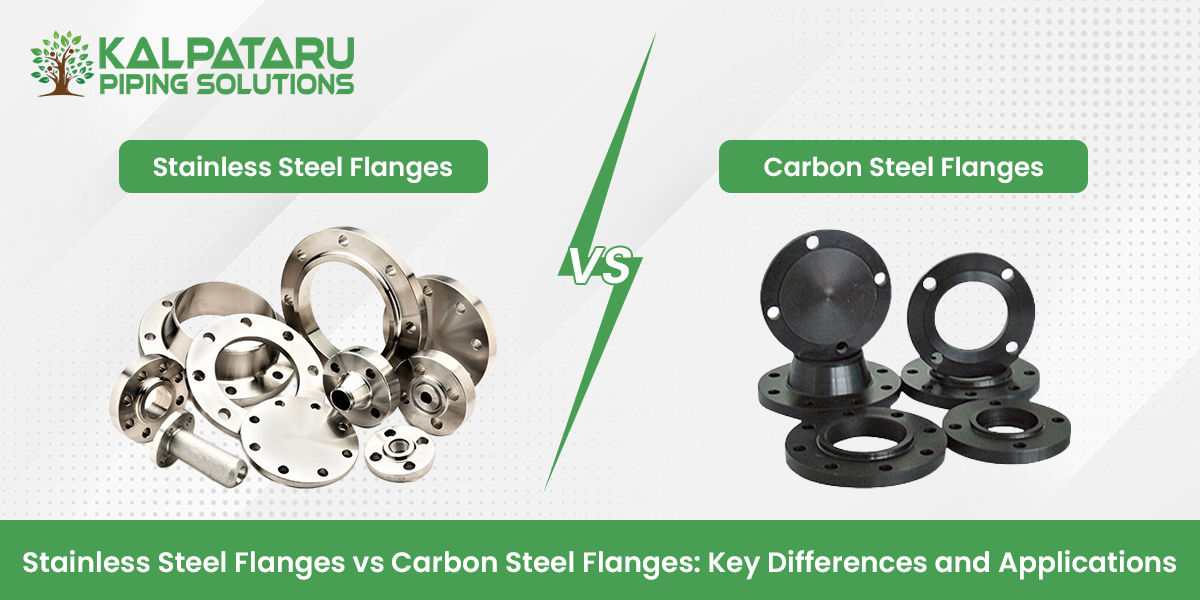
While a flange appears to be a minor component of a piping network in theory, it significantly affects the durability of the entire system in practice. The inappropriate choice of material does not manifest itself immediately, with delays occurring until the problem shows up in the form of a leak, corrosion of the bolts, or unexpected downtime of the equipment that brings about losses exceeding those caused by the flange itself. There are two materials that appear repeatedly during this choice: stainless steel flanges and carbon steel flanges, with the selection depending on the type of fluid, environment, temperature, and maintenance policy of the facility.
Kalpataru Piping Solution supplies stainless steel flanges made of F304, F304L, F316, and F316L grades for industrial projects, along with a wide range of pipes, tubes, and fittings of different build specifications. In this guide, the differences between stainless steel flanges vs carbon steel flanges are analyzed from the points of view of composition, corrosion resistance, strength, temperature resistance, price, and application in practice.
Stainless Steel Flanges Explained
Stainless steel flanges are made from key components that are bolted into a pipe system in order to allow pipes, valves, or machines to be connected while still enabling the disassembly of the joint when necessary. The composition of stainless steel depends on the presence of chromium. At about 10.5 percent of chromium, the surface forms a passive oxide layer that prevents oxidation and corrosion of the material. All stainless steel flanges used in industry belong to the 300 series of austenitic classes, predominantly the ASTM A182 grades F304, F304L, F316, and F316L.
Understanding Carbon Steel Flanges
Carbon steel flanges are manufactured using an iron-carbon alloy that usually contains a carbon content which ranges from 0.05 to 0.35 percent, together with silicon and manganese. There is no chromium present which could act as a protective agent, thus carbon steel does not come with any natural corrosion resistance. However, it provides the strength with lower material costs. ASTM A105 defines the general specifications related to the carbon steel forged flanges, while the low-temperature service is governed by A350 LF2, and A694 is for high-yield-strength series used in pipeline applications.
Material Composition Comparison
Property | Stainless Steel Flanges | Carbon Steel Flanges |
Common specifications | ASTM A182 F304, F304L, F316, F316L | ASTM A105, A350 LF2, A694 grades |
Base material | Iron with significant chromium; nickel is also present in common austenitic grades | Iron with carbon as a principal alloying element |
Chromium | At least approximately 10.5% in stainless steel | Usually much lower and not sufficient to classify the material as stainless steel |
Molybdenum | Present in F316 and F316L | Not normally a defining alloy addition in A105 |
Corrosion resistance | Inherent passive corrosion resistance | Requires suitable coating, protection, or controlled service conditions |
Magnetic behaviour | Austenitic 304 and 316 are generally nonmagnetic when annealed, although cold working can increase magnetism | Generally magnetic |
Common applications | Chemical, food, pharmaceutical, marine, water and corrosive process systems | General process piping, utilities, high pressure transmission and non corrosive service |
For more information about flange materials, dimensions, pressure classes, and facing types, see our broader guide to flange types, materials and standards.
Corrosion Resistance
Stainless steel flanges can prevent rust, pitting, and crevice corrosion because the layer of chromium oxide constantly regenerates every time when something damages the surface layer of the metal. For this reason, stainless steel is widely used in the marine, chemical, and food processing industries, as even the slightest damage to the surface may lead to contamination or failure. Carbon steel undergoes the process of corrosion when encountering moisture and aggressive chemicals, which makes it require galvanization and painting to prolong its service life. Coated carbon steel is a good compromise if some protection of the material is needed but not in the full volume that a stainless steel cost would imply.
Temperature and Service Comparison
Parameter | Stainless Steel F304 or F316 | Carbon Steel A105 |
Typical service temperature range | Roughly negative 196 degrees Celsius up to 800 degrees Celsius or higher, depending on grade | Roughly negative 29 degrees Celsius up to 425 degrees Celsius for standard A105, with A350 LF2 rated for lower temperature service |
Governing pressure temperature standard | ASME B16.5, typically Group 2.1, 2.2, or 2.3 depending on grade | ASME B16.5, typically Group 1.1 |
Best suited for | Cryogenic service, elevated temperature service, corrosive environments | Ambient to moderate temperature, high pressure, non corrosive service |
Do not select a flange from a temperature range alone. The applicable ASME B16.5 pressure class, material group, design temperature, design pressure, flange facing, and material specification should be checked against the project engineering data sheet.
Our RF vs RTJ flange guide explains how flange facing and gasket selection affect sealing in higher pressure applications.
Cost and Maintenance
Carbon steel flanges are appealing due to their lower initial costs, but the true cost of carbon steel becomes clear only after installation. When in a corrosive environment, carbon steel flanges will need recoating and constant checking and therapy before a stainless steel flange would require anything done to it. Once the labor and downtime which are needed to replace the flange after ten to fifteen years are accounted for, the price of carbon steel versus stainless steel flanges starts to become equal and sometimes even disappear altogether after an unplanned stoppage. Although stainless steel flanges are very expensive at the time of purchase, the cost pays off because they have almost zero upkeep and can serve as long as the project lasts. The ideal comparison is the whole cost of ownership instead of the sticker price.
For demanding chemical environments where 316L may not provide enough resistance, higher alloy stainless grades such as 904L stainless steel flanges may also be considered when justified by the process conditions.
SS and CS Flanges Applications by Industry
Industry | Typical Flange Material | Why It Is Selected |
Oil and gas | Carbon steel or stainless steel depending on service | Carbon steel suits many non corrosive services, while stainless grades are selected for corrosive fluids and specific process conditions |
Chemical and petrochemical | F316 or F316L, with other alloys where required | Improved corrosion resistance for many chemical and chloride containing services |
Power generation | Carbon steel, alloy steel or stainless steel depending on system | Material is selected according to temperature, pressure, steam conditions and corrosion requirements |
Food and beverage | F304 or F316 | Corrosion resistance, cleanability and hygienic service requirements |
Pharmaceutical | F316L and other specified stainless grades | Corrosion resistance and hygienic process requirements |
Marine and offshore | F316L, duplex or super duplex where required | Better resistance to chloride rich environments than standard carbon steel |
Water treatment | Stainless steel or coated carbon steel depending on water chemistry | Material selection depends on chloride level, water chemistry and exposure |
General construction and utilities | Carbon steel | Economical choice where service conditions are controlled and corrosion protection is adequate |
For severe chloride exposure, duplex and super duplex materials and copper nickel flanges and fittings may be considered instead of conventional austenitic stainless steel when the project specification requires their higher strength and corrosion resistance. See our guide to copper nickel pipe fittings.
How to Choose the Right Flange Material
- Choose stainless steel flanges when corrosion resistance, hygiene, temperature resistance, or long service life is important, when the fluid is corrosive or chloride bearing, or when the application is food grade, pharmaceutical, or otherwise hygiene critical.
- Choose carbon steel flanges when the environment is controlled and non corrosive, when cost is a priority, when high mechanical strength at moderate temperature is required, or when the flange will be protected by a coating or sits in a dry, controlled setting.
- Always check the pressure class, material grade, service conditions, and project specification before ordering rather than relying on flange type alone.
For more guidance, see our types of stainless steel flanges guide and our quality checklist for genuine stainless steel flanges.
Frequently Asked Questions
Closing
Stainless steel flanges and carbon steel flanges both have a legitimate place in industrial piping, and neither one is the automatic right answer for every project. What matters is matching the material, grade, and pressure class to the actual conditions the system will face. If you are weighing your options or need help specifying the right grade for a specific application, get in touch with our team or explore our full product range to see what fits your project.
Enquire Now
Related Blogs
What is Stainless Steel Valve?
What Is Monel Alloy? Composition, Properties & Uses (Guide)