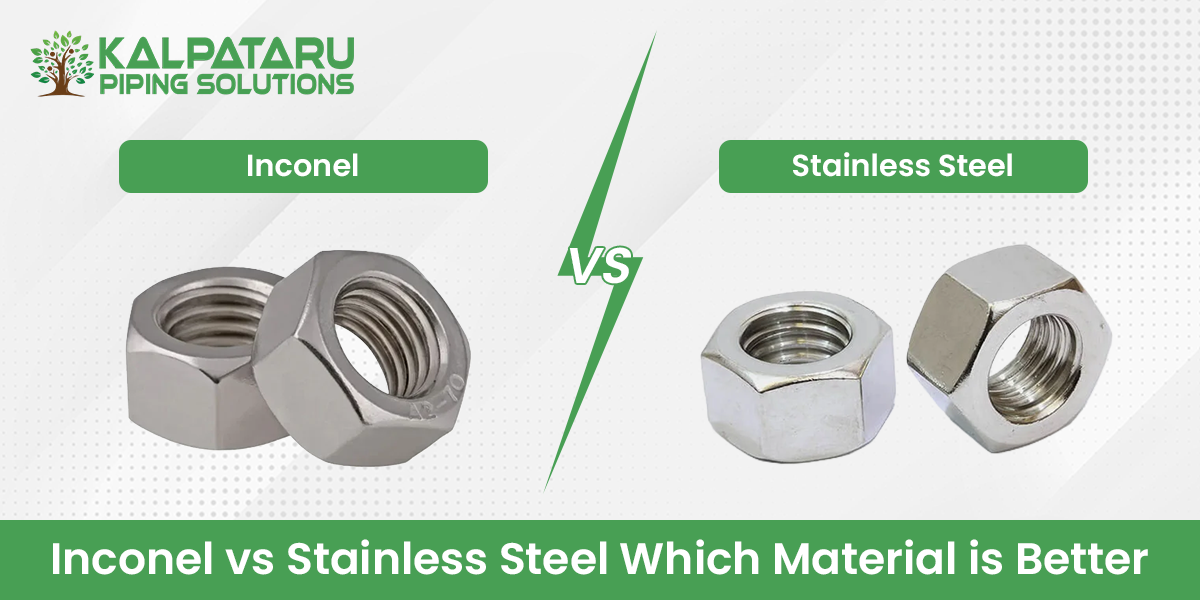
To choose between the inconel and stainless steel mostly depends on the needs and the different types of properties such as heat, pressure, or chemical reactions must be endured by the component? Inconel is a nickel-based alloy, while stainless steel is an iron-based alloy with minimum content of chromium equal to 10.5%. Inconel has excellent properties compared to stainless steel in extreme temperatures and in the most extreme environment corrosive, but is also much more expensive, to a meaningful level. Inconel is a nickel-based superalloy; on the other hand, stainless steel is the alloy which is made up of iron with at least 10.5% chromium content. It performs better than stainless steel at very extreme temperatures and the most corrosive environment, at a significant price premium. The remainder of this guide follows up on the “it depends” with a property-by-property comparison, a detailed comparison of Inconel 625 properties vs 316/316L stainless steel, and numeric thresholds of when each material is the right choice.
What Is Inconel?
Inconel material is the most used alloy in different industries. This is made up of nickel and chromium-based superalloys containing 58% or more nickel, along with other materials like chromium, molybdenum, niobium, and many more, depending upon the type of alloy. That particular composition is what makes Inconel have properties of maintaining its strength and also being resistant to oxidation at high temperatures where other metals lose their strength and form an oxide layer. For more information about the chemical structure, types of alloys (600, 601, 625, 718) and applications of Inconel, visit our special guide on Inconel Material: Properties, Grades, Composition & Applications.
What Is Stainless Steel?
Stainless Steel refers to the alloy composed of iron with at least 10.5% chromium, which acts as a corrosion resistant against corrosive substances. Other materials like nickel, molybdenum, carbon, and nitrogen are also added to improve their mechanical properties including strength, toughness, weldability, or resistance to certain forms of corrosion. Stainless steels can be categorized into four main categories, which include: austenitic, ferritic, martensitic, and duplex. Common grades of stainless steel include 304, 316, 430, 410, 420, 2205, and 2507. If your project is leaning toward a duplex or super duplex grade instead of standard austenitic stainless, our Super Duplex Steel: Composition, Properties & Applications guide covers that comparison in more depth.
Inconel vs Stainless Steel Comparisons
Property | Inconel | Stainless Steel |
Base element | Nickel (58%+ in most grades) | Iron, with 10.5%+ chromium |
Typical alloying elements | Cr, Mo, Fe, Nb, Ti, Al | Cr, Ni (0–35%), Mo |
Tensile strength (UTS) | ~900–1,400 MPa (grade-dependent) | ~485–1,300 MPa (grade-dependent) |
Max continuous service temp | Up to ~1,150–1,200°C (grade-dependent) | Up to ~870°C for grade 310; most grades weaken above ~600°C |
Corrosion resistance | Exceptional — chlorides, seawater, strong acids, sulfur environments | Good — mild acids and moisture; weaker against chlorides and high-heat oxidation |
Cryogenic performance | Retains ductility down to about −196°C | Varies by grade; austenitic grades generally perform well, others become brittle |
Machinability | Difficult — rapid work-hardening, requires carbide tooling and slow speeds | Easier — standard tooling, faster production rates |
Weldability | Weldable but needs matched filler and controlled heat input (e.g., ERNiCrMo-3 for 625) | Readily weldable with standard TIG/MIG processes |
Density | ~8.4–8.6 g/cm³ | ~7.7–8.0 g/cm³ |
Magnetic behavior | Generally non-magnetic (austenitic-type structure) | Austenitic grades non-magnetic; ferritic/martensitic grades magnetic |
Relative cost | High | Low to moderate |
Inconel 625 vs 316 / 316L Stainless Steel — Grade-Specific Comparison
Attribute | Inconel 625 | SS 316 / 316L |
UNS No. | N06625 | S31600 / S31603 |
Base composition | Ni 58% min, Cr 20–23%, Mo 8–10%, Nb+Ta 3.15–4.15% | Fe balance, Cr 16–18%, Ni 10–14%, Mo 2–3% |
Tensile strength | ~827–1,103 MPa (as-rolled/annealed, condition-dependent) | ~485–621 MPa (annealed) |
Max service temperature | Up to ~980°C (continuous service; strength-retention figures vary by source) | Loses significant strength above ~600°C |
Corrosion resistance | Superior — chlorides, seawater, sour gas, strong acids | Good — chlorides and marine environments, aided by molybdenum |
Relevant standards | ASTM B444/B446 (pipe), ASTM B443 (plate) | ASTM A312 (pipe), EN 10217-7 |
Typical use case | Aggressive offshore/chemical service beyond 316’s limits | General corrosion-resistant piping, marine-adjacent service within temperature limits |
When to Choose Inconel vs When to Choose Stainless Steel
As a practical rule of thumb:
- Choose Inconel when continuous service temperature exceeds roughly 800°C, or the environment involves strong acids, chlorides, or sour gas combined with sustained mechanical load — conditions where stainless steel’s corrosion or strength margin runs out.
- Choose stainless steel when service stays below roughly 600°C and the corrosion load is standard (mild acids, moisture, general atmospheric or process exposure) — it does the job at a fraction of the cost.
One thing worth reconciling if you’ve read our other Inconel content: our Inconel Material guide states Inconel remains stable above 1000°C and that stainless steel loses mechanical integrity beyond 600°C. That’s not a contradiction; the 800°C figure above is a practical decision threshold with margin built in, while the 1000°C figure describes Inconel’s absolute stability ceiling. In other words: Inconel is still climbing toward its real limit at 800°C, which is exactly why that’s a sensible point to switch away from stainless steel rather than push it further.
A less commonly discussed factor is the opposite end of the temperature scale: Inconel retains ductility down to around −196°C, which matters for LNG and aerospace fuel-system applications where materials also see cryogenic exposure, not just heat.
Industry-by-Industry: Where Each Material Is Used
Inconel
Shows up where extreme heat or aggressive chemistry rules out cheaper alloys:
- Aerospace — turbine blades, exhaust systems, combustion chambers
- Chemical processing — reactors and piping handling strong acids or chlorides
- Marine and offshore — subsea and sour-service components
- Nuclear — reactor components requiring high-temperature strength and radiation resistance
Stainless Steel
Covers the much larger share of general industrial and commercial use:
- Construction — structural components, architectural fittings
- Food & beverage — process piping and tanks, valued for hygiene and easy cleaning
- Medical — instruments and equipment requiring corrosion resistance and sterilizability
- Automotive — exhaust systems, fasteners, trim
Our own product range spans this same split, from Inconel 600/601 tubes and Inconel 600/601 flanges for the higher-temperature end, through to full stainless ranges including SS 304/304L tubes, SS 304/304L flanges, and higher-alloy grades like SS 904L tubes for the corrosion-resistance step between standard stainless and nickel alloys.
Frequently Asked Questions
No. Inconel is a nickel-based superalloy, while stainless steel is iron-based. They’re often compared because both resist corrosion well, but they’re chemically distinct alloy families.
It depends on temperature. At room temperature, some precipitation-hardened stainless grades can match or exceed Inconel’s strength. As service temperature rises, Inconel pulls ahead and retains far more strength at high heat than any stainless grade.
Nickel — Inconel’s primary element — costs significantly more than iron, and Inconel is also harder and slower to machine and weld, which adds fabrication cost on top of the raw material price.
Below roughly 600°C, yes, in most standard grades. Above that, stainless steel starts losing mechanical integrity faster than Inconel does, so it becomes a weaker and eventually unsafe substitute as temperatures climb further.
Yes. Inconel requires matched nickel-alloy filler metals (such as ERNiCrMo-3 for grade 625) and carefully controlled heat input to avoid cracking. Stainless steel welds readily with standard TIG or MIG processes and more common fillers.
316 stainless steel handles general marine and chloride exposure well thanks to its molybdenum content, and is the standard choice for most marine piping. Inconel is reserved for more extreme seawater or sour-service conditions where 316’s corrosion resistance isn’t sufficient.
No — Inconel is generally non-magnetic. Among stainless steels, austenitic grades (304, 316) are non-magnetic while ferritic and martensitic grades are magnetic.
As a practical threshold, once continuous service temperature approaches 600–800°C — or the environment combines high heat with strong acids, chlorides, or sustained mechanical load — Inconel becomes the safer specification.
Enquire Now
Related Blogs
What is Stainless Steel Valve?
What Is Monel Alloy? Composition, Properties & Uses (Guide)