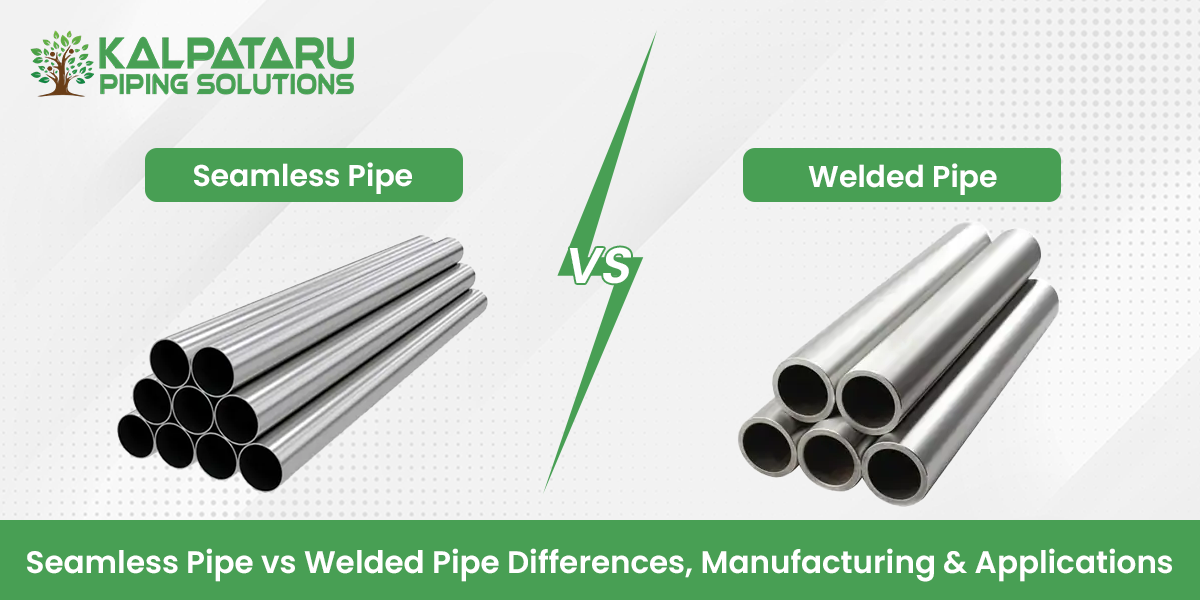
Quick answer: Seamless pipe has no longitudinal weld seam, while welded pipe is formed from strip, coil or plate and joined along a seam. Neither is automatically best for every application. The correct choice comes from the material standard, design code, pressure, temperature, diameter, wall thickness and inspection requirements. |
The seamless-versus-welded question often gets reduced to one line: seamless is stronger, welded is cheaper. That shortcut is attractive, but it is not a reliable engineering rule.
Modern piping specifications define chemistry, mechanical properties, dimensions, heat treatment, inspection and testing for both manufacturing routes. A properly specified welded product can perform reliably in demanding service, while seamless material may be mandatory or preferred in other applications. The purchasing decision should therefore be based on code and service conditions rather than a blanket assumption.
Kalpataru Piping Solutions supplies industrial steel tubes and alloy-specific tube ranges including stainless steel tubes, duplex steel tubes, super duplex tubes, Inconel tubes and copper-nickel tube products for different project requirements.
What Is Seamless Pipe?
Seamless pipe is manufactured without a longitudinal welded joint. In a common hot-finished route, a solid round billet is heated, pierced to create a hollow shell, and then elongated and sized by rolling or related forming processes. Cold drawing or other finishing may be used when tighter dimensions, surface finish or mechanical properties are required.
Because there is no seam, the pipe body is continuous around its circumference. This makes seamless construction attractive for applications where the specification places particular importance on uniform pressure containment, high temperature, cyclic loading or small-diameter heavy-wall sections.
How Welded Pipe Is Manufactured
Welded pipe starts with flat strip, coil or plate. The material is formed into a cylindrical shape and the edges are joined by a welding process. Depending on product size, material and standard, manufacturing may involve electric resistance welding (ERW), electric fusion welding (EFW), submerged arc welding (SAW) or other qualified processes.
After welding, the seam can be heat treated, inspected, sized and tested as required by the specification. Modern production controls and non-destructive examination allow welded pipe to meet demanding standards, particularly where large diameters, close dimensional tolerances or efficient production are important.
Seamless Pipe vs Welded Pipe: Key Differences
Factor | Seamless pipe | Welded pipe |
Manufacturing route | Pierced/extruded/rolled from solid billet without longitudinal seam | Formed from strip, coil or plate and welded along seam |
Longitudinal weld | None | Present and controlled by applicable specification |
Size availability | Strong availability in small to medium diameters and heavy walls; depends on alloy and mill | Very broad size range, particularly advantageous for larger diameters |
Dimensional consistency | Can show more variation from hot piercing/rolling depending on process | Often good control of diameter and wall geometry from formed strip/plate |
Cost | Often higher due to billet and piercing process | Often more economical in common sizes and large diameters |
Inspection focus | Base material and full product requirements | Base material plus weld seam qualification/inspection requirements |
Typical selection driver | Critical service, heavy wall, specific code requirement or availability | Cost, large diameter, dimensional control, broad availability or project specification |
Is Seamless Pipe Stronger Than Welded Pipe?
The honest answer is: it depends on what you mean by stronger and what specification is being compared. Seamless pipe does not have a longitudinal weld, so it avoids weld-seam variables. That is a real design advantage in certain services.
However, welded pipe is not inherently weak. A welded pipe produced to an appropriate ASTM, ASME or API specification can be required to meet defined tensile properties, hydrostatic testing, NDT and dimensional controls. In code design, the applicable product specification and weld quality factor are what matter – not a marketing statement that one manufacturing route is universally superior.
Pressure and Temperature Considerations
For high-pressure or high-temperature service, designers commonly prefer seamless products in certain size ranges and material families because of the absence of a longitudinal seam and established code practice. Examples include high-temperature alloy steel piping and some critical process lines.
Welded pipe is also widely used in pressure service, including pipelines and large-diameter process systems. The required welding process, heat treatment and examination are governed by the material and construction standards. Always confirm the exact allowable design basis in the project code.
Dimensional Range and Availability
Manufacturing economics strongly influence availability. Seamless production is practical across many small and medium diameters and can be well suited to thick-wall sections. Welded production scales efficiently into larger diameters because plate or coil can be formed to size rather than pierced from a massive billet.
This difference matters during procurement. A theoretically ideal material route may have a long mill lead time, while an approved alternative may be available much faster. Engineering, procurement and construction teams should align material approval with actual mill capability early in the project. Where the line connects to equipment or requires removable joints, the companion guide on types of flanges helps match the connection method to service conditions.
Seamless vs Welded in Stainless and High-Alloy Materials
In corrosion-resistant materials, both seamless and welded constructions are common. Stainless, duplex, super duplex, nickel alloys and copper-nickel products are selected first for corrosion and temperature performance, then by manufacturing route as required by the product standard.
For example, buyers comparing stainless products should also distinguish pipe from tube. Kalpataru’s guide on stainless steel tubes vs pipe explains how dimensional conventions and intended use differ before seamless-versus-welded construction is considered.
Common Applications for Seamless Pipe
- High-pressure process piping where seamless construction is specified
- High-temperature power and refinery service in code-specified alloy grades
- Hydraulic and mechanical applications requiring heavy walls or compact diameters
- Boiler, heat-exchanger and pressure-equipment services where the relevant material specification calls for seamless manufacture
- Critical instrumentation or process duties where project specifications restrict longitudinal welds
Common Applications for Welded Pipe
- Large-diameter transmission and process pipelines
- Water, desalination and utility piping
- Structural and general industrial systems
- Stainless and corrosion-resistant piping where welded construction is permitted by specification
- Projects where dimensional consistency, large diameter and cost efficiency are key procurement drivers
Standards Buyers Commonly Encounter
The exact standard depends on material and product. ASME B36.10M establishes dimensions for welded and seamless wrought steel pipe, while ASME B36.19M covers stainless steel pipe dimensions. Product specifications such as ASTM A106, ASTM A53, ASTM A312, ASTM A335, ASTM A790 and various nickel-alloy standards define manufacturing and testing requirements for particular materials and services.
Do not specify only ‘seamless pipe’ on a purchase order. At minimum, identify material specification and grade, NPS or OD, schedule or wall thickness, manufacturing type, end finish, heat-treatment condition where applicable, testing, certification and quantity.
How to Choose: A Practical Procurement Checklist
- Read the project piping class or material requisition before choosing the manufacturing route.
- Confirm material standard and grade. The same alloy family may have different pipe and tube specifications.
- Check design pressure and temperature against the construction code.
- Review diameter, wall thickness and mill availability. Large-diameter welded options may be more practical than seamless.
- Define NDT and hydrostatic testing requirements, especially for welded seams.
- Check corrosion allowance, heat treatment and surface condition.
- Request MTCs and traceability. For critical service, include PMI or third-party inspection where specified.
- Compare total installed cost, not only unit price. Lead time, welding, inspection and site availability can change the best commercial choice.
Final Takeaway
Seamless pipe is a proven choice for many high-pressure, high-temperature and critical applications, but welded pipe has equally important advantages in size range, dimensional control, availability and economics. Good engineering does not choose by slogan. It chooses the manufacturing route permitted by the code and best suited to the actual service.
Explore Kalpataru Piping Solutions’ steel tube range and material-specific categories, or send your project specification for a quotation including grade, size, wall thickness, seamless/welded requirement, standard and documentation needs.
Frequently Asked Questions
A seamless pipe is manufactured without a longitudinal weld seam. Depending on the material and process, a solid billet is pierced and then rolled, drawn or extruded to achieve the required dimensions and properties.
Not necessarily. Seamless pipe avoids a longitudinal weld and is often preferred for certain high-pressure, high-temperature or critical services, but modern welded pipe made to the correct specification can meet demanding mechanical and pressure requirements. The governing code and product standard determine suitability.
The main difference is manufacturing route. Seamless pipe is formed without a longitudinal seam, while welded pipe is produced from plate, coil or strip that is formed and welded. This affects available sizes, wall thicknesses, cost, dimensional consistency and inspection requirements.
Welded pipe is often more economical, especially in larger diameters and common wall thicknesses, because it can be produced efficiently from plate or coil. Actual cost depends on material grade, size, quantity, testing, delivery and market availability.
Use the project specification first. Check material grade, design pressure and temperature, corrosion allowance, size, wall thickness, welding factor, NDT requirements, dimensional tolerance, availability and total installed cost.
Enquire Now
Related Blogs
What is Stainless Steel Valve?
What Is Monel Alloy? Composition, Properties & Uses (Guide)