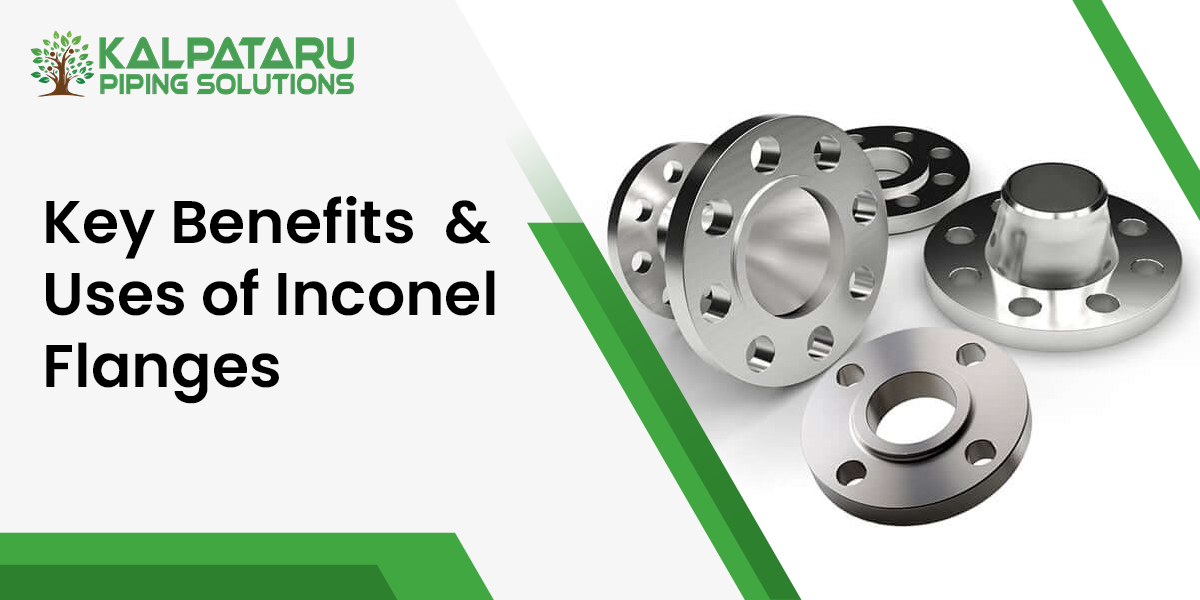
Inconel Flanges are piping systems that are manufactured out of a special branch of nickel-chromium-based superalloys.These flanges are particularly chosen in the industrial settings where regular stainless steel or carbon steel would not perform under the conditions of high heat, high pressure or corrosion by chemicals.
We shall discuss the various Inconel flange grades ( 600, 601, 625, 718), their various characteristics, manufacturing standards used worldwide and how to identify the appropriate type of flange to use in your particular case.
What Are Inconel Flanges?
Inconel is one of the leading families of austenitic nickel chromium superalloys developed to resist very harsh conditions in which the other metals would have collapsed. This chemical composition enables it to exhibit an extraordinary high structural integrity, mechanical strength over cryogenic depths up to red-hot temperatures. Inconel offers triple the protection when used in flanges: the most important connection point in piping, also offers the highest oxidation resistance through stable passivating layer, resistant to chloride- ion stress corrosion cracking, and is not brittle when subjected to thermal stress.
Key Properties of Inconel Flanges
Inconel flanges are chosen for “harsh service” because of their unique chemical and mechanical profile:
- Corrosion & Oxidation Resistance: High chromium content provides resistance to oxidizing chemicals, while high nickel content provides resistance to reducing environments and alkaline solutions.
- High-Temperature Performance: These flanges can operate in temperatures exceeding 1000°C (1832°F) depending on the grade.
- Pressure Ratings: They maintain high tensile and creep-rupture strength under extreme mechanical loads.
Best for:
- High-heat systems (Exhaust manifolds, heat exchangers)
- Corrosive chemical lines (Sulfuric, hydrochloric, and nitric acids)
- Marine/Offshore (Subsea equipment and seawater handling)
Common Grades Used in Inconel Flanges
The grade of Inconel significantly changes the performance of the flange.
1. Inconel 600 Flanges
A standard engineering material for applications requiring resistance to corrosion and heat. It is used heavily in the furnace industry and chemical processing.
2. Inconel 601 Flanges
A variation with added aluminum, which provides even higher resistance to high-temperature oxidation and “spalling”.
3. Inconel 625 Flanges (The Most Popular)
This is the most versatile grade for flanges. The addition of molybdenum and niobium gives it high strength without the need for heat treatment and excellent resistance to a wide range of corrosive environments.
4. Inconel 718 Flanges
A precipitation-hardenable grade used for its incredibly high yield and tensile strength. It is commonly found in aerospace and high-pressure oil and gas applications.
Grade Comparison Table
|
Grade |
Key Advantage |
Best For |
PREN Value |
|
High-temp stability |
Furnace components |
~16 |
|
|
Oxidation resistance |
Heat-treating baskets |
~18 |
|
|
Corrosion + Strength |
Marine & Chemical |
~45 |
|
|
Inconel 718 |
Extreme Strength |
Aerospace & Gas Turbines |
~30 |
Types of Inconel Flanges
To beat competitors, you must select the flange type that matches your piping stress requirements.
- Weld Neck (WN): Best for high-pressure and high-temperature systems where the weld can be easily inspected.
- Slip-On (SO): Easier to align and lower cost, used for moderate-pressure applications.
- Blind Flanges: Used to seal the ends of piping systems or pressure vessel openings.
- Socket Weld (SW): Ideal for small-diameter, high-pressure pipes.
- Lap Joint: Used when frequent dismantling for cleaning or inspection is required.
Standards & Specifications for Inconel Flanges
- To ensure safety and compatibility, these flanges must meet strict global standards. Below is a detailed technical specification table:
|
Category |
Standard / Specification |
Details |
|
Material Specs |
ASTM B564 / ASME SB564 |
Standard for Nickel Alloy Forged Flanges |
|
Dimensions |
ASME B16.5 |
NPS 1/2″ to NPS 24″ (Class 150 – 2500) |
|
Large Diameter |
ASME B16.47 Series A & B |
NPS 26″ to NPS 60″ (Class 75 – 900) |
|
Pressure Ratings |
Class 150, 300, 600, 900, 1500, 2500 |
Pressure-temperature ratings for nickel alloys |
|
Face Types |
RF, FF, RTJ, TF, GF |
Raised Face, Flat Face, Ring Type Joint, etc. |
|
Custom Specs |
MSS SP-44 / API 6A |
Specific for high-pressure oilfield and pipeline use |
|
Certifications |
EN 10204 3.1 / 3.2 |
Full material traceability and inspection reports |
Applications of Inconel Flanges by Industry
Inconel flanges are found in environments where most metals simply cannot survive.
- Oil & Gas / Petrochemical: Used in subsea manifolds, wellhead equipment, and refineries handling high-temperature crude.
- Chemical Processing: Vital for equipment handling organic acids, caustic solutions, and chlorides.
- Marine & Offshore: Preferred for seawater-cooled heat exchangers and shipboard exhaust systems.
- Power Generation: Used in nuclear steam generators and high-temperature furnace components.
- Aerospace: Found in jet engine exhaust systems and high-pressure fuel lines where weight and strength are critical.
How to Choose the Right Inconel Flanges
-
If Seawater/Offshore: Choose Inconel 625 for its high PREN and resistance to salt-water pitting.
- If Extreme Oxidation (>900°C): Choose Inconel 601 for its aluminum-enhanced protective layer.
- If Highest Mechanical Strength: Choose Inconel 718 for turbine or subsea manifold applications.
- If General High-Heat Service: Choose Inconel 600 for cost-effective heat resistance.
Inconel vs. Stainless Steel vs. Monel Flanges
- Inconel vs. SS 316: Inconel is superior for temperatures above 500°C and aggressive acids. SS 316 is for general-purpose corrosion.
- Inconel vs. Monel: Monel (Nickel-Copper) is specifically excellent for hydrofluoric acid and seawater but lacks the high-temperature oxidation resistance of Inconel.
FAQs About Inconel Flanges
Yes, Inconel 625 is considered one of the best materials for seawater due to its resistance to pitting and crevice corrosion.
Always request a Mill Test Certificate (MTC) to EN 10204 3.1 and perform PMI (Positive Material Identification) testing before installation.
Conclusion
Inconel flanges are the ultimate selection in case of high stakes in the industrial applications, as the flanges have unmatched reliability in cases where conventional materials are not able to cope. Just like your project requires the outstanding multifunctional characteristics of the Inconel 625 grade or the high tensile possibilities of the Inconel 718 grade, it is essential to choose the right grade in order to ensure the structural stability of your product and its safety in operation. Kalpataru Piping Solution focuses on offering highly engineered parts that perform well in environments with excessive thermal conditions and brutal corrosive services. With our high-performance flanges incorporated into your system, you will have a high-performance, fail-safe system that would be used under the most rigorous circumstances. Kalpataru Piping Solution has a reputation for providing durability, expertise and quality standards that your sensitive piping systems need to achieve optimum performance and life cycle.
Enquire Now
Related Blogs
What is Stainless Steel Valve?
What Is Monel Alloy? Composition, Properties & Uses (Guide)