
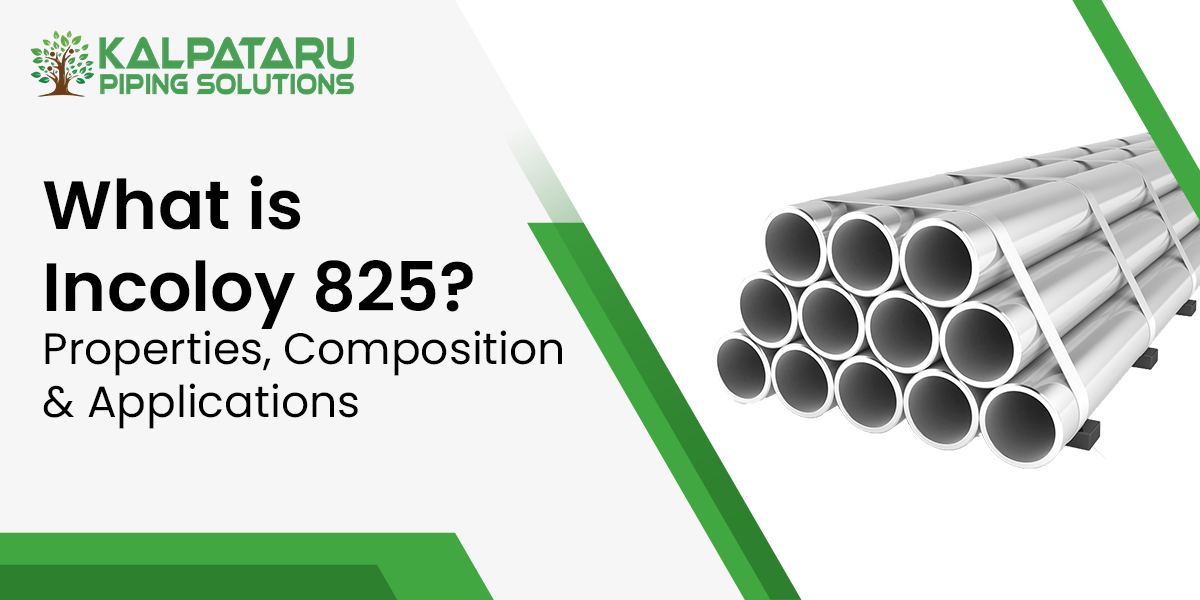
Incoloy 825 is the material specification of choice when seawater, sour gas and even stronger acids overwhelm stainless steel. This is the complete guide to all the facts about Incoloy 825’s composition, properties, corrosion resistance, weldability, and its comparison with Inconel and Hastelloy.
Incoloy 825 (UNS N08825, WERKSTOFF NR. 2.4858 and DIN 2.4858 – is an austenitic iron-nickel-chromium-molybdenum-copper-titanium alloy. Designed to provide resistance in oxidising and reducing environments, Incoloy 825 occupies a mid-ground between economical stainless steels and high-performance superalloys like Inconel and Hastelloy.
At Kalpataru Piping Solutions, we distribute Incoloy 825 pipes, flanges, pipe fittings, and tube fittings to various industries in India and overseas. Here, we provide an overview of the exact Incoloy 825 chemical composition and mechanical properties, its corrosion-resistant benefits, best practices for fabricating this alloy, and how it compares with other nickel alloys.
Whether you are designing a chemical process plant, oil & gas installation or a desalination plant, knowing this alloy inside out will assist with material specification.
Explore our range of Incoloy 825 Flanges and Pipe Fittings or contact our technical team for material advice before specifying. |
Incoloy 825 Chemical Composition
Incoloy 825’s superior performance is derived from the unique Incoloy 825 alloy composition. The alloying elements are added within a narrow band to impart complementary protection and variations from Incoloy 825 specifications may affect the performance. The table below gives the full breakdown as per the Incoloy 825 data sheet (ASTM B424 / ASME SB424).
Element | Symbol | Composition Range | Role in Alloy |
Nickel | Ni | 38.0 – 46.0% | Primary element; resists chloride-ion stress-corrosion cracking |
Iron | Fe | 22.0% min (~33%) | Structural backbone; cost-efficiency element |
Chromium | Cr | 19.5 – 23.5% | Oxidation resistance; forms protective passive oxide layer |
Molybdenum | Mo | 2.5 – 3.5% | Pitting & crevice corrosion resistance; reducing acid environments |
Copper | Cu | 1.5 – 3.0% | Resistance to sulfuric & phosphoric acids |
Titanium | Ti | 0.6 – 1.2% | Stabilises against intergranular corrosion after welding |
Manganese | Mn | 1.0% max | Trace stabiliser |
Carbon | C | 0.05% max | Limits carbide precipitation |
Silicon | Si | 0.5% max | Deoxidiser in manufacturing |
Sulfur | S | 0.03% max | Controlled for ductility |
Aluminum | Al | 0.2% max | Minor deoxidiser |
Key Physical Properties of Incoloy 825
Incoloy 825’s physical constants are key in its design. Density, melting point, thermal conductivity and temperature range allow designers to ensure the material is fit for purpose for their intended applications.• Density: 8.14 g/cm3 (0.294 lb/in3) – higher than typical austenitic stainless steels, due to the high nickel and iron element content.• Melting Point / Temperature Range: 1370 -1400°C (2500 – 2550°F)• Maximum Service Temperature: 538°C (1000°F).
- Density: 8.14 g/cm³ (0.294 lb/in³) — heavier than standard austenitic stainless steels, reflecting the high nickel and iron content.
- Melting Point / Temperature Range: 1370 – 1400°C (2500 – 2550°F)
- Maximum Service Temperature: 538°C (1000°F). Precipitation of brittle phases (sigma phase) can occur above 540°C – see superalloy comparison below.• Thermal Conductivity: 11.1 W/m·K at 100°C – acceptable for chemical processing and power generation heat exchangers and condensers.• Thermal Expansion Coefficient: 14.0 µm/m·°C – critical for thermal cycling and joining considerations.• Modulus of Elasticity: 196 GPa – offers similar stiffness to other nickel alloys.• Electrical Resistivity: 1.14 µΩ·m at 20°C.
- Thermal Conductivity: 11.1 W/m·K at 100°C — adequate for heat exchangers and condensers in chemical processing and power generation.
- Coefficient of Thermal Expansion: 14.0 µm/m·°C — important for thermal cycling and joint design.
- Elastic Modulus: 196 GPa — provides stiffness comparable to other nickel-based alloys.
- Electrical Resistivity: Approximately 1.14 µΩ·m at room temperature.
Incoloy 825 is a great choice for high temperature materials up to its maximum service temperature. In applications where higher temperatures are required, engineers will commonly turn to superalloys like Inconel 625 or Incoloy 800HT.
Incoloy 825 Mechanical Properties & Performance
The Incoloy 825 mechanical properties are governed by ASTM B424 (plate), B423 (pipe), B425 (rod and bar), and related ASME SB specifications. These standards define minimum tensile strength, yield strength, and elongation values to ensure consistent structural integrity across all product forms.
Property | Value / Range | Standard Reference |
Tensile Strength | ≥ 586 MPa (85 ksi) | ASTM B424 / B423 |
Yield Strength (0.2% offset) | ≥ 241 MPa (35 ksi) | ASTM B424 / B423 |
Elongation | ≥ 30% | ASTM B424 / B423 |
Hardness (Brinell) | ≤ 180 HB | ASTM B424 / B423 |
- Tensile Strength & Yield Strength
Incoloy 825 offers minimum load-bearing capabilities of 586 MPa tensile strength and 241 MPa yield strength for use in pressure vessels, downhole tubulars, and process piping. This strength is sustained over a wide range of temperatures, including room temperatures and moderately high temperatures. - Ductility & Toughness
Incoloy 825 has a minimum elongation of 30% and is very ductile. The material is shock-resistant, resistant to brittle failure, and can be readily shaped by cold working processes. The austenitic structure also means it has excellent toughness at low temperatures – a useful feature for offshore and cryogenic service. - Hardness
The maximum Brinell hardness of 180 HB confirms the alloy will not yield, or deform, under mechanical stress. This Brinell hardness also ensures the alloy has not been over-aged during the annealing process, which is important for optimum corrosion performance during service. - Incoloy 825 Corrosion Resistance
The best reason to use Incoloy 825 is its multi-faceted corrosion resistance. It is resistant to almost all types of corrosive attack found in industry. - General Corrosion
Incoloy 825’s high nickel, chromium, molybdenum and copper content provides excellent general corrosion resistance in a variety of environments, including dilute and concentrated sulfuric acid and phosphoric acid, often at the most economical alloy selection for acid service. Independent immersion tests in 65% sulfuric acid at 79°C have shown Incoloy 825 to have a corrosion rate of less than 0.5 mm/year, more than 10 times less than 316 stainless steel. (See Special Metals technical bulletin SMC-046.) - Pitting & Crevice Corrosion
Pitting and crevice corrosion resistance is controlled by the presence of molybdenum. Incoloy 825’s 2.5-3.5% Mo content offers excellent resistance for applications involving chlorides, such as seawater and brine, and oil & gas streams. Such conditions are especially important in slowly flowing environments where crevices can form easily. - Stress-Corrosion Cracking (SCC)
Chloride stress-corrosion cracking (SCC) is one of the most dramatic failure mechanisms for stainless and nickel alloy pipes. Incoloy 825’s high nickel content (38-46%) ensures that it is well outside the range of nickel content that would be susceptible to SCC in hot chloride environments (where 316 stainless steel is highly susceptible). This makes Incoloy 825 pipes ideal for tubing and well head equipment in the oil & gas industry. - Intergranular Corrosion
The titanium stabilisation in Incoloy 825 means no sensitisation-induced intergranular corrosion occurs, following welding or hot working in the sensitisation temperature range (650 – 760°C). This is in contrast to non-stabilised austenitic alloys where grain boundary precipitation of chromium carbide leads to depleted grain boundaries vulnerable to corrosion.
Resistance in Specific Environments
- Sulfuric Acid: Exceptional resistance across a wide concentration and temperature range. First-choice alloy for acid production equipment.
- Phosphoric Acid: Used in phosphoric acid plant heat exchangers, evaporators, and scrubbers.
- Seawater Corrosion: Copper and molybdenum together provide excellent resistance to seawater, ideal for marine heat exchangers, offshore piping, and desalination evaporators.
- Nitric Acid: Chromium content delivers strong resistance to oxidising acids.
- Reducing Environments: The Ni–Mo–Cu combination makes Incoloy 825 superior in reducing acid environments compared to standard austenitic stainless steels.
Industrial Applications of Incoloy 825
The unique balance of Incoloy 825 properties makes it indispensable across a broad range of industries. Its versatility in both aqueous corrosive environments and moderately elevated temperature service has driven widespread adoption globally.
- Oil & Gas Pipelines and Downhole Equipment: Incoloy 825 meets oil & gas demands in sour environments, such as Middle East and North Sea. It can handle H2S, CO2 and brines above the NACE MR0175 threshold for stainless steels. It’s suitable for downhole tubing, casing, wellheads, valves, and offshore pipes. Kalpataru Piping Solutions has ASTM B366 Incoloy 825 fittings such as elbows and tees.
- Chemical Processing Plants: Incoloy 825 works in acid services. It works for sulfuric acid plants, coolers and towers. It is good for phosphoric acid evaporators, exchangers, and scrubbers. It resists mixed acids in tanks, reactors, and pipes. It is most economical for many tasks.
- Desalination Plants: Incoloy 825 is used in desalination MSF and MED systems. Copper and molybdenum combat seawater. It works well in high-velocity brine tubes and exchangers. Nickel prevents SCC in brines, unlike stainless.
- Marine Engineering: Incoloy 825 suits marine uses. It shields seawater heat exchangers and condensers. It’s used on offshore water and injection pipes. It’s ship piping and exhausts too. Subsea umbilicals and controls stay strong.
- Power Generation: Power stations choose Incoloy 825. Nuclear reprocessing treats nitric acid. It stores radioactive waste safely. It’s used in heat recovery and steam generation in nuclear and fossil plants. Fossil plants have FGD scrubbers.
- Aerospace: Incoloy 825 helps aerospace to resist heat and corrosion. It builds exhaust components. Structural parts withstand high temperatures and corrosive air and chemicals.
💡 Related Reading: If you are specifying flanges for a corrosive process application, see how Kalpataru’s Incoloy 825 Flanges are manufactured to ASTM B564 and what to check before ordering. |
Fabrication & Weldability of Incoloy 825
Probably the most asked question about this alloy is: “Is Incoloy 825 welded?” The short answer to that question is yes. Incoloy 825 is one of the easiest-to-fabricate of the nickel alloys, and it can be worked with all of the standard methods.
Welding Methods
All conventional weldability processes are applicable:• Gas Tungsten Arc Welding (TIG): TIG is preferred for root passes and critical welds.
- GTAW (TIG Welding): Preferred for root passes and precision work. Provides clean welds with good properties.• GMAW (MIG Welding): Recommended for higher welding rates.• SMAW (Stick Welding): Suitable for repair and maintenance welding.• SAW (Submerged Arc Welding): Suitable for fabricating pressure vessels.
- GMAW (MIG Welding): Suitable for higher-deposition rate applications.
- SMAW (Stick Welding): Appropriate for field welding and repair work.
- SAW (Submerged Arc Welding): Used for heavy-section fabrication in pressure vessels.
Recommended Filler Metals
Recommended filler metals when welding Incoloy 825 are Incoloy Alloy 65 (ERNiFeCr-1) or Inconel 625 (ERNiCrMo-3). These fillers will give the same or increased corrosion resistance to the weld zone and heat-affected zone (HAZ).
Heat Treatment for Incoloy 825
Annealing is essential to ensure maximum corrosion resistance, particularly for welded components:• Solution Annealing: 940 – 980°C (1725-1800°F) followed by a rapid water quench.
- Solution Annealing: Performed at 940 – 980°C (1725 – 1800°F), followed by rapid water quench. Dissolves carbides and returns full corrosion resistance.• Stabilising Anneal: Performed at 915°C (1675°F) when titanium carbide precipitation is required to avoid sensitisation in welding applications.• No PWHT: Most applications don’t require metallurgical post-weld heat treatment (PWHT), thus reducing cost.
- Stabilising Anneal: Applied at 915°C (1675°F) when titanium carbide precipitation is desired to prevent sensitisation in welded assemblies.
- No PWHT Required: For most applications, no post-weld heat treatment (PWHT) is required for metallurgical reasons, significantly reducing fabrication cost. Note: Check with the design code (ASME VIII, EN 13445) and owner’s engineering design specification, as they may dictate PWHT for other reasons.
Cold & Hot Forming
Incoloy 825 can be cold-formed on conventional equipment, although due to its higher strength than carbon steel, more substantial equipment and lubricants are required. Lubricants must be removed before high-temperature treatments, or embrittlement will result. Hot forming should be performed at 925 – 1175°C followed by annealing.
Machinability
Incoloy 825 can be machined with conventional tooling, but has a higher work hardening rate than carbon steel. Slow speed, high feed, hard tooling and positive rake gives best results. Best results are achieved with high volume coolant, free of sulphur.
FAQs About Stainless Steel Flange
The applications for Incoloy 825 include oil & gas downhole tubing, chemical processing components, desalination plant piping, marine heat exchangers and nuclear waste management. Its excellent corrosion resistance to acid, seawater and sour gas environments render it vital in applications where conventional stainless steel cannot perform.
Incoloy 825 is able to maintain its mechanical properties up to 538°C (1000°F). Higher temperatures can lead to the formation of brittle phases, such as sigma phase. For temperatures exceeding 540°C, high performance superalloys such as Inconel 625 and Incoloy 800HT are recommended.
Yes, Incoloy 825 can be easily welded. You can use any of the common processes: GTAW (TIG), GMAW (MIG), SMAW (Stick), SAW. Post-weld heat treatment is generally not required. Suggested filler alloys are Incoloy Alloy 65 (ERNiFeCr-1) or Inconel 625 (ERNiCrMo-3).
Incoloy 825 is the most economical material for aqueous acid and seawater corrosive environments. The Inconel alloys are used for hight temperatures (above 538°C). Hastelloy C-276 is used for the most corrosive environments but at a much higher price. See Section 8 table.
UNS number for Incoloy 825 is N08825. It is also known as Werkstoff Nr. 2.4858 (DIN 2.4858). These are stamped on material test reports and specified when ordering to the Incoloy 825 specification.
Conclusion & Material Selection Guide
Incoloy 825 is a highly versatile and dependable nickel alloy. Its carefully balanced chemical makeup – the high strength of nickel combined with the added oxidation resistance of chromium, acid resistance of molybdenum and copper, and the weldability of titanium – results in a versatile material that stands up to a broad spectrum of the harshest industrial operating conditions.
Whether it is oil & gas downhole tubing, desalination evaporators, acid towers in chemical plants or nuclear waste management, Incoloy 825 is a reliable, affordable alternative to both over-engineered superalloys and under-performing stainless steels.
✅ Material Selection Quick Guide Choose Incoloy 825 when you need: → Resistance to chloride SCC + pitting in seawater or brine → Protection against sulfuric or phosphoric acid at moderate temperatures → A weldable, titanium-stabilised alloy for chemical plant fabrication → An upgrade from 316 SS in sour service or marine environments |
Enquire Now
Related Blogs
What is Stainless Steel Valve?
What Is Monel Alloy? Composition, Properties & Uses (Guide)