
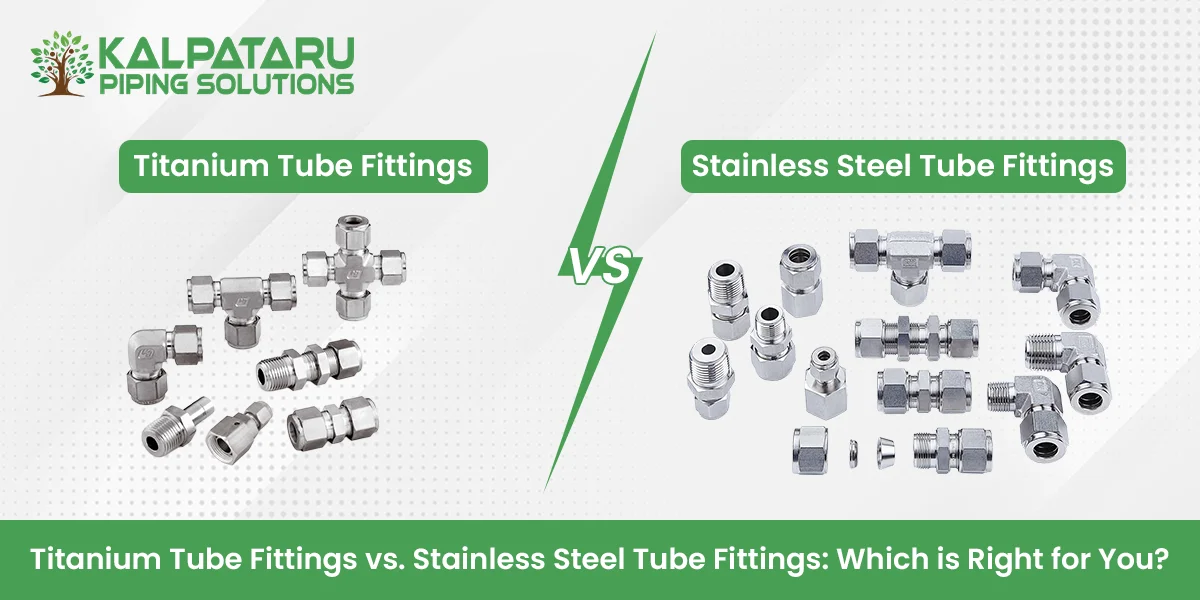
The integrity of any industrial system depends on the choice of the right components. Titanium tube fittings and Stainless Steel tube fittings are the most popular products in the market today, particularly among the engineers and the project managers. Although both are capable of withstanding use, they have very diverse applications in the aerospace, marine, medical and automotive industries.
We will divide the strength differences, corrosion resistance and cost differences into this guide so that you can make an informed choice when making a procurement.
Titanium Tube Fittings
In any project that requires the greatest strength to weight ratio, titanium is the standard of gold. As a leading Titanium tube fittings Manufacturer, we ensure these parts are developed to tolerate extreme environments without failure.
Key Advantages:
- Greater Corrosion Resistance: Titanium is a passive oxide forming alloy. This ensures that it is almost impossible to be affected by salt water hence the choice in marine engineering and desalination plants.
- Weight Efficiency: These fittings are incredibly strong and they are much lighter than steel- which is a crucial consideration to fuel efficiency in the aerospace market.
- Thermal Stability: Titanium has a very high temperature where it can withstand structure, compared to most types of steel, and is used in high-heat exchangers.
- Biocompatibility: Titanium is used in medical implants and special lab equipment as it is not toxic and may be used with human tissue.
- Cost Advice: There is a higher cost attached to high performance. The extraction and machining processes required Titanium tube fittings sizes are complicated which makes them relatively expensive compared to the steel ones.
Stainless Steel Tube Fittings
Stainless steel is the most viable and cost- efficient option in many situations in the industry. It is an affordable yet durable material with 304 Stainless Steel tube fittings up to highly specialized grades.
Key Advantages:
Dependable Strength: Stainless steel, although not as light as titanium, is extremely tough and can withstand a significant amount of mechanical pressure in a high pressure plumbing system and construction.
- Cost-Effectiveness: In terms of projects that have very tight budgets, stainless steel will be the most economical in terms of bang of your buck without necessarily compromising the much needed safety standards.
- Simplicity of installation: Stainless steel is more easy to weld and make. Stainless steel tube fittings types including compression, bite-type, and flared fittings, which can be assembled fast.
- Hygienic Properties: This material is the industry standard in food processing as well as pharmaceutical manufacture since it is easy to clean.
Titanium vs. Stainless Steel Cookware
Cooking ware is available in the different materials available, with each having their own advantages, and this will assist you to decide what best fits you. The following is the comparison between titanium and stainless steel cookware in order to make your decisions.
The knives, cutters, and other blades are usually made of stainless steel as it retains a sharp edge compared to titanium. Being heavier than titanium or aluminum, it is nevertheless durable and long-lasting. Stainless steel cookware does not conduct heat so fast but it is appreciated due to its strength, smooth appearance and low expenses. It is popular with those who need something durable and strong to do their daily cooking.
The lightweight construction of titanium is its primary strength as it is 45 percent less heavy than steel and is slightly heavier than aluminum. It has great resistance to corrosion and durability. Titanium cookware heats fast because it has thin sides and it is ideal to use when boiling water or cooking easy food. It is perfect when one requires light weight equipment to go camping or to have fast food, which is low in calories.
Titanium vs Stainless Steel in Machinery
Both Titanium Steel and stainless steel are normally used in machined parts, but there are significant differences between the two.
Titanium is not easily machined and is up to 30 times more expensive to handle than steel. Titanium is very costly but with a very important benefit, it is as strong as stainless steel but nearly half its weight. This renders it suitable in industries such as the aerospace where weight minimization is very important. It is also applied in medical parts since titanium is biocompatible, that is, it is safe when placed in the human body.
Stainless steel is extensively employed in any kind of industry due to its resistance to corrosion and strength. It is cheaper than titanium and can be used in the environment where the temperatures are not constant. Stainless steel can also be found in other alloys and thus it can be used in various types of applications including welded sections.
Concisely, titanium is the material of choice in lightweight and high temperature purposes whereas stainless steel is the choice in cost effective and general purpose purposes.
Titanium vs Stainless Steel
Both titanium and steel are metals that are powerful and are employed in various industries. Which is better is dependent on the design needs and the application in question.
Strength and Weight: When titanium is mixed with such metals as aluminum or vanadium, it becomes extremely tough, up to approximately 430 MPa strong. It is famous because of its high strength to weight ratio which makes it fit into the aerospace industry and other industries where weight reduction is a major concern. Steel is heavier as well as generally stronger.
Industrial Use: Titanium is very durable and has a high melting point hence is suitable in heavy works of industrial use. It is also biocompatible, that is, it is not harmful to the human body and can be applied in medical implants such as knee replacements and pacemaker casings.
Stainless steel on the contrary is known to be formable as well as weldable. It is easily welded and can be shaped, this is why it is usually applied in cookware, medical devices and domestic products such as sinks and shelves. It is also popular as a decorative purpose because it is shiny.
Cost and Applications: Titanium costs more compared to stainless steel hence it is not more viable in large scale projects such as construction. Stainless steel is usually an option in a situation whereby the budget is an issue. It is strong, durable and resistant to corrosion just like titanium but less expensive.
Temperature Resistance: Titanium can withstand high temperatures as compared to steel. It is also able to withstand fatigue due to quick change in temperature and this makes it the option in situations that have variable high and low temperatures.
Comparison between Titanium Tube Fittings & Stainless Steel Tube Fittings
| Property | Titanium Tube Fittings | Stainless Steel Tube Fittings |
| Corrosion Resistance | Exceptional (Acidic/Saltwater) | Good (General Moisture/Chemicals) |
| Weight | Ultralight | Heavy |
| Fabrication | Challenging / Specialized | Easy / Standard |
| Best For | Aerospace, Deep-sea, Medical | Construction, Food, Automotive |
| Common Grades | Grade 2, Grade 5 | 304, 316, 316L |
What Is the Better Metal: Titanium or Stainless Steel?
Each of them has its own advantages in titanium and stainless steel. Titanium is a natural pure metal whereas stainless steel is an alloy that is composed of chromium and iron, as well as nickel and others. Stainless steel tends to be cheaper, simpler to model, as well as, to weld. It is also scratch and fatigue-resistant. Titanium on the other hand is also stronger in cases where there is a fluctuation of temperatures and is lighter and could be used where weight is an issue. Also titanium is not that toxic and is commonly utilized in medical equipment, but can be easier to scratch than stainless steel.
Making the Final Choice
Choose Titanium Tube Fittings if:
- You are in the aerospace or defense industries where weight is of importance.
- The system will be flooded in the seawater, or subjected to very hostile chemicals.
- Its usage is in medical implants or power generation of high temperature.
Choose Stainless Steel Tube Fittings if:
- You need 304 Stainless Steel tube fittings that are durable to be used by general industries.
- One of the main issues that your project is concerned with is budget efficiency.
- You require a wide variety of standard Stainless steel tube fittings types that are easy to replace and maintain.
The Bottom Line
Both Titanium and Stainless Steel find their application in the present-day infrastructure. Titanium provides a performance that is unrivaled by weight and very high durability in extreme conditions whereas Stainless Steel provides cleaning and economic effective solution to a wide range of industries.
At Kalpataru Piping Solutions, we provide both materials in high-quality finishes. Whether you need specific Titanium tube fittings sizes or specialized Stainless steel tube fittings types, our team is prepared to help you develop a piping system that stands the test of time.
Frequently Asked Question (FAQs).
Enquire Now
Related Blogs
What is Stainless Steel Valve?
What Is Monel Alloy? Composition, Properties & Uses (Guide)