
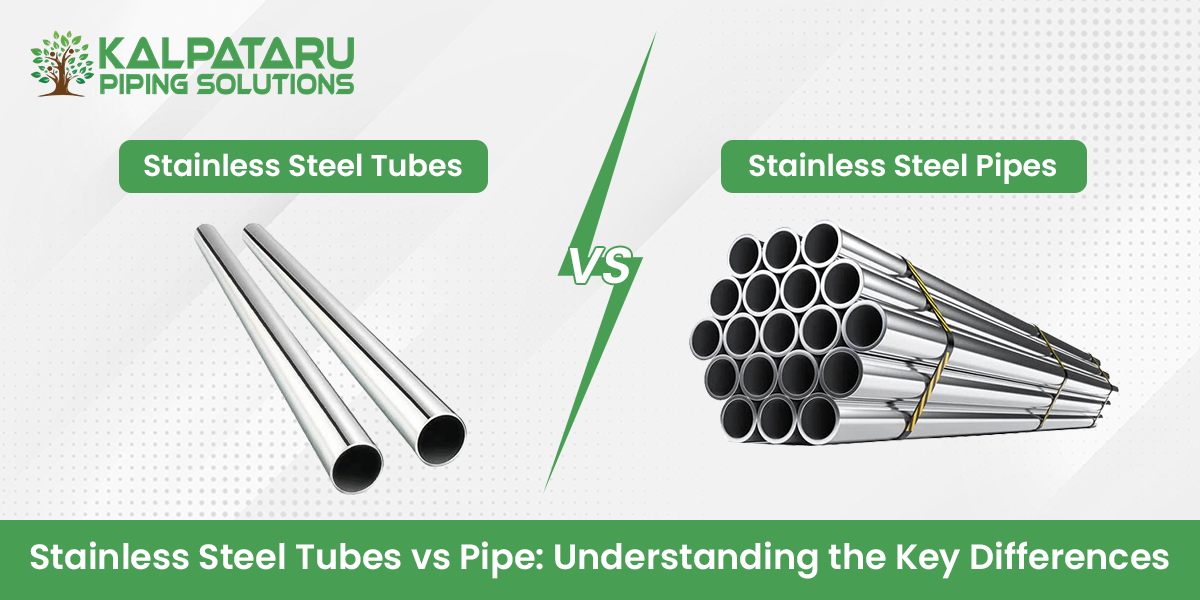
Stainless steel pipes and stainless steel tubes are both made of good quality stainless steel, although the construction process and use is different. Pipes can be made to standardized nominal pipe sizes (NPS) and are typically applied in moving fluids and gases in chemical manufacturing and oil and gas industries, water treatment, and chemical processing. Tubes, however, are produced with a very good outer diameter and wall thickness, which is why they are all good in structural, mechanical, and instrumentation. In the case of the stainless steel tubes vs pipe, the main differences are the standards of measurements, dimensional accuracy, the requirements of strength, and the use with the intended purpose which directly influence the performance, the cost, and the adaptability of the selected industrial usage.
What is a Stainless Steel Tube?
The structure of stainless steel tubes is hollow type and is constituted of alloyed stainless steel which is not corrosive. They are also of various shapes which include round, square, rectangular, and oval. Tubes are categorized according to measurements i.e. the outer diameter (OD), the thickness of the walls (WT) and in some cases the inner diameter (ID). They are manufactured under close dimensional tolerance and accurate measurement requirements unlike pipes. The measurements of the stainless steel tubes are done by checking the thickness of the outer and wall of the tubes and the hollow which ensures that the correct dimensional control is done.
What is Stainless Steel Pipe?
Stainless steel pipes are hollow circular structures that are manufactured using stainless steel materials. The pipes are round in shape, unlike the tubes. They are denoted by nominal pipe size (NPS) and schedule, which defines the wall thickness. The sizes of pipes are usually determined by the standard sizing systems that take into consideration the inner diameter in determining size. A stainless steel pipe is determined as hollow by subtracting the wall thickness twice from the outside diameter.
Types of Stainless Steel Tubes
The stainless steel tubes are manufactured in different sizes and forms and come in different types. Some of the most common types of stainless steel tubes are listed below.
Seamless Stainless Steel Pipes
The stainless steel pipes are created in such a manner that there are no welding joints in the material.
Stainless Steel Welded Pipes:
The stainless steel welded pipes are produced by rolling the stainless steel pipes into a tube and later welding the ends.
Round Stainless Steel Pipes:
Round stainless steel is the most prevalent type of a pipe since it is applied in a multifunctional way.
Square and rectangular Stainless steel Pipes:
The stainless steel pipes are also available in a square and rectangle form to be used as an aesthetic feature among others.
ERW (Electric Welded Resistance) Pipes:
ERW pipes are those pipes that are welded by use of electric resistance instead of the traditional welding.
Types of Stainless Steel Tubes
The stainless steel tubes are a little bit different from pipes but they have the same base material in it and they come in a different shape and sizes. Some of the common ones are listed below.
Seamless Stainless Steel Tubes:
Seamless tubes are produced out of solid stainless steel billet, which is heated and then processed by mechanisms, to take the shape of hollow construction with no welding line.
Stainless steel Welded Tubes:
Welded tubes are made by bending the stainless steel strips or coils into a tube shape and then welding the open ends of the tubes.
Precision Stainless Steel Tubes:
Dimensional accuracy and tight tolerances are imposed on the production of precision tubes. During manufacturing, their external diameter, thickness of the wall and finish are strictly regulated in order to comply with specific size requirements.
Heat exchanger Stainless Steel Tubes:
These tubes have controlled dimensions and surface properties that are specifically designed to facilitate the effective thermal transfer of properties in heat exchange systems.
Capillary Stainless Steel Tubes:
Capillary tubes are very tiny tubes that are produced with a lot of precision. Their internal bores are very fine and the margin between the dimensions is tight enough to control the internal flow accurately.
Difference between Stainless Steel Tubes vs Pipe
Feature | Stainless Steel Pipe | Stainless Steel Tube |
Shape | Mostly round | Can be round, Square or rectangular |
Measurement | Normal Pipe Size (NPS) & Schedule | Outer Diameter (OD) & Wall Thickness |
Applications | Fluid & gas transport | Structural, mechanical & precision uses. |
Strength | Generally thicker walls for pressure resiistance | Higher dimensional accuracy for precision applications |
Fabrication | Easier to weld & thread | More precise machining required. |
Cost | Always lower per unit length | More expensive due to precision requirements |
Surface Finish | Rougher surface | Available in polished, seamless, finishes |
Grades of Stainless Steel Tubes and Pipes
The stainless steel tubes and pipes are manufactured in common grades and some of the widely used grades are given below.
304 Stainless Steel:
One of the most common types of 304 stainless steel used which is a balanced grade of strength, durability and corrosion resistance making the grade useful in general purpose applications.
316 Stainless Steel:
The stainless steel 316 is highly resistant to corrosion, particularly when it comes to moisture, chemical and chloride environment, because of the molybdenum that it contains.
310 Stainless Steel:
Stainless steel 310 is developed to be used in high-temperature applications and it offers good resistance to oxidation and heat and therefore it is effectively applicable in the process that demands high thermal stability.
Difference Between Pipe and Tube Diameter
In making the order, you can order a pipe with outside diameter and wall thickness, you can order a pipe during order placement. Besides this, the order in some cases may also be placed with such dimensions as OD and ID and Wall Thickness. The ID or the internal diameter is normally theoretical, but the thickness of the wall of a particular tube has been explained with the help of a gauge quantity. A smaller gauge value is associated with a big outdoor diameter. On the other hand, the tube is ordered with NPS standard, furthermore, this system quantity and amplifier; nominal diameter or pipe length must be specified.
Manufacturing Process of Stainless Steel Tube and Pipe
The stainless steel tube and pipe they both are made by using the same process is just a little different in the formatting of these two materials. The step by step manufacturing process of stainless steel tube and pipe are given below.
Step 1: Selecting Raw Material
The grade of the billets is selected due to high-quality stainless steel billets (solid round bars) or steel coils.
Step 2: Heating the Steel
The stainless steel is also heated to high temperature to soften it and now it is in a condition of shaping.
Step 3: Forming the Shape
For Seamless Pipes and Tubes:
A good round billet is pierced in the middle so that it is hollowed and then rolled and stretched to the size desired.
For Welded Pipes and Tubes:
The strip in stainless steel is rolled in a cylindrical shape and an edge is welded up.
Step 4: Sizing
The pipe or tube is taken through the machines to obtain the right diameter and wall thickness.
Step 5: Heat Treatment
The heat-treatment (annaled) is done to enhance strength and eliminate internal stress.
Step 6: Finishing
The final size and smooth surface are attained by cutting, straightening and surface finishing.
Step 7: Testing
Every pipe or tube is tested and checked to maintain quality and correct dimensions.
Conclusion:
The decision on whether to use pipes or tubes made of stainless steel will ultimately depend on the way the product is measured, and the degree of dimensional accuracy demanded. Pipes will be categorized according to nominal size and schedule, and stainless steel tubes are categorized according to precise outer-diameter and wall-thickness. Where the needs are high accuracy in the size, product alternatives such as 304 stainless steel tubing are useful since they provide balance between strength and corrosion resistance, but a 316 stainless steel tube is also available with a superior defense in harsh conditions. Kalpataru Piping Solution delivers reliable solutions designed to ensure consistent performance, structural integrity, and long-term dependability.
FAQs About Stainless Steel Flange
The main difference is measurement and purpose. Pipes are measured by nominal pipe size (NPS) and schedule, while tubes are measured by exact outer diameter and wall thickness.
Generally, stainless steel pipes are cheaper than tubes because tubes require tighter tolerances and more precise manufacturing.
Stainless steel pipes and tubes can last 20–50 years or more, depending on the grade and environmental conditions.
Yes, 304 stainless steel tubing offers good corrosion resistance in normal environments but may not perform as well in highly salty or chemical conditions.
316 stainless steel tube is better for harsh or marine environments due to added molybdenum, while 304 is suitable for general-purpose applications.
Enquire Now
Related Blogs
What is Stainless Steel Valve?

What Is Monel Alloy? Composition, Properties & Uses (Guide)