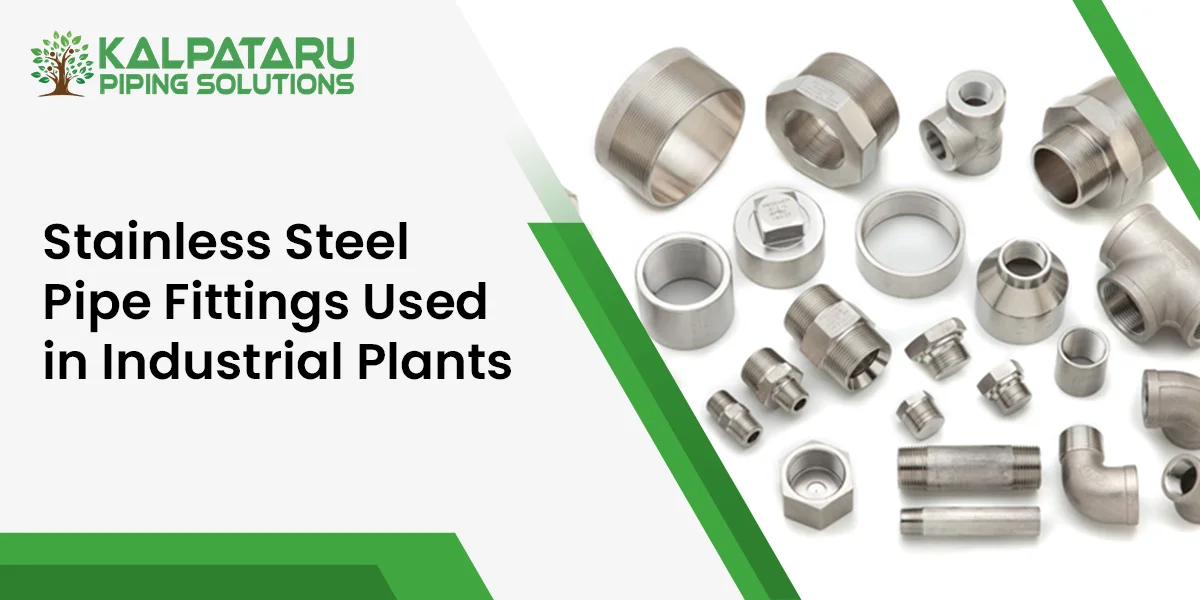
The quality of the piping system is greatly dependent on even the smallest elements, that is, the fittings in the intricate system of the modern infrastructure. To plant managers and engineers, the choice of the appropriate components is not associated with uniting two pipes; it is about ensuring safety, efficiency and durability. At Kalpataru Piping Solutions, we are aware that in the industry-sensitive regions, such as petrochemical refineries to food processing units, Stainless Steel Pipe Fittings form the bedrock of the operations.
This guide discusses the reasons why stainless steel continues to be the most suitable material in heavy-duty applications, and with particular attention to the general purpose SS 304 and SS 304L alloy.
Why Stainless Steel Fittings are the Preferred Choice
In industrial processes that are heavy, the failure of equipment is very expensive and hazardous. Although fittings can be made of many other materials such as brass or carbon steel, stainless steel presents special benefits that enhance it over the others under harsh conditions.
Corrosion Resistance: Outstanding Corrosion Resistance of Stainless Steel Pipe Fittings is one of the best assets of the product as such material is naturally resistant to rust and chemical corrosion. This is essential in marine, chemical processing, as well as outdoor industrial settings where moisture and other corrosive elements are always present.
Temperature Stability: Stainless steel is uniform within a wide range of temperatures. It is resistant to high temperature and does not brittle in frozen conditions hence it can be used in various applications such as in cryogenic storage and steam distribution.
Long Service Life: Since the stainless steel does not wear or corrode it has much longer service life than the fittings that are made of softer metals or coated material. This reliability minimises the number of replacements and associated risks of any unanticipated failures, and is more cost effective in the long-term.
How Stainless Steel Fittings Work
This is due to the fact that by knowing the mechanism behind these fittings, we will be able to select the appropriate type to use in your plant. Stainless Steel Pipe Fittings serve the purpose of tightly binding tubes or pipes using such techniques as compression, welding, or threading. This provides a tight fit that seals off any leakages and helps in the effective flow of liquids or gases continuously and without leakages.
The process is usually characterized by:
- Tube Preparation: It is important to cut the tube ends accurately and smooth and deburr them.
- Insertion: Popping the tube into the fitting so that it fits into the fitting.
- Sealing: Fastening the connection either through compression, threading or welding depending on the type of fitting.
Common Types and Specifications
We are able to offer numerous configurations to fit the needs of individual systems at Kalpataru Piping Solutions.
Buttweld Fittings: These are directly welded to the ends of the pipes, and this gives them a smooth flow of the fluid. They are very good in high-pressure and high-temperature systems. The most common ones are the elbows, reducers, tees, and caps.
Forged Fittings: These are produced using forging process and are stronger. They are usually offered in socket weld, threaded and are usually used in systems that need a high pressure (3000, 6000 and 9000 lbs pressure classes).
Specific Configurations
- Elbows: These are used to divert the flow (45, 90 and 180 degrees).
- Tees: Tees are used to connect three piping and are designed in a T-shape of fluid flow.
- Reducers: Pipes of different diameters can be connected, and it is possible to make transitions between their flows.
- Unions: Important in maintenance, and thus pipes can be simply disconnected.
SS 304 and SS 304L Pipe Fittings
Stainless Steel 304 Pipe Fittings and Stainless Steel 304L Pipe Fittings are the most common ordered when it comes to the industrial grades because they offer a compromise between performance and cost.
- SS 304 Pipe Fittings: SS 304 is standard with 18/8in stainless steel which consists of 18 percent chromium and 8 percent nickel. It is the most common and diverse alloy of the family of stainless steel. These fittings have high forming and welding properties. They are preferred to be used in the situations when good corrosion resistance and formability are needed.
- Stainless Steel 304L Pipe Fittings: The 304L L is Low Carbon. The chemical composition of Stainless Steel 304L Pipe Fittings is similar to that of SS 304, only that the latter contains lower carbon. This is an essential modification that is important in welding. The reduced carbon allows less precipitation of carbide during welding thus preventing intergranular corrosion. In case of heavy gauge or a lot of welding work related to your project, then Stainless Steel 304L Pipe Fittings are usually a better choice of specification.
Key Industrial Applications of Stainless Steel Pipe Fittings
Stainless Steel Pipe Fittings have found their way in all industries because of their versatility.
- Oil and Gas: Pipelines in this industry are exposed to damaging fluids as well as a hostile climate. SS 304 Pipe Fittings resist corrosion and the humid temperatures.
- Chemical Processing: In refineries that expose pipelines to severe chemicals, stainless steel can withstand chemical attacks and help the infrastructure to serve longer.
- Food and Beverage: Here, it is either clean or dirty. The stainless steel material has a smooth surface, which does not allow microorganisms to grow, and can resist a strict cleaning system, which avoids contamination.
- Water Treatment: Be it desalination plants to the municipal water supply, these fittings offer leak-free operation and they resist corrosion in saline water.
Stainless Steel Pipe Fittings Maintenance Tips for Longevity
To maximise on your investment, it is important to have regular maintenance.
- Periodic Check-up: Check that there are no leakage or stress cracks and corrosion, particularly in highly-stress regions.
- Correct Cleaning: it should be cleaned with mild detergents or special stainless steel cleaners to avoid the accumulation which might cause localised corrosion.
- Do not Over-Tighten: When using threaded fittings, the threads may be damaged by excessive force resulting in a leak. Torque specifications should always be followed.
- Lubrication: To avoid galling in threaded fittings, lubrication is recommended to these fittings.
The Bottom Line
You can be refurbishing a chemical plant or erecting a new water treatment plant but the safety of your piping system depends on how its connections are made. Stainless Steel Pipe Fittings-especially SS 304 Pipe Fittings, Stainless Steel 304L Pipe Fittings have the durability, hygiene, and strength needed in the modern industry.
At Kalpataru Piping Solutions, we do not compromise on quality piping components that are well proven. Get in touch with us today and establish what you need for your project and identify the ideal fittings to use in your plant.
Frequently Asked Question (FAQs).
Carbon content is the major difference. SS 304 contains a normal amount of carbon, whereas the Stainless Steel 304L Pipe Fittings have a low amount of carbon. This is the reason why 304L can be used in the welding processes since it incorporates the chances of corrosion in the welded zone.
Yes. Such grades as SS 304 are hygienic, non-porous, and leakless of chemicals, which is why they are safe in drinking water.
Rating of pressure depends on type (buttweld or forged), as well as schedule. Fitted fittings may be used to a pressure of up to 9000 lbs (in particular high-pressure designs) whereas the usual buttweld fittings rely on the pipe schedule (e.g. Sch 40, Sch 80).
Yes, threaded connections. Preferably a thread sealant or PTFE (Teflon) tape can be used to coat the joint during assembly (to prevent galling) and to seal the joint leak-tight.
Enquire Now
Related Blogs
What is Stainless Steel Valve?
What Is Monel Alloy? Composition, Properties & Uses (Guide)