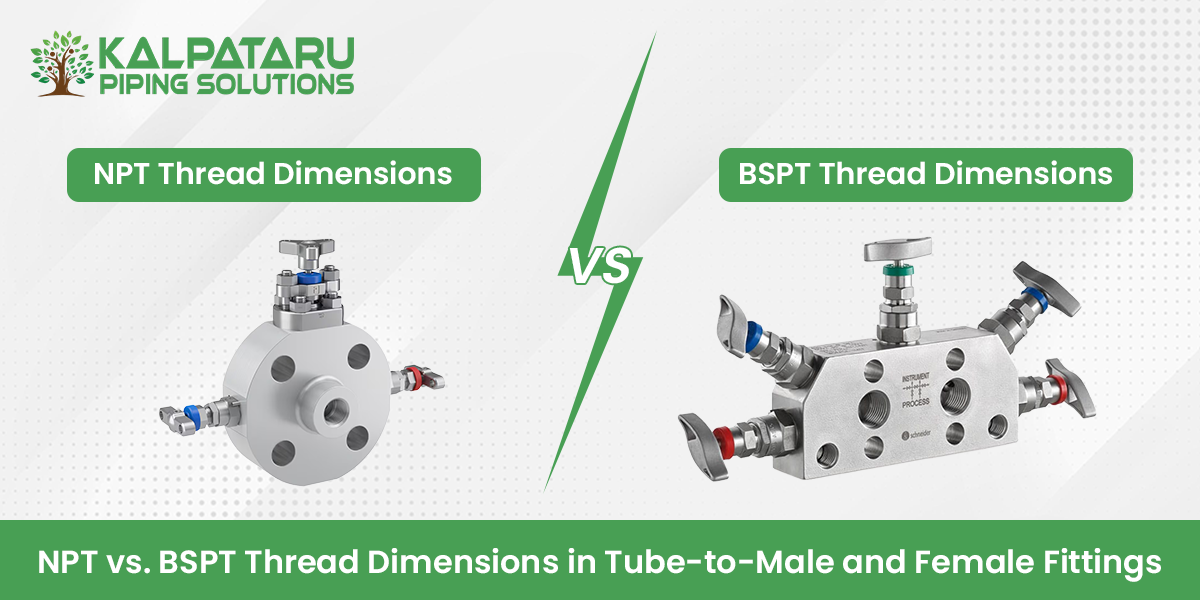
A BSPT to NPT connection may not appear to be an issue until it is at 300 psi and the system leaks. They are both tapered pipe threads, but they are oriented 5° apart, which makes them incompatible, and if they get mixed up in an instrumentation system, it can have serious repercussions.The most common standards are NPT (“National Pipe Taper”) and BSPT (“British Standard Pipe Taper”), both of which are tapered pipe threads, but have different geometry, angle and standards, and are generally non-interchangeable. This blog will provide an explanation of the differences between NPT vs BSPT thread, pipe thread standards, dimensional differences and selection guidelines in order to help achieve safe, leak free and reliable industrial connections.
What Are Thread Standards in Pipe Fittings?
Threaded connections in pipe fittings are identified by their standards, which outline the design, geometry and sealing process. These standards specify whether the threads are tapered or parallel and provide for proper sealing under pressure by metal-to-metal contact or sealing compound. Selecting the right thread in high pressure fluid and gas systems is critical to ensure that the system remains intact and does not experience leakage. The use of thread standards is very common in instrumentation tube fittings that require precision and reliability. There are internationally recognized standards such as ANSI (American), BSP (British) and ISO (International) all of which cater to specific regional and industrial needs.
What is NPT Thread?
NPT (National Pipe Taper) is a popular US pipe thread standard found in ANSI/ASME B1.20.1. It has a tapered shape with a 1:16 taper ratio which enables threads to tighten up and make a seal by mechanical deformation. Sealing compounds are generally employed to make the system leak-proof, including PTFE tape or thread sealant. NPT threads are widely employed in oil and gas, petrochemical, power generation and specialized monoflange valves where sealing connections under high pressures and reliability are essential.
What is BSPT Thread?
BSPT (British Standard Pipe Taper) is a taper pipe thread standard based on ISO 7 and BS EN 10226 specifications. It has been widely adopted throughout Europe, Asia and India. BSPT is similar to NPT in tapered design, but the angle of the threads is different (55° instead of 60°), which renders it unsuitable for most applications. It is employed for plumbing, industrial pipe systems and instrumentation systems that follow British and ISO standards.
How NPT and BSPT Threads Differ: Angle, Pitch, and Compatibility
The NPT and BSPT threads are both pipe thread standards, with the difference being the geometry, the way the threads are sealed, and the various types of compatibility. These differences have a direct effect on the performance of tube fittings, instrumentation lines and high pressure systems. One of the most crucial differences between NPT vs BSPT threads is the inability to interchange them. Though both are tapered, the slight difference in thread angle and form causes a mismatch to result in a failure to seal and the risk of leakage, damage to the thread and failure of the system, particularly in high pressure applications. NPT threads are used extensively in the USA and BSPT threads in Europe and other countries such as Asia and India, so the region is of critical importance in industrial projects. Sometimes improper pairing can also lead to issues with precision systems, such as tube-to-male and female fittings. To achieve high reliability sealing in such systems, the right fitting selection is essential: Single Ferrule vs. Double Ferrule Compression Fittings for High-Pressure Systems explains how compression fittings can contribute to leak-free performance in instrumentation systems.
NPT Thread vs. BSPT Thread Comparison Table
Parameter | NPT Thread | BSPT Thread |
Thread Angle | 60° | 55° |
Standard | ANSI/ASME (US) | ISO 7 / BS EN (UK/Global) |
Thread Form | Flat crest and root profile | Rounded crest and root profile |
Pitch System | Threads per inch (TPI) | Metric-based pitch system |
Sealing Method | Thread interference + sealant (PTFE) | Thread interference + sealant |
Interchangeability | Not interchangeable | Not interchangeable |
NPT vs BSPT Thread Dimensions
Trade Size (Inches) | NPT Pitch (TPI) | BSP Pitch (TPI) |
1/8 | 27 | 28 |
1/4 | 18 | 19 |
3/8 | 18 | 19 |
1/2 | 14 | 14 |
¾ | 14 | 14 |
1 | 11 ½ | 11 |
1 ¼ | 11 ½ | 11 |
1 ½ | 11 ½ | 11 |
2 | 11 ½ | 11 |
2 ½ | 8 | 11 |
3 | 8 | 11 |
3 ½ | 8 | 11 |
4 | 8 | 11 |
5 | 8 | 11 |
6 | 8 | 11 |
How to Identify NPT vs BSPT Threads
If you are unsure whether a fitting is NPT or BSPT, these four methods will confirm the thread type without specialist equipment.
1. Thread Angle Measurement
The angle of the thread can be used to determine the type of thread, as NPT and BSPT threads have different angles. NPT is an angle of 60° and BSPT is an angle of 55°. This is the most dependable means of identification.
2. Thread Pitch Check
A thread gauge is used to measure pitch. NPT is based on Threads Per Inch (TPI) while BSPT is based on a metric based pitch system. The spacing also varies to further identify the type of thread.
3. Visual Inspection of Thread Profile
Typically, the crests of NPT threads are sharper while those of BSPT threads are a little more rounded. The thread is easily observed to form.
4. Standard Marking and Labeling
Manufacturers often mark fittings according to ANSI (NPT) or ISO (BSPT) standards. These markings are included to make sure the correct item is checked.
How to Choose Between NPT and BSPT: Selection Guide
To choose the perfect thread between NPT and BSPT, you can follow the below instructions to get the perfect threads for your projects.
1. Regional Standards
NPT is used most often in the United States and BSPT is used in Europe, Asia, and India. The first selection factor is regional compatibility.
2. Application Pressure Requirements
In high-pressure systems, thread matching is crucial for preventing leakage and mechanical failures. For absolute safety in high-pressure loops, verify that your male adapters, female ports, and intermediate stainless steel tubing runs share identical thread series.
3. Temperature and Media Type
The operating temperature and the type of fluid should be taken into account. For corrosive media or high-temperature applications, dependable sealing is critical.
4. System Design and Compatibility
Selection of threads should match with the overall design of the system such as fittings and flanges. To learn about the sealing performance characteristics of the flanges in industrial applications, check out Raised Face (RF) vs Ring Type Joint (RTJ) Flanges: Pressure and Temperature Ratings.
Applicational Uses of NPT and BSPT Threads
Oil & Gas Industry
NPT and BSPT threads are widely used in pipelines, drilling systems, and offshore platforms for secure, high-pressure fluid connections and instrumentation lines.
Chemical Processing Industry
These threads are used in corrosive and high temperature applications where a leak-free connection ensures safe handling of corrosive chemicals.
Power Plants
They are employed in steam lines, boiler systems and pressure measurement setups to operate reliably in extreme conditions.
Instrumentation Systems
In tube fittings, transmitters, and control systems, accurate pressure and flow measurement is highly important and relies on the use of NPT and BSPT threads.
HVAC Systems
For secure connections in fluid and gas flow for HVAC in commercial and industrial applications.
Conclusion:
NPT and BSPT threads are not interchangeable and are not used for the same applications. Selecting the right type of thread is a key element in preventing leaks, system safety and reliability. In high pressure and instrumentation systems, the proper compatibility of the thread, as well as the appropriate fittings, is critical. Topics such as NPT vs. BSPT Thread, Raised Face (RF) vs. Ring Type Joint (RTJ) Flanges and Single Ferrule vs. Double Ferrule Compression Fittings further improve system performance. Kalpataru Piping offers industry standard fittings for safety, durability and efficient operation, providing precision engineered solutions and reliable products.
FAQs About Stainless Steel Flange
NPT has a 60° thread angle and uses TPI, while BSPT has a 55° angle and uses metric pitch. They follow different standards and are not compatible.
No, NPT and BSPT threads should not be used together as they have different angles and pitches, leading to leakage.
Neither is inherently better. Use NPT for ANSI/ASME (mainly US) systems and BSPT for ISO/BS EN (Europe, India, Asia). Always follow the equipment specification—never mix the two thread types.
Check the 55° thread angle, use a thread gauge for metric pitch, and look for ISO or BSP markings.
Yes, BSPT threads are commonly used in India for industrial piping and instrumentation systems.
Enquire Now
Related Blogs
What is Stainless Steel Valve?
What Is Monel Alloy? Composition, Properties & Uses (Guide)