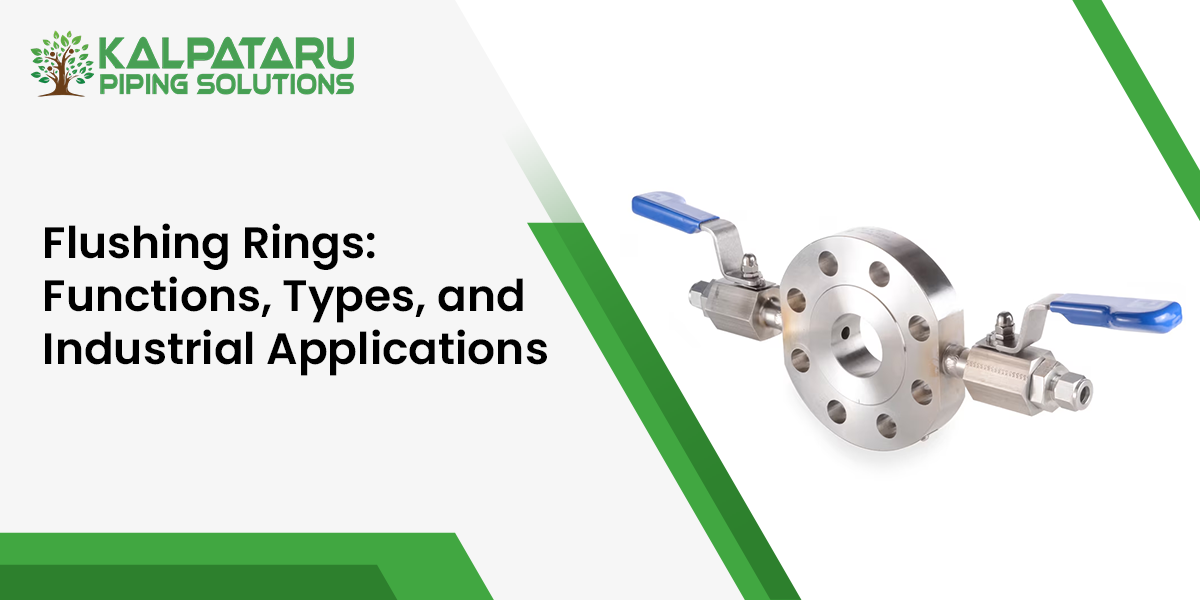
Flushing Rings are very important elements in any structure that are fitted between a diaphragm seal and a process flange to enable the area of sensing to be washed, flushed, or vented without having to take the system apart. They are important in industrial instrumentation systems in ensuring measurement accuracy, particularly in processes that use viscous, corrosive, or slurry-based media. A diaphragm seal flushing ring is used to prevent clogging, accumulation of material and contamination that may cause pressure readings. By applying it as a diaphragm seal with a flushing ring, one can safely inject or remove cleaning fluids without developing any downtime and disrupted operation. The Flushing Rings are commonly used in the industry where hygiene, accuracy, and reliability of the system are critical to the efficient and reliable control of the process.
What are Flushing Rings?
A flushing ring is a metal ring, circular in shape, and flat, which is used to fit between the process flange and a diaphragm seal. It has a radial port(s) which enable fluid to be injected or evacuated and this allows the user of the pressure measurement system to wash, drain, or calibrate the system without having to take it apart. Flushing rings are usually entirely of stainless steel (such as SS316) or more durable alloys such as Hastelloy or Monel; they are designed to support high pressure, high temperature and corrosive media. They are particularly prevalent in those industries whereby the process media is prone to crystallization, solidification or getting deposited along the diaphragm which may result in erroneous readings or long time imperfection.
How a Flushing Ring Works
The working of the flushing ring includes a simple mechanism that detailed information is given below.
Between Components Installed
The diaphragm seal and the process flange are surrounded by the flushing ring.
Provides Access Ports
It has one or two ports which expose the area around the diaphragm surface.
Injection of Cleaning Fluid
The port is injected with fluid like water, steam or solvent.
Removal of Deposits
The fluid drains the residue, sludge, or obstructions of the diaphragm area.
Drainage of Contaminants
In dual-port designs, fluid is injected in one port and waste material is drained in the other.
Recovers Proper Measurement
The diaphragm is also responsive and reflects the correct pressure levels after cleaning.
No System Dismantling Required
The cleaning is performed outside, which will minimize time lost and enhance safety.
Types of Flushing Rings
The flushing rings are manufactured in different types and forms according to the industry requirements. Some of the most common types of flushing rings are listed below.
SS 304 Flushing Ring
The stainless steel 304 flushing ring is used in general industrial applications, offering good corrosion resistance and durability for standard pressure measurement systems.
SS 316 Flushing Ring
This flushing ring is used to enhance resistance to chemicals and marine environments, making it suitable for corrosive process conditions.
Duplex Flushing Ring
Duplex flushing rings are made specially for higher strength and improved corrosion resistance in demanding industrial applications.
Super Duplex Flushing Ring
Many offshore or chemical industries work in highly aggressive environments and in that case a super duplex flushing ring is used due to it’s corrosion resistance ability.
Inconel Flushing Ring
This flushing ring is suitable for high-temperature and high-pressure applications where exceptional heat and corrosion resistance is required.
Hastelloy C276 Flushing Ring
The Hastelloy C276 Flushing ring is best for extreme chemical processing applications where strong resistance to harsh media is essential.
Alloy 20 Flushing Ring
This alloy 20 flushing rings are made to handle the sulfuric acid and other highly corrosive chemicals.
Cupro Nickel Flushing Ring
Widely used in marine and desalination systems due to its strong resistance to seawater corrosion.
Flushing Ring vs Calibration Ring
The flushing ring and calibration might look the same but they are different from each other and used for different purposes. The calibrating ring is used to isolate the transmitter or gauge from the process media.
| Feature | Stainless Steel Pipe | Stainless Steel Tube |
| Purpose | Flushing/cleaning of diaphragm area | Enabling calibration without process exposure |
| Port Function | Injection/drainage of fluid | Connection to a calibration device |
| Media Compatibility | Required to match process media | Used with clean test fluid |
| Placement | Between diaphragm seal and flange | Same as flush ring |
Application Uses of Flushing Rings
The flushing rings are important components in many industry applications and some of the common industry that uses this is given below.
Flushing rings find application in a diverse field of areas with a prevalence in those areas that have diaphragm seals installed in order to measure pressure or level. Examples of common areas of use are:
Oil & Gas:
It’s used in many oil and gas industries to eliminate the heavy oils, waxes and chemical deposits.
Chemical Processing:
Many chemical processing industries use flushing rings to avoid the damage of the sensor interface by corrosive material.
Pharmaceuticals:
Many Hygienic surfaces of measurement of clean-in-place (CIP) systems use flushing rings in their applications.
Food & Beverage:
To observe the cleanliness in the measurement of the dairy, brewing and sugar process flushing rings is used.
Wastewater Treatment:
Liquor and fibrous material that can foul diaphragm sensors The sludge, slurry and fibrous content in these situations.
Installation & Maintenance Tips for Flushing Rings
For the longshelf life of any components the proper installation and regular maintenance is required. So the installation and maintenance tips for flushing rings is given below.
Installed correctly with Diaphragm Seal
Install the flushing ring between the process flange and the diaphragm seal and make sure the gaskets are in place and all the bolts are tightened evenly to avoid leakage.
Correct Port Alignment
Ensure that the ports of flushing are conveniently open so that cleaning and maintenance services can be performed.
Regular Flushing Schedule
Flush set intervals depending on the kind of media particularly viscous, sticky or corrosive fluids.
Apply Compatible Flushing Fluid
Always have cleaning fluids, which are chemically compatible with process media and seal material.
Monitor Pressure Accuracy
Inaccurate readings may occur suddenly, and this may be a sign of accumulation on the diaphragm and should be flushed immediately.
Check for Leakage
Look at the joints of the flanges and gaskets on a regular basis to prevent the loss or contamination of the pressure.
Check against Corrosion or Damage
Check the material of the flushing ring periodically to confirm that it fits into the environment during which it operates and change it as necessary.
How to Choose the right Flushing Rings
Before choosing any flushing rings for your structure it’s important to consider some points that are given below.
Check Process Temperature and Pressure
Choose a material of a flushing ring that must be resistant to deformation and rupture under operating conditions of temperature and pressure.
Understand Process Media
When dealing with corrosive, viscous or slurry based fluids, the better material to use is SS 316, Duplex, or special alloys.
Diaphragm Seal Compatibility
The flushing ring should be equal in size, rating and material to the diaphragm seal to make them leak-proof.
Decide the Number of Ports
Basic flushing can be achieved with a single-port design and more complex injection and drainage with dual port rings.
Confirm Industry Certifications
In food, pharmaceutical or hazardous use, choose rings that are standards, e.g. FDA, 3A or ATEX.
Account Maintenance Requirements
Select an easy to clean and inspect design to reduce downtimes.
Conclusion:
Flushing rings (also called calibrating rings, seal support components) are used to ensure proper pressure measurement and guard against diaphragm seal accumulation and contamination. A diaphragm seal with flushing ring is used to enhance the equipment performance, improve the service life, and guarantee the reliability functioning in some hard industries, including oil and gas, petrochemical, and power generation. Kalpataru Piping Solution is a leading manufacturer of flushing rings that are produced and made to facilitate durability, resistance to corrosion and accurate engineering principles and specifications, hence we are the company to rely on when considering reliable instrumental parts of industry.
Enquire Now
Related Blogs
What is Stainless Steel Valve?
What Is Monel Alloy? Composition, Properties & Uses (Guide)