Choosing the wrong flange facing type in a high-pressure system is not a theoretical risk. It is a documented cause of leaks, unplanned shutdowns, and in hazardous service, serious safety incidents. There are two most commonly specified flanges facing for stainless steel flanges (according to ASME B16.5) raised face (RF) and ring type joint (RTJ) each of which seal in a different way, and each of which are most suitable for particular pressure classes, temperature ranges and services. This guide includes the primary types of each, pressure-temperature ratings by ASME class, gasket choice and a decision matrix for deciding between the two.This guide details the function of each type, its strengths, the differences in pressure and temperature ratings, the gasket each uses, and how to select the proper one for the project. Interacting with flange selection, this allows for information to be found within the complete piping and instrumentation system via internal links throughout.Internal links throughout connect related topics, thread standards, compression fittings and instrumentation manifolds that relate to flange selection in a complete piping and instrumentation valves.
What Is a Raised Face (RF) Flange?
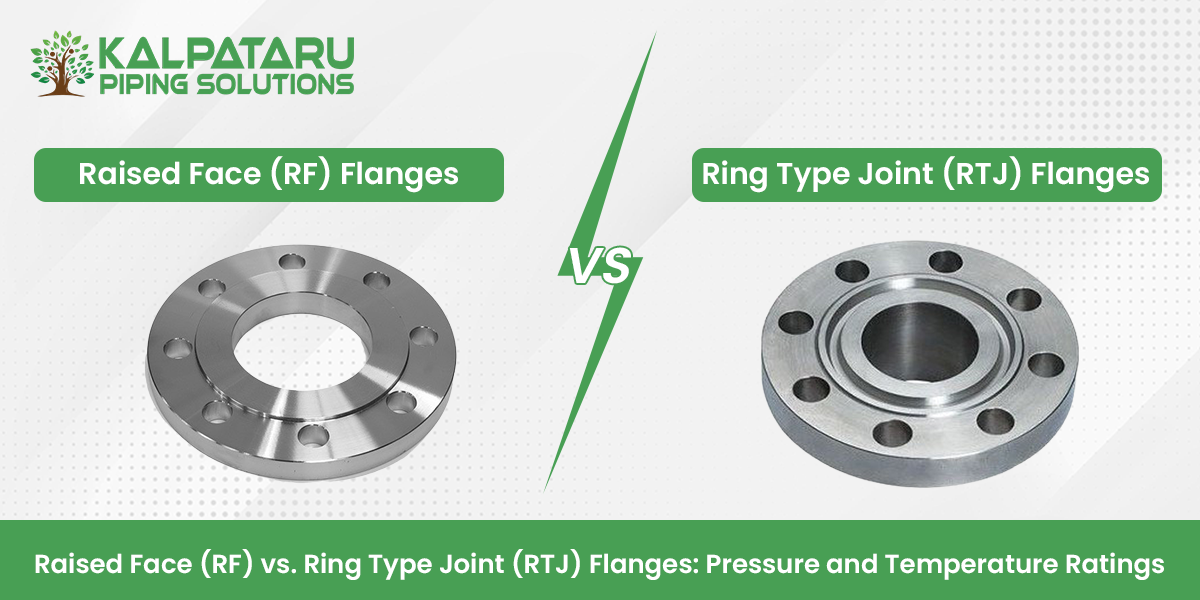
A raised-face flange is one in which the sealing surface is cut up from the face of the flat ring surrounding the bore of the pipe so that when the flange is bolted together, the entire bolt load is applied to the gasket. This concentrated compression makes it possible to have a higher pressure inside the joint than in flat face arrangement with the same bolt size. They can be produced in different classes depending on the type of pressure they carry, and the height of the raised face depends on it. According to ASME B16.5 standards, the raised face for flanges of Class 150 and Class 300 will have approximately 1.6 mm (1/16 inch) height. But after Class 400, the height of the raised face increases to approximately 6.4 mm (1/4 inch). The sealing face in such flanges is provided with concentric or spiral serrations to improve gasket retention.
How the RF Seal Works
The gasket, which can be spiral wound, sheet, graphite, PTFE, kammprofile or composite depending on the requirements of the service, is located between two mating raised faces. The gasket begins to compress evenly from surface irregularities as the bolts are tightened to the designed torque, which results in a seal against the process fluid. The quality of the seal is dependent on the material of the gasket, the surface finish of the raised face, the parallelism of the mating flanges and the uniformity of the bolt load.
What Is a Ring Type Joint (RTJ) Flange?
A Ring Type Joint flange has a precision-machined groove on its face. The RTJ flanges are bolted together with a solid metallic ring gasket in the RTJ groove of each flange. The ring, formed of a slightly softer material than flange body, is pushed slightly into the wall of the groove as bolt load is applied, establishing a metal-to-metal seal of unsurpassed integrity. The key difference from RF is that RTJ sealing is not a compression gasket sealing process, but it is a controlled metallic deformation under load process. The groove geometry, surface finish and ring dimensions are standardized in accordance with ASME B16.20 for the flanges conforming to ASME B16.5 and ASME B16.47 standards as well as API 6A for wellhead and Christmas tree equipment. Ring gaskets are available in oval and octagonal cross-sections (R type), as well as pressure-energized (RX type, to about 5,000 psi) and high pressure profiles (BX type, to about 20,000 psi) for use between subsea and wellhead components.
How the RTJ Seal Works
The metallic ring is loose in the groove prior to bolt-up. During the process of torqueing, the groove face pushes against the groove walls, which causes the face to plastically deform. The contact pressure of metal-to-metal contact is much greater than what a soft gasket can withstand, and that’s why RTJ joints are able to retain their seal in situations that could cause a spiral wound or sheet gasket to blow out or creep. The ring is held in the groove and so is shielded from direct contact with the process fluid flowing over the face of the flange. It also has the capacity to self-center. However, the groove can easily get damaged through the process of corrosion, mechanical movement, and contamination, and any scratch at all made on the groove surface affects the seal, hence the need for cleanliness and caution.
ASME B16.5 Pressure-Temperature Ratings by Flange Class: RF vs RTJ
One of the misconceptions is that the pressure ratings of RTJ flanges are greater than the pressure ratings of RF flanges of the same class. Pressure-temperature ratings specified in ASME B16.5 are not ratings for the flange face type itself, but rather are for the flange body and material. The pressure-temperature ratings are the same on a Class 900 flange with an RF face as they are on a Class 900 face with an RTJ face. The metal to metal sealing is a factor that gives engineers the confidence to use RTJ in their engineering specs or industry codes, particularly in the oil and gas and petrochemical service. The table below shows the standard face type used at each ASME B16.5 pressure class and the approximate maximum allowable working pressure at 38°C (100°F) for carbon steel flanges per ASME B16.5.
Pressure Class | Common Face Type | Max Pressure (approx.) | Typical Service |
Class 150 | RF (standard) | 285 psi @ 38°C | Low-pressure general process |
Class 300 | RF (standard) | 740 psi @ 38°C | Moderate process service |
Class 600 | RF or RTJ | 1480 psi @ 38°C | High-pressure process |
Class 900 | RTJ preferred | 2220 psi @ 38°C | High-pressure oil & gas |
Class 1500 | RTJ standard | 3705 psi @ 38°C | Very high-pressure service |
Class 2500 | RTJ standard | 6170 psi @ 38°C | Extreme pressure / critical |
Gasket Types for RF and RTJ Flanges
It is at the gasket that the seal occurs. One of the most frequent reasons for flange joint leaks is due to the incorrect gasket selection for the flange face type. No, RF and RTJ flanges are not interchangeable, nor are their gaskets; mixing them together is a specification error that is likely to cause the gaskets to fail to seal and ultimately result in nonconformance to ASME or API standards.
Gasket Type | Used With | Pressure Rating | Material | Notes |
Spiral wound | RF | Up to Class 2500 | SS + graphite/PTFE filler | Most common for RF flanges |
Sheet / flat | RF | Up to Class 300 | Graphite, PTFE, rubber | Low-pressure general use |
Kammprofile | RF | Up to Class 1500 | SS core + soft facing | Good for thermal cycling |
R-ring (oval) | RTJ | Up to ~5,000 psi | Soft iron, SS, Inconel | Most widely used RTJ ring |
R-ring (octagonal) | RTJ | Up to ~5,000 psi | Soft iron, SS, Inconel | Interchangeable with oval grooves |
RX-ring | RTJ | Up to ~5,000 psi | Soft iron, SS, Inconel | Pressure-energized; enhanced seal |
BX-ring | RTJ | Up to ~20,000 psi | Alloy steel, Inconel | API 6BX; subsea / wellhead |
RF vs. RTJ Full Comparison Table
Parameter | Raised Face (RF) | Ring Type Joint (RTJ) |
Sealing Face Design | Flat raised ring around the pipe bore; gasket sits on this elevated surface | Precision-machined groove on the flange face accepts a metallic ring gasket |
Gasket Type | Soft or semi-metallic gaskets: spiral wound, sheet, graphite, PTFE, composite | Solid metallic ring gaskets: R (oval/octagonal), RX (up to ~5,000 psi), BX (up to ~20,000 psi) |
Sealing Mechanism | Gasket compression between two raised faces under bolt load | Metal-to-metal contact — ring deforms into groove under bolt load |
Pressure Class Range | Classes 150 to 2500 (moderate to high); standard service | Classes 600 and above; preferred for 900, 1500, 2500 and critical service |
Max Temperature Suitability | Up to approximately 538°C (1000°F) with correct gasket selection | Up to and beyond 538°C (1000°F); handles thermal cycling reliably |
Leak Tightness | Good for moderate service; gasket degradation possible under extreme cycling | Superior metal-to-metal seal; maintains integrity under vibration and thermal cycling |
Machining Complexity | Relatively straightforward; raised face height per ASME B16.5 (1.6 mm at Class 150/300; 6.4 mm at higher classes) | Precision groove machining required; tight tolerances on depth, width, and surface finish |
Cost — Initial | Lower; simpler machining and widely available gasket materials | Higher; precision machining, metallic ring gaskets, tighter tolerances |
Cost — Long-Term | May increase if leaks occur in severe service | Lower lifecycle cost in critical or high-cycle applications |
Installation | Easier; align faces, place gasket, torque bolts to spec | More demanding; groove must be clean, ring must seat correctly, bolt load must be precise |
Maintenance | Easier gasket replacement; soft gaskets widely available and lower cost | More complex; groove damage is critical; metallic ring gaskets have tighter sourcing |
Interchangeability | RF mates with RF only; cannot directly connect to RTJ | RTJ mates with RTJ only; cannot directly connect to RF |
Applicable Standards | ASME B16.5, ASME B16.47 | ASME B16.5, ASME B16.47, ASME B16.20 (ring gaskets), API 6A |
Typical Industries | Oil & gas, chemical, power generation, water treatment, HVAC, general process | Offshore platforms, refineries, wellheads, steam boilers, high-pressure pipelines |
Best Suited For | General-purpose pipelines, moderate P&T, standard process service | Critical service, high-pressure/high-temperature, hazardous fluids, offshore |
How to Choose Between RF and RTJ
The selection between RF and RTJ should be driven by the actual service conditions and applicable project specifications, not by cost alone. The following criteria provide a practical framework for the decision.
Pressure class
RF is normally suitable for normal processes for Class 150 to 600. RTJ is becoming the preferred choice and sometimes specified by the customer’s requirements or industry codes at class 900 and above. In most critical applications, RTJ is the default medium size.
Temperature and thermal cycling
RTJ is able to provide long-term sealing because it resists the gasket creep relaxation that occurs during significant or repeated temperature changes. High quality spiral wound gasket is reliable for temperature service in the moderate temperature range.
Fluid hazard level
Highly flammable, hazardous, or toxic fluids require greater joint integrity and less chance of leakage. This is offered by RTJ’s metal-to-metal seal. In many instances, the enhanced integrity of joints that RTJ provides is desired for fluid service applications such as ASME B31.3 Category M. RF is perfectly acceptable for non-hazardous fluids, in general, for moderate processes.
Vibration environment
When mechanical vibration is present, near compressors, pumps or flow induced pulsation, flanged joints benefit from the rigidity of the metal-to-metal sealing of RTJ, which is able to provide a more consistent contact stress than compressed soft gaskets. The selection of compression fittings at every tubing to valve connection can also have an impact on vibration resistance when impulse tubing runs are included instrumentation tube fittings. For a detailed analysis of fitting behavior under cyclic loading, please see the guide Single Ferrule vs. Double Ferrule Compression Fittings for High-Pressure Systems.
Maintenance frequency and access
RF is usually more convenient when the joint is expected to be broken and then put back together often (for regular cleaning, inspection or catalyst replacement). The soft gaskets are less expensive, readily available, and are easily replaced on site. Reusing RTJ ring gaskets is generally not recommended because the ring will slightly deform when the joint is first made up. This increases maintenance expense for applications that have a high rate of flanges separating.
Cost vs. reliability trade-off
The cost of manufacturing RF flanges is less than that of metallic RTJ rings, and the gaskets are much less expensive and more readily available than the metallic RTJ rings. For non-critical service with moderate pressures and temperatures, RF provides reliable service at lower total installed costs. When it comes to high pressure, high temperature service, or critical service, the initial expense of the RF can be lost when you consider the cost of a single leak (process loss, maintenance shut down, or safety incident). In such situations, RTJ’s upfront expense will be offset by its reduced long-term risk.
Conclusion:
The Raised Face (RF) and Ring Type Joint (RTJ) flanges are both proven and widely accepted sealing solutions for bolted flange connections but are designed for different operating conditions. For most general processing applications, sealing (Class 150 – 600) is met using cost-efficient and versatile RF flanges. RTJ flanges on the other hand are suitable for environments typically Class 600 and above, including high pressures, high temperatures, hazardous and thermally cyclic applications, and are usually used at Class 900 and above in oil & gas, offshore and petrochemical industries. The secret is to choose the correct flange facing type depending upon the specific conditions of the service, not on being familiar with the face or on its initial cost.
The selection of the correct flange is not an isolated problem, but must be correlated with the proper gasket specification, compatible thread standards for instrument connections, the proper manifold design, and the correct compression fitting specification, throughout the instrumentation loop. If you are ordering flanges for an application that is critical and need to verify the appropriate face type for your application, Kalpataru Piping and our engineering team can help.
Frequently Asked Questions
It’s possible with re-machining, but not recommended. It weakens the flange and affects pressure rating, requiring re-certification. Specify an RTJ flange from the start.
No, both follow the same bolt pattern as per ASME B16.5. RTJ flanges are only slightly thicker.
Both can be used, but RTJ is preferred for high-pressure sour service due to better sealing reliability.
Typically 63 micro-inches Ra (1.6 µm) or better, as per ASME standards.
No, RF is allowed, but RTJ is often preferred in critical applications for better sealing.
Enquire Now
Related Blogs
What is Stainless Steel Valve?
What Is Monel Alloy? Composition, Properties & Uses (Guide)