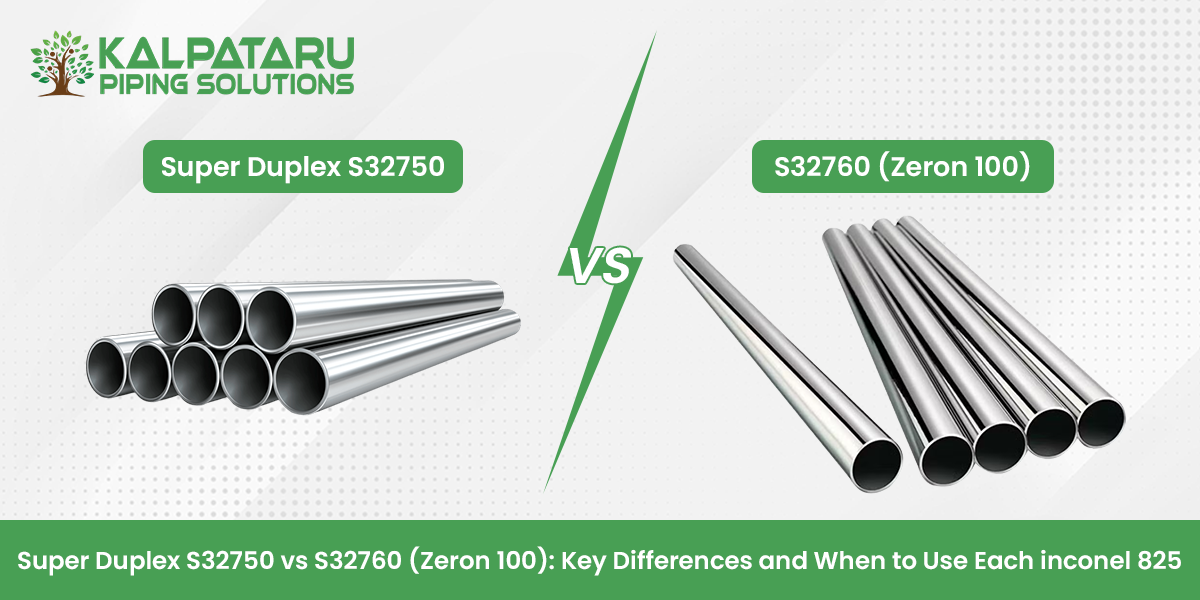
There’s a lot at stake when engineers and procurement managers decide between Super Duplex S32750 vs S32760 like equipment durability, project costs, and safe operation in harsh environments. They’re premier-grade stainless steel alloys designed for harsh environments in offshore and subsea, chemical processing, oil and gas, and desalination industries. But selecting the wrong grade for your application can result in premature failure due to corrosion, expensive repairs and rework, or paying for more material than you need.
In this in-depth guide, you will:
- How the S32750 and S32760 chemical compositions differ,
- Which is more pitting resistant and resistant to chloride-induced corrosion
- Their relative tensile strength, yield strength and thermal resistance
- The key factors in choosing Super Duplex S32750 over S32760 (or vice versa) for specific uses, environments, and cost considerations
- Decision making flow chart
Whether you are specifying pipe fittings, steel flanges, steel tubes, or round bars for a critical project, this guide will give you the clarity you need.
What Is Super Duplex Stainless Steel?
Duplex stainless steels are a group of alloys designed to have a microstructure containing approximately equal volumes of austenitic and ferritic phases (50/50). This microstructure is designed to take the advantages of each:
- Austenitic phase: excellent toughness, ductility, and weldability
- Ferritic phase: high strength, resistance to stress corrosion cracking, and chloride resistance.
Super duplex stainless steels (SDSS) go one step further. They have a PREN of greater than 40 and higher chromium, molybdenum, and nitrogen content than conventional duplex stainless steels such as grade 2205. This makes super duplex superior to austenitic stainless steels such as 316L or 317L in corrosive, chloride-bearing or acidic environments.
UNS S32750 and UNS S32760 are considered super duplex grades. They are widely used in environments where austenitic stainless steels would corrode prematurely and where the use of nickel-based alloys such as Inconel or Hastelloy would be financially prohibitive. To understand the S32750 vs S32760 materials, it’s crucial to explore the performance of the alloys’ chemistries in various environmental conditions.
Kalpataru Piping Solution’s range of super duplex pipe fittings, steel tubes, and steel flanges covers the grades and product forms discussed throughout this guide, see the product pages for dimensions, standards, and specifications.
Chemical Composition Analysis: S32750 vs S32760
Understanding the S32750 composition and S32760 composition side by side is the foundation of this comparison. Both grades share a similar base, but the additions in S32760 create a meaningfully different corrosion profile.
S32750 vs S32760: Composition Comparison Table
Property | UNS S32750 (SAF 2507) | UNS S32760 (Zeron 100) |
Chromium (Cr) | 24–26% | 24–26% |
Nickel (Ni) | 6–8% | 6–8% |
Molybdenum (Mo) | 3–5% | 3–5% |
Copper (Cu) | Max 0.5% | 0.5–1.0% |
Tungsten (W) | None | 0.5–1.0% |
Nitrogen (N) | 0.24–0.32% | 0.20–0.30% |
Carbon (C) | 0.030% max | 0.030% max |
DIN Designation | 1.4410 | 1.4501 |
ASTM Designation | F53 | F55 |
The impact of copper and tungsten on properties: these elements slightly adjust the phase balance and meaningfully influence performance in acidic and high-chloride environments — the primary reason engineers choose S32760 Zeron 100 for the most aggressive applications.
Mechanical Properties Comparison of Super Duplex S32750 vs S32760
One of the most common questions in the S32750 vs S32760 comparison is: which is stronger? The answer: they are essentially equivalent in mechanical performance.
Room Temperature Mechanical Properties
Property | UNS S32750 | UNS S32760 |
Yield Strength (0.2% proof) | ≥ 550 MPa (80 KSI) | ≥ 550 MPa (80 KSI) |
Tensile Strength | ≥ 750 MPa (109 KSI) | ≥ 750 MPa (109 KSI) |
Elongation | ≥ 15% | ≥ 25% |
Hardness (Brinell) | Max 290 HBW | Max 290 HBW |
Impact Toughness | Excellent | Excellent |
Density | 7.8 g/cm³ | 7.8 g/cm³ |
Note: S32760 carries a higher elongation minimum (≥25%) as specified in ASTM F55 compared to S32750’s ≥15% (ASTM F53). In practice, both grades exhibit similar ductility for most fabrication purposes, this is a specification difference, not a real-world performance gap.
These mechanical properties represent a significant advantage over standard austenitic grades like 316L (yield strength ~220 MPa), enabling the use of thinner wall sections and lighter components, a major factor in offshore and subsea applications where weight matters.
Corrosion Resistance Analysis of Super Duplex S32750 vs S32760
This is where the S32750 vs S32760 comparison matters most. Both alloys offer outstanding corrosion resistance, but S32760 is designed to perform at the edge of the envelope in the most aggressive environments.
What Is PREN (Pitting Resistance Equivalent Number)?
The PREN is the standard benchmark for comparing pitting corrosion resistance in stainless steels. The standard formula is:
PREN = %Cr + 3.3 × %Mo + 16 × %N
For tungsten-containing alloys (such as S32760), a modified formula adds 3.3 × %W/2 to account for tungsten’s contribution to localised corrosion resistance.
Grade | Typical PREN |
316L | ~24 |
Duplex 2205 | ~35 |
S32750 (SAF 2507) | ≥ 42 |
S32760 (Zeron 100) | ≥ 40–43 |
Chloride Resistance
These alloys are intended for use in harsh chloride-containing environments. The high chromium, molybdenum and nitrogen contents give them a very stable passive film that is less susceptible to chlorine attack than standard or even standard duplex grades. Where high temperature (greater than 40-50°C) and high chloride are present (hot seawater injection or subsea heat exchanges), S32760’s presence of copper and tungsten offer marginal improvements.
Crevice Corrosion
Crevice corrosion can occur in stagnant, low-oxygen environments such as under gaskets, under biofilm, and in threaded fittings. Both steels are highly resistant, but S32760 typically performs somewhat better in long-term crevice tests using seawater immersion. This is an important consideration for steel flanges and fittings in offshore and subsea applications where crevice conditions can’t be eliminated.
Stress Corrosion Cracking (SCC)
Stress corrosion cracking (SCC) is the scourge of austenitic stainless steels in chloride environments. The ferritic phase in both super duplex alloys inherently resists chloride SCC – much better than 316L, let alone 904L. Neither alloy is SCC-proof under severe conditions of temperature, stress and chloride, but both are significantly better than single-phase austenitic alloys under normal conditions of oil and gas and marine applications.
Welding & Fabrication of Super Duplex S32750 vs S32760
Weldability is an important practical consideration for both grades, especially in field fabrication of pipe fittings and steel tubes assemblies. For subsea and high-pressure applications, tube fittings and steel valves in super duplex are equally common.
S32750 Weldability vs S32760 Weldability
Weldability is essentially equivalent between S32750 and S32760. Both grades can be welded using:
- GTAW (TIG welding) — preferred for precision root passes and thin-wall tubing
- GMAW (MIG welding) — suitable for higher deposition structural work
- SMAW (stick welding) — used for on-site repairs and field construction
- SAW (submerged arc welding) — used for heavy plate and pressure vessels
Filler Metal Selection
Filler metal selection is critical and must be tailored to the base material:
- For S32750: Use matching super duplex filler such as AWS ER2594 / E2594 (e.g., Avesta 2507/P100)
- For S32760 (Zeron 100): Use the dedicated Zeron 100X filler wire to preserve the copper and tungsten chemistry in the weld metal
Important: Always verify filler metal selection with your welding engineer and the filler manufacturer’s qualification data for your specific service conditions. Using a standard duplex 2205 filler will result in insufficient PREN at the joint, the most common point of failure in poorly fabricated super duplex assemblies.
Heat Treatment Guidance
- Both alloys require solution annealing at 1080–1120°C followed by rapid water quenching
- Post-weld heat treatment (PWHT) is not typically required if interpass temperatures are controlled
- Maximum interpass temperature: 150°C, exceeding this risks sigma phase formation
- Preheating is generally not required for ambient temperature welding
Cost Analysis & Availability of Super Duplex S32750 vs S32760
Material Costs: S32750 vs S32760
Both grades command a significant premium over standard duplex 2205 and austenitic 316L, due to their high alloying content. Between the two, S32760 (Zeron 100) is typically 5–15% more expensive than S32750 due to its tungsten and copper additions and more specialised supply chain.
Grade | Relative Cost Index | Availability |
316L Austenitic | 1.0× (baseline) | Very High |
Duplex 2205 | 1.4–1.6× | High |
Super Duplex S32750 | 2.2–2.8× | Moderate–High |
Super Duplex S32760 | 2.5–3.2× | Moderate |
Note: cost ratios are indicative and fluctuate with nickel, molybdenum, and tungsten market prices. Request a current quote from Kalpataru Piping Solution for project-specific pricing.
Total Cost of Ownership
In critical service environments, the total cost of ownership (TCO) perspective often favours both super duplex grades over cheaper alternatives:
- Longer service life reduces replacement frequency
- Reduced wall thickness (due to higher strength) saves material and weight
- Lower maintenance downtime in corrosive service reduces operational costs
- Avoided failure costs (leaks, plant shutdowns, environmental incidents) can far exceed the material premium
Lead Times & Availability
S32750 is more widely stocked globally, with shorter lead times for standard bar, plate, pipe, and fittings in common sizes. S32760 (Zeron 100) has a more specialised supply base, often available but may require longer lead times for non-standard dimensions or large tonnages. For projects with tight schedules, S32750 is the safer procurement choice.
Industrial Applications & Case Studies
Offshore & Subsea Applications
The offshore & oil & gas industry uses S32750 and S32760 extensively in wellhead components, subsea manifolds and pipe connectors, umbilical tubes for hydraulic and chemical injection lines, seawater piping topside, and structural components exposed to splash zone and full seawater immersion. In subsea and full immersion offshore seawater service, where complex creviced geometry is involved, the superior resistance of S32760 to crevice corrosion makes it the more conservative choice.
If you are specifying super duplex components for offshore or oil & gas applications, Kalpataru Piping Solution’s steel flanges, pipe fittings, and steel tubes cover the product forms most commonly required with full traceability to ASTM and EN standards.
Chemical Processing
In chemical processing applications, both alloys are specified for heat exchangers that process chloride-containing streams, pressure vessels and reactors subjected to mixed acid environments, pumps, valves and agitators exposed to aggressive slurries, and for acetic acid, phosphoric acid and nitric acid piping. The copper content in S32760 also makes it a preferred choice for intermediate concentrations of sulfuric acid, such as those encountered in pulp and paper, fertilisers and mining.
Desalination Plants
Super Duplex stainless steel is widely specified for many desalination plant components, especially in reverse osmosis (RO) and multi-stage flash (MSF) plants. S32760 (Zeron 100) has found extensive application in Gulf desalination plants, as it has been successfully used in hot, high-salinity seawater. S32750 is also widely specified for RO pressure vessels and high-pressure pipework where seawater at ambient temperature or slightly warmer is the main consideration.
Oil & Gas (Upstream & Midstream)
Upstream oil and gas operations requires compliance with NACE MR0175 / ISO 15156 (sour service, H₂S present). Both grades are usually compliant with the correct hardness controls. Typical applications include downhole tubing, surface production manifolds and separators, gas injection, compression piping, as well as pipeline connections and risers. Super duplex tube fittings and steel valves are also routinely specified in super duplex for instrumentation and sour service flow control.
Power Generation
Both alloys are also used for condenser tubing and water box piping in power stations, mainly nuclear and conventional thermal power stations with seawater cooling in coastal locations, feed water heaters and heat exchangers, and for nuclear waste disposal systems (S32760 is preferred in this case for its improved corrosion margin).
Conclusion & Recommendations
There is no one answer to the Super Duplex S32750 vs S32760 question, it depends. These two alloys are the zenith of stainless steel development, offering the highest possible combination of tensile strength, resistance to pitting and resistance to chloride stress corrosion cracking (SCC) in a single material. Because of their similar mechanical properties, strength is not the issue.
Choose S32750 if:
- The environment is general chloride service at ambient temperatures
- Cost and availability are important project constraints
- The application is topside, above-waterline, or with accessible maintenance
- Seawater is at or below 40°C and crevice geometry is managed
Choose S32760 (Zeron 100) if:
- The environment involves hot seawater (>40°C), high salinity brine, or reducing acids
- The application involves long-term subsea or full seawater immersion with creviced geometry
- The consequence of failure is very high, safety-critical, inaccessible, or deepwater
- The application is in Gulf desalination, nuclear, or North Sea deepwater service
- Both chloride attack and acid corrosion co-exist in the process stream
S32750 is a great value for most topside and conventional chemical processing services. In the harshest seawater immersion, high-temperature saline, or reducing acid environments, S32760 (Zeron 100) is the logical choice if the added cost is justified by the importance of the service.
If you need support specifying the right super duplex grade for your application, the Kalpataru Piping Solution technical team is happy to help. Browse our pipe fittings, steel flanges, steel tubes, and round bars or get in touch to discuss your project requirements.
FAQs About Stainless Steel Flange
S32760 (Zeron 100) has small amounts of copper (0.5-1.0%) and tungsten (0.5-1.0%) added to S32750. This increases their performance in reducing acids and highly corrosive chloride environments.
The minimum PREN of both is ≥ 40. S32750 may have a marginally higher PREN because of the higher level of nitrogen required (0.24-0.32%). But the tungsten in S32760 results in better localised corrosion performance than calculated PREN might indicate.
No. They are equally resistant to many chloride environments at room temperatures. S32750 is preferred when cost and availability are important and the environment is not reducing acids or hot seawater.
Yes, with appropriate filler selection. A 25%Cr super duplex filler (e.g. ER2594) is typically suitable for welding S32750 to S32760.
Zeron 100 is the trade name of UNS S32760 originally developed by Mather & Platt in the UK. It’s most commonly used interchangeably with S32760.
S32760 is the preferred choice for hot seawater (>40°C) applications, such as MSF desalination plants in the Gulf region, due to its proven performance history and its slight performance edge for high salinity, hot seawater.
Both grades can be supplied in accordance with NACE MR0175 / ISO 15156 for sour service with controls on hardness and heat treatment.
DIN 1.4410 is the European grade designation for UNS S32750 (SAF 2507). DIN 1.4501 is the European designation for UNS S32760 (Zeron 100).
S32750 is more readily available worldwide and has shorter lead times. S32760 can be obtained but from a limited source.
Yes. Kalpataru Piping Solution can provide super duplex steel pipe fittings, steel flanges, steel tubes, round bars for high critical services. See our product list or contact us for more information.
Related Reading
Enquire Now
Related Blogs
What is Stainless Steel Valve?
What Is Monel Alloy? Composition, Properties & Uses (Guide)