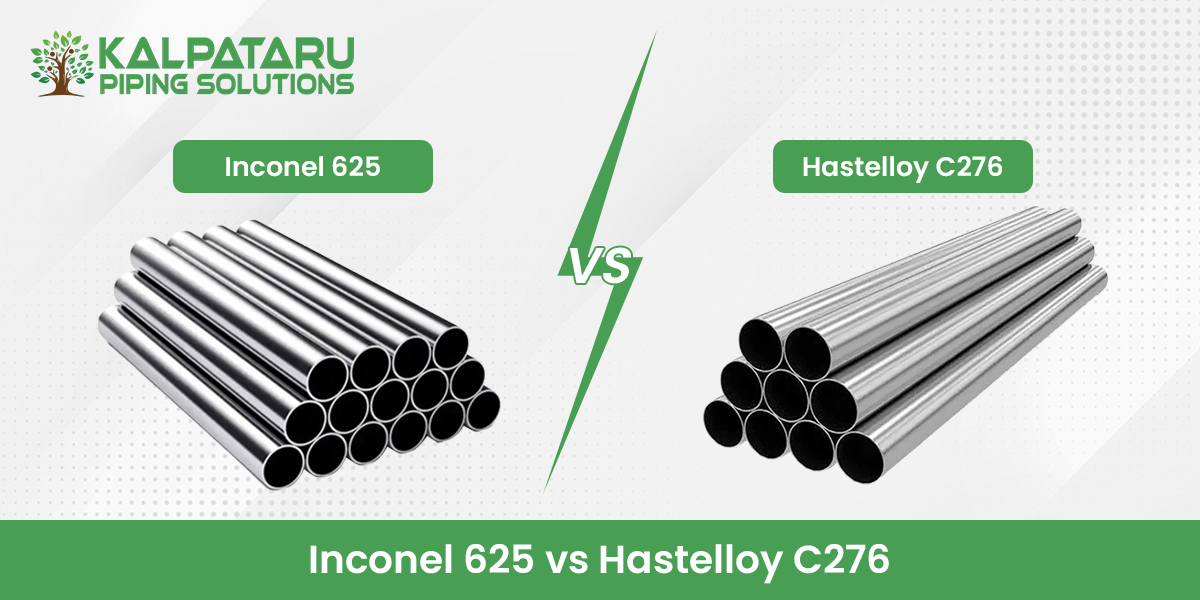
Inconel 625 vs Hastelloy C276, when engineers are deciding between these two alloys, they are looking at two of the most widely recognized nickel-based superalloys. Inconel Alloy 625 and Hastelloy Alloy C-276 are nickel-chromium-molybdenum alloys with excellent corrosion resistance and strength. But while their compositions may be similar, these alloys are designed with different priorities in mind and the wrong choice could jeopardize your whole process.
Kalpataru Piping Solutions stocks both alloys in a wide variety of product forms such as tubes, pipes, pipe fittings, and steel flanges. This article draws upon a side-by-side Inconel 625 vs Hastelloy C-276 comparison of composition, corrosion resistance, mechanical properties, applications and cost to guide your decision-making.
Inconel 625 vs Hastelloy C276: What Sets These Two Nickel Alloys Apart?
Inconel 625 (UNS N06625 / W.Nr. 2.4856) is a nickel-chromium-molybdenum-niobium alloy with high strength, good Inconel 625 corrosion resistance and excellent workability. It can be used from cryogenic temperatures up to 982°C (1,800°F), and is one of the most widely used high-temperature alloys.
Hastelloy C276 (UNS N10276 / DIN 2.4819) was the first wrought nickel-chromium-molybdenum alloy developed to address welding concerns (this was done by keeping the carbon and silicon content very low). It has 50 years of successful operation in a wide range of corrosive environments, and is the standard alloy for the chemical industry.
The key difference: Inconel 625 has a higher chromium content, whereas Hastelloy C276 has a much higher molybdenum content. This difference has a profound effect on how these alloys respond to varying corrosive environments.
Inconel 625 vs Hastelloy C276 Chemical Composition
Element | Inconel 625 (%) | Hastelloy C276 (%) |
Nickel (Ni) | 58 min | 57 min |
Chromium (Cr) | 20–23 | 14.5–16.5 |
Molybdenum (Mo) | 8–10 | 15–17 |
Iron (Fe) | 5 max | 4–7 |
Tungsten (W) | — | 3–4.5 |
Cobalt (Co) | 1 max | 2.5 max |
Others | Nb, Ti | V, Mn, Si |
Inconel 625 properties are based on its high nickel and chromium content, which delivers good oxidation resistance and strength. The niobium content offers solid-solution strengthening without the need for precipitation hardening heat treatments, a significant manufacturing benefit.
Hastelloy C276 properties benefit from its high molybdenum and tungsten content. They enhance resistance to reducing acids and materials that would cause Inconel 625 to experience localised attack. The reduced chromium makes Hastelloy C276 slightly less resistant to purely oxidizing environments, but much better in acid environments such as hydrochloric acid.
You can review full chemical and mechanical specifications on our dedicated Inconel 625 Tubes and Hastelloy C276 Tubes & Pipes product pages.
Corrosion Resistance of Inconel 625 vs Hastelloy C276
The main characteristic separating Inconel 625 and Hastelloy C-276 is their resistance to corrosion, and it’s essential to understand the nature of the corrosion present in your environment.
- Oxidizing Environments
Inconel 625 is highly resistant to corrosion in oxidizing environments due to its nickel and chromium content. The oxide layer it builds acts as a protective barrier to concentrated sulfuric acid, nitric acid and other oxidisers. Hastelloy C276 also offers excellent resistance in oxidizing environments but the lower chromium content means Inconel 625 may offers slightly better resistance in the most severe oxidizing conditions. - Reducing Environments
Hastelloy C276 corrosion resistance is unsurpassed in reducing environments, those containing reducing agents such as hydrogen sulfide, hydrochloric acid and other reducing agents. The elevated levels of molybdenum and tungsten give it superior corrosion resistance. Inconel 625 also offers resistance in reducing environments but never matches Hastelloy C276 in severe conditions. - Hydrochloric Acid
Hastelloy C276 excels in hydrochloric acid environments. Hastelloy C276 contains about 16% molybdenum compared to 9% in Inconel 625, which allows it to retain low rates of corrosion at higher acid concentrations and temperatures. Inconel 625 has been reported to suffer severe corrosion and stress corrosion cracking in severe acidic chloride environments at elevated temperatures – where Hastelloy C276 still performs well.
Alloy | Mo Content (%) | Preferred Environment |
Inconel 625 | ~9 | Moderate acid, oxidizing, marine, high-temp |
Hastelloy C276 | ~16 | Aggressive reducing acids, halide species, wet chlorine |
Localized Corrosion: Pitting & Crevice Resistance of Inconel 625 and Hastelloy C276
Inconel 625 and Hastelloy C276 alloys are both resistant to pitting and crevice corrosion in chloride environments, but they do so for different reasons. Inconel 625 develops a passive film that resists pitting in most seawater and marine service environments – hence its popularity in subsea risers, propeller shafts and subsea connectors.
The more protective Hastelloy C276 is used in more severe chloride-containing environments, or in crevices that create oxygen-starved zones. Its high molybdenum and tungsten content maintains the integrity of the passive film under the harsh attack conditions associated with crevice corrosion – a primary reason it is the material of choice in chemical processing vessels, scrubbers and FGD systems where small geometric crevices are unavoidable.
For a related discussion on how alloy selection affects piping components, read our blog on Key Benefits & Uses of Inconel Flanges.
Mechanical Properties & Physical Comparison of Inconel 625 and Hastelloy C276
Both alloys are solid solution strengthened, but with different primary elements contributing to strength. Inconel 625 relies on niobium and tantalum for strengthening, while Hastelloy C276 uses tungsten and molybdenum, elements with large atomic radii that significantly reinforce the matrix.
Property | Inconel 625 | Hastelloy C276 |
Tensile Strength | 930 MPa (135,000 psi) | 790 MPa (115,000 psi) |
Yield Strength | 517 MPa (75,000 psi) | 355 MPa (52,000 psi) |
Elongation | 42.5% | 40% |
Density | 8.44 g/cm³ | 8.89 g/cm³ |
Melting Range | 1,290–1,350°C | 1,323–1,371°C |
Max. Service Temp. | 982°C (1,800°F) | 427°C (800°F) |
Inconel 625 has better tensile and yield strength, making it a good choice in applications that involve heavy mechanical stress and heat. It also has a lower density (8.44 g/cm³ compared to 8.89 g/cm³ for Hastelloy C276) – an important consideration for aerospace and marine applications.
Hastelloy C276 has a marginally higher melting point, and is better at retaining ductility following long-term chemical exposure at high temperatures, despite its lower maximum continuous use temperature.
Key ASTM / ASME Standards of Inconel 625 and Hastelloy C276
Procurement engineers specifying either alloy should reference the following applicable international fabrication standards:
Product Form | Inconel 625 Standard | Hastelloy C276 Standard |
Seamless Pipe & Tube | ASTM B444 / ASME SB444 | ASTM B622 / ASME SB622 |
Welded Pipe | ASTM B705 / ASME SB705 | ASTM B619 / ASME SB619 |
Plate, Sheet & Strip | ASTM B443 | ASTM B575 |
Rod & Bar | ASTM B446 | ASTM B574 |
Forgings | ASTM B564 | ASTM B564 / B462 |
Welding Accessories | ASTM B366 | ASTM B366 |
High-Temperature Performance & Weldability of Inconel 625 and Hastelloy C276
High-Temperature Service Limits
Inconel 625 is best for high temperature service It’s capable of withstanding creep-rupture forces and maintaining its structural integrity at temperatures as high as 982°C (1,800°F) – a major reason why it’s the dominant material in the aerospace industry for turbine ducting, exhaust pipes and fuel lines. Special Metals Corporation’s Inconel 625 product data shows the alloy maintains creep resistance and plasticity to temperatures of more than 1,100°C, a performance capability that stainless steels do not have.
Hastelloy C276 is best suited to temperatures below 427°C (800°F), which makes it unsuitable for continuous high-temperature applications, but well matched to the majority of chemical processing, pollution control, and oil and gas service applications.
Weldability: Design for the As-Welded Condition
Both alloys are good choices for welding, but more so for Hastelloy C276, which was specifically developed for this application (it has extremely low carbon and silicon content, and does not sensitise and cause intergranular corrosion when welded). Inconel 625 is also good for welding, especially using Cold Metal Transfer (CMT) welding processes to reduce the iron content in the weld overlay, avoiding loss of corrosion resistance at the weld boundary.
For a material comparison in a similar context, see our blog on Titanium Tube Fittings vs. Stainless Steel Tube Fittings.
Inconel 625 vs Hastelloy C276: Applications by Industry
Inconel 625 Applications
- Aerospace: Turbine blades, combustion chambers, exhaust systems, fuel and hydraulic lines, where high-temperature strength and oxidation resistance are paramount.
- Marine & Offshore: Propeller blades, drive shafts, subsea flexible risers, and offshore platform components due to excellent chloride pitting and fatigue resistance.
- Oil & Gas: High-pressure, high-temperature (HPHT) down-hole tubing and wellhead equipment.
- Chemical Processing: Reactors and heat exchangers handling dilute acids and oxidizing media.
- Power Generation: Boiler tubes, turbine seals, and heat-transfer systems.
Hastelloy C276 Applications
- Chemical Processing: The benchmark alloy for reactors, piping, and heat exchangers handling reducing acids, wet chlorine, hypochlorite bleach, and chlorine dioxide.
- Pollution Control: Flue gas desulfurization (FGD) systems and industrial scrubbers.
- Oil & Gas: Sour gas service and components exposed to aggressive corrosive fluids.
- Pulp & Paper: Bleach plants where resistance to chlorine-based oxidizers is essential.
- Waste Management & Pharmaceutical: Vessels and process piping in highly corrosive, sanitation-critical environments.
Browse our Steel Flanges, Pipe Fittings, and Round Bars in both alloys for complete system solutions. For nickel alloy flange comparisons, also read our guide on Types of Monel Flanges and Their Applications.
Price Comparison: Which Alloy Costs More and Why?
Generally, molybdenum commands a higher raw material cost than chromium, which means Hastelloy C276 price tends to run slightly higher than Inconel 625 price. The cost difference is not dramatic and it should never be the sole deciding factor. Specifying the wrong alloy in a corrosive service environment always costs more in downtime, maintenance, and early replacement than the premium paid for the correct material upfront.
Check out our catalog and contact us for a detailed quote.
Which Alloy Should You Choose?
The Inconel 625 vs Hastelloy C-276 decision comes down to one core question: What kind of corrosion dominates your environment?
- Choose Inconel 625 when high-temperature mechanical strength, oxidation resistance, and marine or aerospace-grade fatigue resistance are the primary requirements.
- Choose Hastelloy C276 when maximum corrosion resistance in reducing, acidic, or mixed-chemical environments is non-negotiable — especially in chemical processing, pollution control, or oil and gas sour service.
Both alloys overlap in many applications, but each has distinct strengths that make it the superior choice within that overlap. For additional insights on alloy-based piping systems, read our complete guide on Stainless Steel Tubes vs Pipe: Understanding the Key Differences.
FAQs About Stainless Steel Flange
Inconel 625 has more chromium, which results in better oxidation resistance and strength at elevated temperatures. Hastelloy C276 has more molybdenum and tungsten, and is better suited for operation in reducing environments and severe acid service conditions, including hydrochloric acid and wet chlorine.
Hastelloy C276 is the preferred alloy for chemical processing. It is the only alloy with superior resistance to reducing acids, halides, wet chlorine and mixed chemical environments. Inconel 625 is used in chemical processing when oxidizing conditions and high temperature strength is the main selection criteria.
Both alloys can be welded. Hastelloy C276 was developed to be weldable; its very low carbon and silicon content prevents sensitization in the as-welded condition. Inconel 625 is an excellent welding material, including using Cold Metal Transfer (CMT) for low-dilution weld overlays.
Hastelloy C276 tends to be marginally more expensive because of its increased molybdenum content. Inconel 625 costs $37,000-$56,000 per metric ton and Hastelloy C276 costs $51,000-$65,000 per metric ton (depending on location and product form).
Not sure which alloy suits your application? Our technical team at Kalpataru Piping Solutions can help you match the right material to your process conditions, get in touch for a no-obligation consultation. |
Related Resources: Inconel 625 Tubes | Hastelloy C276 Tubes & Pipes | Key Benefits & Uses of Inconel Flanges | Duplex Steel Flanges Guide
Enquire Now
Related Blogs
What is Stainless Steel Valve?
What Is Monel Alloy? Composition, Properties & Uses (Guide)