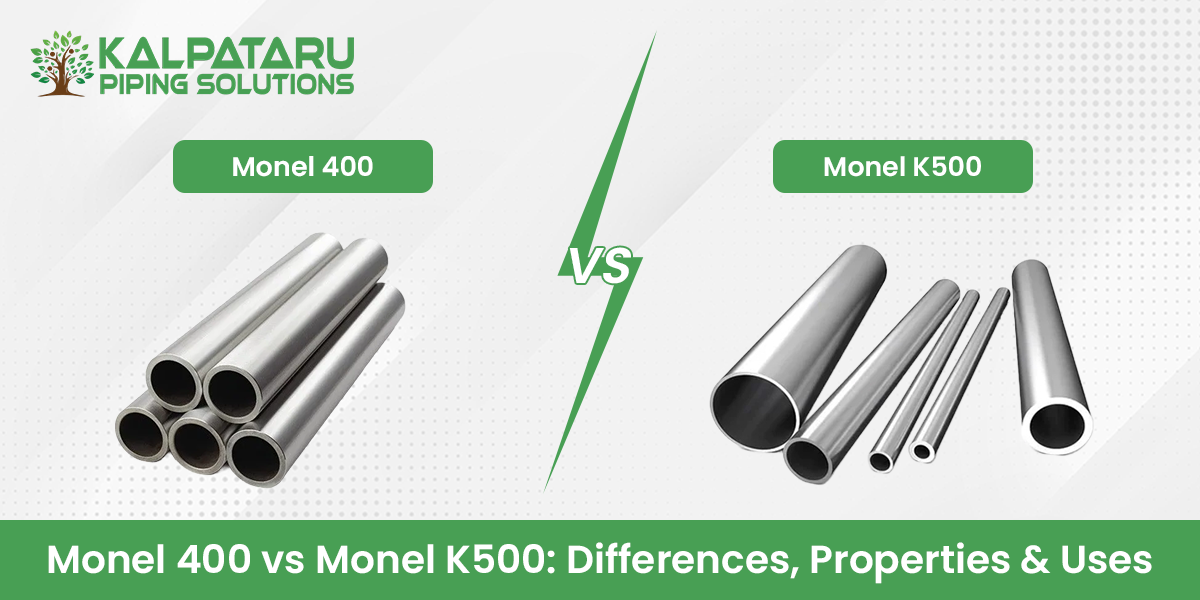
Monel 400 and Monel K500 are among the world’s most popular choices of nickel-copper alloys and also its most misunderstood. Both alloys are highly resistant to corrosion, they have the same base composition and they look similar enough to be mistaken for silver. But using the wrong alloy for a highly stressed application can lead to premature failure, costly downtime and budget blowouts.
The real difference is strength, not corrosion resistance. Monel K500 is, in the aged condition, roughly twice as strong as Monel 400, a feature that governs its preferred application in the oil & gas, marine, chemical and subsea markets. We’ve broken down the sections below into composition, strength, weldability, heat treatment, cost and suitability for use including data for each condition.
Kalpataru Piping Solutions supplies Monel 400 across a full range of product forms including Monel 400 Pipes & Tubes, Monel 400 Round Bars and Monel 400 Flanges. For a full breakdown of grades, standards and fabrication considerations, read our complete Monel 400 Material Guide.
What Is Monel K500?
Monel 400 (UNS N04400, ASTM B164) is a solid-solution binary alloy of nickel and copper with a composition of 63-70% nickel and 28-34% copper, plus iron, manganese and carbon. It is a versatile material, widely available, easily formed and welded, and well-tested in a century of widespread use.
Monel 400 is strengthened by solid-solution hardening and is not amenable to heat treatment. As-annealed it exhibits a tensile strength of around 550 MPa and a yield strength of around 240 MPa, which is more than sufficient for most chemical process, seawater and food industry applications where good corrosion resistance, rather than high strength, is the design driver.
The benefits of Monel 400 include very good weldability with no need for post-weld heat treatment (PWHT), good formability and comparative low cost compared with K500.
We supply Monel K500 in multiple product forms including Monel K500 Pipes & Tubes, Monel K500 Round Bars and Monel K500 Fasteners, all supplied with full mill test certification.
Key Differences at a Glance
Property | Monel 400 | Monel K500 |
UNS Number | N04400 | N05500 |
ASTM Standard | B164 | B865 |
Key Specification | ASTM B164 / QQ-N-281 | ASTM B865 / AMS 4676 |
Nickel Content | 63–70% | 63–70% |
Key Additions | Copper (28–34%) | Al (2.3–3.15%) + Ti (0.35–0.85%) |
Tensile Strength | ~550 MPa (annealed) | ~1100 MPa (aged) |
Yield Strength | ~240 MPa | ~790 MPa (aged) |
Hardness | HRB 65 | HRC 30+ |
Magnetic Behaviour | Slight ferromagnetic (all temps) | Non-magnetic above −93°C |
Heat Treatable? | No | Yes (age hardening) |
Weldability | Excellent — no PWHT | Good — PWHT required |
Relative Cost | Base | ~30–40% higher |
Chemical Composition Comparison
The table below shows elemental composition ranges for both alloys per their respective ASTM standards. The aluminium and titanium additions in K500 — absent in Monel 400 — are the sole reason for the significant strength differential between the two grades.
Element | Monel 400 (%) | Monel K500 (%) |
Nickel (Ni) | 63.0 – 70.0 | 63.0 – 70.0 |
Copper (Cu) | 28.0 – 34.0 | 27.0 – 33.0 |
Iron (Fe) | 2.5 max | 2.0 max |
Manganese (Mn) | 2.0 max | 1.5 max |
Carbon (C) | 0.30 max | 0.25 max |
Silicon (Si) | 0.50 max | 0.50 max |
Aluminium (Al) | — | 2.30 – 3.15 |
Titanium (Ti) | — | 0.35 – 0.85 |
Mechanical Properties Comparison
Mechanical performance is where the two alloys diverge most significantly. The table below compares properties across three material conditions — Monel 400 annealed, Monel K500 annealed, and Monel K500 in the fully aged (precipitation hardened) condition.
Property | Monel 400 (Annealed) | Monel K500 (Annealed) | Monel K500 (Aged) |
Tensile Strength | 550 MPa | 760 MPa | 1100 MPa |
Yield Strength (0.2%) | 240 MPa | 345 MPa | 790 MPa |
Elongation (%) | 35% | 30% | 20% |
Hardness | HRB 65 | HRB 85 | HRC 30+ |
Note: The reduction in elongation from annealed to aged K500 (35% → 20%) is significant for any application involving bending or forming after heat treatment. Components should be formed before the ageing cycle where possible.
Corrosion Resistance
Environments Where Both Alloys Excel
Perhaps the greatest misunderstanding in this comparison is corrosion. Monel 400 and Monel K500 have an identical corrosion performance for a broad range of applications. Corrosion performance is based on the nickel-copper matrix, and not on the aluminium/titanium additions. Both alloys perform very well in seawater and brine, dilute hydrofluoric acid, hydrochloric acid up to the boiling point, most alkaline solutions, and neutral and reducing chloride environments.
- Not Suitable for Either Grade
Both grades are poor performers in oxidising acids (such as nitric acid) and moist chlorine gas at high temperatures. If corrosion resistance alone is the main driver for your selection, then the alloys are interchangeable – selection should be based on strength and the ease of manufacturing.
- Weldability & Fabrication
Monel 400 is a great choice for welding with GTAW (TIG), GMAW (MIG) and SMAW processes with no required pre- or post-weld treatment. Alloy 60 (ERNiCu-7) filler metal is typically used. This allows easy fabrication and low production costs.
Monel K500 needs post-weld treatment. Welding heat input dissolves the strengthening precipitates in the heat-affected zone, diminishing the strength. The welded assembly must be re-solution-annealed and re-aged to regain the material’s full mechanical properties after welding – an added expense in time, money and furnace load. The weld filler metal does not precipitation harden after re-ageing, so K500 welds should be placed away from the highest stress areas if possible. For this reason K500 is typically used in machined or formed parts, and not complex welded structures.
Fabricators should also anticipate greater spring-back when bending Monel K500 bar or sheet stock – the higher yield strength K500 material will spring back more than Monel 400. Be sure to check allowable overbends with your tooling engineer. - Heat Treatment
Monel 400 can’t be heat treated. The alloy can be cold worked to improve its mechanical properties but not markedly so in comparison to K500’s precipitation hardening.
A two-step heat treatment is required for Monel K500 to dissolve existing precipitates (solution anneal at around 870°C) and precipitate fine Ni3(Al,Ti) particles (ageing at 538°C for 8-16 hours). The latter operation results in precipitation of fine Ni3(Al,Ti) particles that block dislocation motions, enhancing hardness (up to HRC 30+) and yield strength (up to 790 MPa). This cycle is repeated after hot forming, welding or substantial cold working. - Magnetic Behaviour
A less well understood property difference between the two grades is magnetism. Monel 400 can be described as “weakly ferromagnetic” at all temperatures. Monel K500 has a magnetic transition temperature of around -93°C, and can be considered non-magnetic at service temperatures. This characteristic is essential in components that must be installed near sensitive navigational equipment, magnetic resonance equipment and for naval applications that require a low magnetic signature. It’s a specification that is often desired for K500, and which can be critical to successful applications in defence, subsea instrumentation and offshore drilling. - Cost Comparison
The cost of Monel K500 is 30-40% higher than Monel 400 per unit weight. This is because the K500 premium covers three factors; the higher cost of raw material (Aluminium and Titanium), the added cost of heat treatment (solution anneal + ageing cycle) and the additional quality control required for aerospace and subsea approvals (e.g., K500 bar stock is approved to AMS 4676).
For cost-sensitive applications where superlative mechanical properties are not needed, Monel 400 will almost always be the preferred option. For subsea, offshore or rotating equipment applications where failure is unacceptable, the additional cost of K500 is readily justified by the increased performance and the reduction in component size (and hence weight) afforded by its increased yield strength.
Not sure which grade fits your project budget and specification? Browse our complete Monel Products range or read our Monel 400 Material Guide for further guidance on grade selection, specifications and available product forms. |
When to Choose Monel 400
- Your application is governed by corrosion resistance, not extreme mechanical load.
- The component will be welded on-site or in the field, no PWHT is feasible.
- Budget is a primary constraint and design stresses are within Monel 400’s capability.
- You are sourcing for chemical processing, marine heat exchangers, or food/pharmaceutical service.
- Thin-section tubing, flanges or fittings where forming is required, Monel 400’s ductility is advantageous.
When to Choose Monel K500
- Your component is a rotating shaft, fastener, spring or downhole tool operating under high cyclic or static stress.
- The application is subsea, offshore or naval where high strength and seawater resistance must coexist.
- Slimmer cross-sections are required, K500’s higher yield allows weight-optimised design.
- Non-magnetic behaviour is required at operating temperature, K500 is non-magnetic above −93°C; Monel 400 is not.
- Sour service compliance is specified, Monel K500 is acceptable under NACE MR0175/ISO 15156 for H2S environments; confirm hardness limits with your project metallurgist.
- Full traceability and certifications such as AMS 4676 or NORSOK M-630 are required.
The Bottom Line
Both Monel 400 and Monel K500 are corrosion-proven nickel-copper alloys, the decision between them is almost always a mechanical one. Choose Monel 400 when your application is corrosion-governed, budget-sensitive, or requires on-site welding without PWHT. Choose Monel K500 when you need maximum strength in a seawater or sour-service environment, when component geometry demands a higher yield strength, or when non-magnetic behaviour is a project requirement. If in doubt, specify K500 for rotating or load-bearing components and Monel 400 for static, fluid-handling and structural parts.
FAQs About Stainless Steel Flange
Yes, significantly. In the aged condition, Monel K500 has about twice the tensile strength (1100 MPa vs 550 MPa) and more than three times the yield strength (790 MPa vs 240 MPa) of annealed Monel 400.
Monel K500 is generally around 30-40% more costly than Monel 400 due to the cost of the aluminium/titanium additions and the required precipitation hardening heat treatment.
Yes, but it requires post-weld heat treatment (re-solution anneal + re-age) to re-establish precipitation-hardened properties in the heat-affected zone. Monel 400 can be welded without PWHT.
Monel K500 is typically used for subsea fasteners, pump shafts and downhole tools owing to its improved strength. Monel 400 is generally preferred for less mechanically stressed seawater components such as piping and heat exchangers.
Aluminium and titanium are added to the nickel-copper matrix to allow precipitation hardening. Precipitation of fine Ni3(Al,Ti) intermetallic particles during ageing at 538°C pins dislocation motion, and strength is increased beyond that attainable in the solid-solution Monel 400 alloy.
UNS N04400 is the Unified Numbering System code for Monel 400 (ASTM B164), a solid-solution nickel-copper alloy. UNS N05500 is the designation for Monel K500 (ASTM B865 / AMS 4676) containing additional aluminium and titanium to allow precipitation hardening and deliver about twice the yield strength of N04400.
Looking for Monel 400 or Monel K500 Products? Kalpataru Piping Solutions stocks both grades across pipes, tubes, round bars, flanges and fasteners, supplied with full mill test certification to over 70 countries worldwide. Explore our product range below: → Monel 400 Pipes & Tubes — seamless and welded, ASTM B165, full MTCs → Monel K500 Round Bars & Wire — annealed and aged condition, AMS 4676 available → Monel K500 Fasteners — bolts, nuts, studs, NORSOK and subsea certified → View all Nickel Alloy Products — Inconel, Hastelloy, Monel and more Have a specific application or grade query? Our technical team responds within 24 hours, contact us via the enquiry form on any product page. Browse our complete Monel Products range or read our Monel 400 Material Guide for further guidance on grade selection, specifications and available product forms. |
Enquire Now
Related Blogs
What is Stainless Steel Valve?
What Is Monel Alloy? Composition, Properties & Uses (Guide)