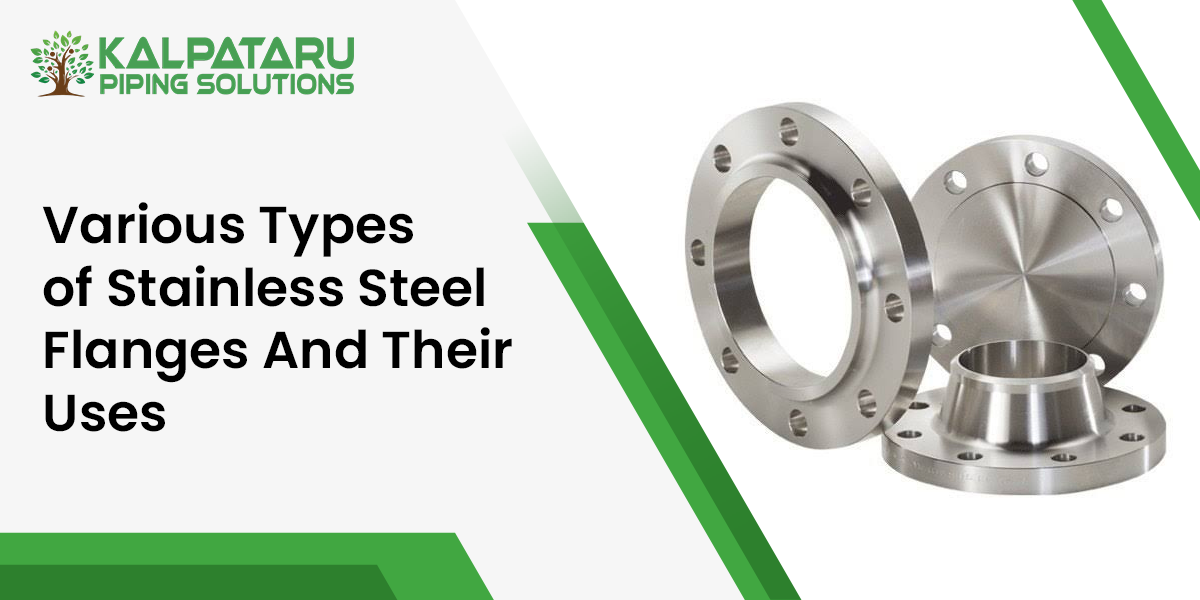
Stainless steel flanges are critical components used to connect pipes, valves, pumps, and other equipment to form a secure piping system. Unlike carbon steel, stainless steel is selected for its exceptional corrosion resistance, durability under extreme temperatures, and hygienic properties. Whether you are designing a high-pressure oil pipeline or a sanitary food processing line, choosing the right combination of flange type, face, and grade is essential for a leak-proof and long-lasting installation.
By the end of this guide, you will understand the technical differences between various flange types, pressure classes, and material grades to help you make the right selection for your project.
What Are Stainless Steel Flanges?
Stainless steel flanges are high-performance piping components used to connect pipes, valves, pumps, and other equipment to create a secure, modular piping network. These components feature a dual-phase benefit: they provide the structural strength needed to hold pressurized systems together while utilizing a chromium-rich alloy to prevent rust and chemical degradation. Unlike carbon steel alternatives, stainless steel flanges do not require external coating or painting to resist corrosion, making them the preferred choice for environments involving moisture, chemicals, or extreme temperatures. Their primary function is to allow for easy assembly, disassembly, maintenance, and cleaning of the system without cutting the pipes.
In industrial piping, these flanges act as the critical junction points that must withstand mechanical stress and internal pressure. They are manufactured through forging or casting and are designed to host a gasket between two flange faces, which is then compressed by bolts to create a leak-proof seal. Because stainless steel is non-porous and resists bacterial growth, these flanges are also standard in hygienic applications like food processing and pharmaceuticals. By selecting the correct grade, such as the versatile 304 or the marine-grade 316, engineers can ensure the system remains durable and maintenance-free for decades.
Standards & Specifications for Stainless Steel Flanges
To ensure safety and global compatibility, all stainless steel flanges are manufactured according to standardized dimensions and material chemistries.
Technical Specification
Category | Standard / Specification | Details |
Material Specs | ASTM A182 / ASME SA182 | Standard for Forged Stainless Steel Flanges |
Dimensions (Small) | ASME B16.5 | NPS 1/2″ to NPS 24″ (Class 150 – 2500) |
Dimensions (Large) | ASME B16.47 Series A & B | NPS 26″ to NPS 60″ (Class 75 – 900) |
Pressure Ratings | Class 150, 300, 600, 900, 1500, 2500 | Ratings depend on material grade and temp |
Face Types | RF, FF, RTJ, TF, GF | Raised Face, Flat Face, Ring Type Joint, etc. |
European Specs | EN 1092-1 | PN6, PN10, PN16, PN25, PN40, PN64 |
Certifications | EN 10204 3.1 / 3.2 | Full traceability with Mill Test Certificates |
Flange Face Types (RF vs. FF vs. RTJ)
The “face” of the flange is the surface where the gasket is placed to create the seal.
Face Type | Seal Method | Best For | Pros/Cons |
Raised Face (RF) | Concentrates pressure on a small area | General industrial use | Most common; easy to install |
Flat Face (FF) | Full surface contact | Low pressure; cast iron equipment | Prevents flange cracking |
Ring Type Joint (RTJ) | Metal-to-metal seal in a groove | High pressure / High Temp | Highest reliability; expensive |
Types of Stainless Steel Flanges and Their Uses
Weld Neck Flange (WN)
Features a long tapered hub that is welded to the pipe. It is the preferred choice for high-pressure, extreme-temperature, and critical service because it offers excellent stress distribution.
Slip-On Flange (SO)
Slipped over the pipe and welded both inside and out. It is ideal for lower-pressure applications where cost is a factor and alignment needs to be simplified.
Blind Flange (BL)
A solid disc used to terminate a pipe run or block an opening. It is essential for isolation during pressure testing, maintenance, and future expansion.
Socket Weld Flange (SW)
The pipe is inserted into a socket and welded on the outside. It is primarily used for small-bore (NPS 4 and smaller) high-pressure lines where space is limited.
Lap Joint Flange (LJ)
Used with a “stub end” welded to the pipe; the flange slides freely. This is perfect for systems requiring frequent dismantling for cleaning or inspection.
Applications of Stainless Steel Flanges
- Oil, Gas & Petrochemical: Connecting high-pressure pipelines in refineries and offshore platforms to resist “sour” gas (H2S).
- Food & Pharma: Used in sanitary piping for milk, beverages, and medicines because the material is non-reactive and easy to sanitize.
- Water Treatment: Essential in desalination plants where 316L or Duplex flanges prevent salt-water pitting.
- Power Generation: Used in steam lines and heat exchangers to maintain strength at elevated temperatures.
- Marine & Coastal: shipboard piping and exhaust systems where constant exposure to salt air is a factor.
How to Choose the Right Stainless Steel Flange
When selecting stainless steel flanges, use this step-by-step checklist to ensure a perfect match for your piping system:
- Analyze the Media: Is the fluid corrosive, acidic, or food-grade? This determines if you need 304, 316, or Duplex.
- Determine Pressure & Temperature: This dictates your ASME Class (e.g., 150 vs. 600).
- Check Pipe Schedule: Ensure the flange bore (ID) matches your pipe schedule (e.g., Sch 40S or 80S).
- Choose the Right Connection: Select between Weld Neck (critical), Slip-On (utility), or Blind (isolation).
- Verify Gasket Compatibility: The flange face (RF vs. RTJ) must match your gasket type for a leak-proof seal.
FAQs About Stainless Steel Flange
Weld Neck flanges are superior for high-pressure and high-stress environments due to their tapered hub and better stress distribution. Slip-On flanges are more cost-effective and easier to align for low-pressure, non-critical utility lines.
Grade 304 is the industry standard for general-purpose applications. However, Grade 316/316L is preferred for marine environments or chemical processing due to its superior resistance to pitting and chlorides.
Generally, no. ASME B16.5 and EN 1092-1 have different bolt hole patterns, dimensions, and pressure-temperature ratings. Mixing them usually results in alignment failures and leaks.
The face determines the gasket type. Raised Face (RF) is standard for most industrial uses, while Ring Type Joint (RTJ) is used for extreme high-pressure services (Class 600 and above) to create a metal-to-metal seal.
At Kalpataru Piping Solution, we provide fully certified (EN 10204 3.1) flanges that undergo rigorous quality checks, ensuring they meet exact dimensional and material specifications for your critical infrastructure.At Kalpataru Piping Solution, we provide fully certified (EN 10204 3.1) flanges that undergo rigorous quality checks, ensuring they meet exact dimensional and material specifications for your critical infrastructure.
Conclusion
We specialize in providing premium, precision-engineered stainless steel flanges from Weld Neck and Slip-On to Blind and Socket Weld types manufactured to the highest ASME and ASTM standards. Our expert team is committed to helping you navigate technical specifications to ensure a leak-proof, maintenance-free installation tailored to your specific industrial needs. Partner with Kalpataru Piping Solution to secure high-quality components that thrive in the most demanding environments. Contact us today for a technical consultation or a competitive quote for your next project.
Enquire Now
Related Blogs
What is Stainless Steel Valve?
What Is Monel Alloy? Composition, Properties & Uses (Guide)